
BMT UMY Clears Interest-Based Debts for 18 Residents, Warned Against Falling into the Same Pit Again
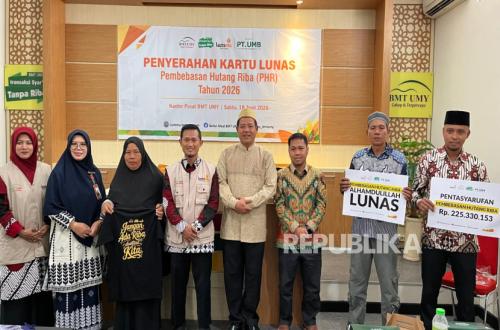
REPUBLIKA.CO.ID, YOGYAKARTA – Lazismu BMT UMY continues to strengthen its commitment to realising a riba-free ecosystem. This is embodied through the Handover of Debt-Free Cards for Interest Debt Liberation (PHR) to 18 beneficiaries, who are sanitation workers and security personnel in Yogyakarta, considered vulnerable to falling into interest-based debt practices.
Deputy Chairman of the BMT UMY Board of Management, Prof Halim Purnomo, stated that this programme is part of a collective effort to respond to the widespread phenomenon of online loans (pinjol) and interest-bearing debt practices in society.
“This is a ray of hope from the hands of BMT UMY managers who give and spread benefits to all of you,” he said during his speech at the Handover of Debt-Free Cards for Interest Debt Liberation (PHR) event at the BMT UMY Head Office on Saturday (18/4/2026).
In this PHR programme, the total funds disbursed reached Rp 225,330,153. The funds consisted of grants amounting to Rp 51,665,918 and a qardh scheme (interest-free loan) of Rp 173,664,235. The disbursed funds are part of CSR and collected donations, and form a sustainable programme aimed at increasing annually.
Halim also mentioned that BMT UMY is preparing expansion steps so that the reach of benefits can extend to the national level.
“Hopefully, it increases every year, in line with the enthusiasm of members becoming part of the large BMT family, and our efforts can be realised to expand the reach, to expand it further,” he said.
On this occasion, the President Director of PT Umat Mandiri Berkemajuan (UMB), Uang Wari, stated that the PHR programme itself has been running for nine years and targets various segments, from MSME actors, educators, to now sanitation and security personnel. There are two aid schemes provided in this programme, namely qardh (loan without addition) and qardh hasan (full grant) for recipients deemed unable to continue debt payments.
Uang emphasised that the issuance of debt-free cards is not merely symbolic or just financial aid, but a movement to change mindsets so that society does not fall back into interest-based debt practices. The beneficiaries were reminded that debt, especially interest-based, has broad impacts on life.
“You will receive debt-free cards as proof that your debts have been taken over or paid off by BMT UMY. May this not just be ceremonial, but can be used as our collective effort to truly resolve within ourselves not to enter the same pit, namely the pit of debt,” he said.
“We understand that this debt consumes our thoughts, time, everything, even to the point where we have found family relationships that are no longer harmonious. We have also found cases where people wanted to commit suicide,” he added.
He also highlighted the phenomenon of online loans that are now increasingly close to people’s lives, including students. The ease of access is seen as a trap that causes many people to get trapped in debt without considering the risks. “If faith is not strong, hopefully with just a few clicks, the money comes in. But after that, we forget the many sins, high interest, not to mention the terror, and so on,” he said.
Furthermore, Uang hopes that the beneficiaries can change and become agents of change in their respective environments by spreading education on the dangers of riba.
“We hope that you become the extension of BMT UMY’s hands to spread anti-riba dakwah in the smallest environments. Come on, together we should not be complacent with pinjol, judol, and loan sharks,” he said.
Meanwhile, the Secretary of the Lazismu DIY Board of Management, Eka Yuhendri, hopes that this programme can be developed into a national movement. According to him, interest debt liberation not only has economic impacts but also on the social and spiritual aspects of society.
Eka also highlighted the high number of people trapped in riba in DIY, including among students. Therefore, programmes like PHR are considered important as part of social and economic recovery.
“Interest debt liberation, this is a good branding programme. I hope this can later be expanded to the national scale,” he said.
One of the beneficiaries, Puput Purnomo, admitted to initially doubting receiving the aid. However, news of her debt settlement became a turning point in her life. For her, the debt-free card received is not just a document, but the start of a new, more peaceful life without debt pressure.
“Actually, from the programme we received, we haven’t had the information for long. We have been enjoying, in quotes, enjoying interest-based debt for a long time. We are perpetrators, not just victims of riba. Thanks to good communication from BMT UMY, and by Allah’s grace, Allah made it easy, so we received this benefit. We received the debt-free card,” she said.