
BMKG: No Indication of Godzilla El Niño in 2026
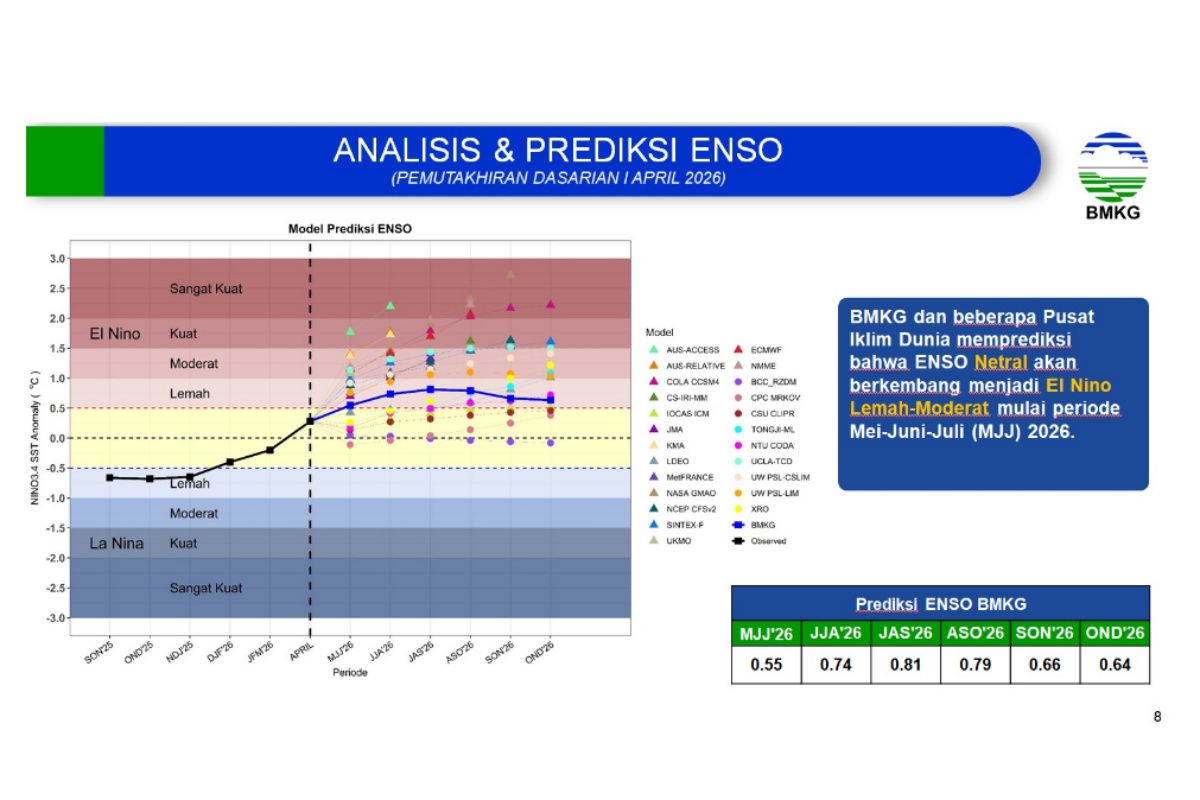
Cilacap (ANTARA) - The Agency for Meteorology, Climatology, and Geophysics (BMKG) has confirmed that there are no indications of a super El Niño phenomenon, often referred to as Godzilla El Niño, occurring in 2026.
The Head of the BMKG Tunggul Wulung Cilacap Meteorological Station’s Data Services and Information Dissemination Working Team, Teguh Wardoyo, in Cilacap, Central Java, on Tuesday afternoon, stated that until the first half of 2026, the El Niño-Southern Oscillation (ENSO) conditions will remain in a neutral phase.
“Entering the second half, ENSO has the potential to shift towards a weak or even moderate El Niño with about a 55 percent probability, particularly from the June to August period,” he said.
He explained that ENSO is a global climate phenomenon resulting from the interaction between the ocean and atmosphere in the tropical Pacific Ocean, characterised by changes in sea surface temperature and air pressure.
The phenomenon has three main phases: El Niño, La Niña, and Neutral. El Niño is marked by positive sea surface temperature anomalies in the central equatorial Pacific region (Nino 3.4), while La Niña is the opposite condition with negative anomalies.
According to him, the impact of El Niño in Indonesia generally involves a decrease in rainfall, although it is heavily influenced by sea temperatures in Indonesian waters.
“If Indonesian waters are sufficiently cool, El Niño can significantly reduce rainfall. However, if the waters are relatively warm, the impact may not be as pronounced,” he said.
He noted that the strength of El Niño is measured based on sea surface temperature anomalies in the Nino 3.4 region. El Niño is categorised as weak if the anomaly is in the range of 0.5-0.9 degrees Celsius, moderate at 1.0-1.4 degrees Celsius, strong at 1.5-1.9 degrees Celsius, and very strong if it reaches or exceeds 2.0 degrees Celsius.
He emphasised that the term Godzilla El Niño is not an official BMKG term, but rather a popular expression referring to super El Niño events like those in 1997 and 2015.
“BMKG has never issued the term Godzilla El Niño. It is merely a public term to describe a very strong El Niño with temperature anomalies exceeding 2 degrees Celsius,” he said.
Furthermore, he assured that in 2026, there are no indications of a shift towards a super El Niño, but only the potential for a weak El Niño developing in the second half.
Nevertheless, the public is still advised to be vigilant about the potential for reduced rainfall in certain areas, especially those prone to drought, and to continue monitoring official information from BMKG.