
Blora Public Works Agency Addresses Land Movement with Gabion Retaining Wall along Riverbank
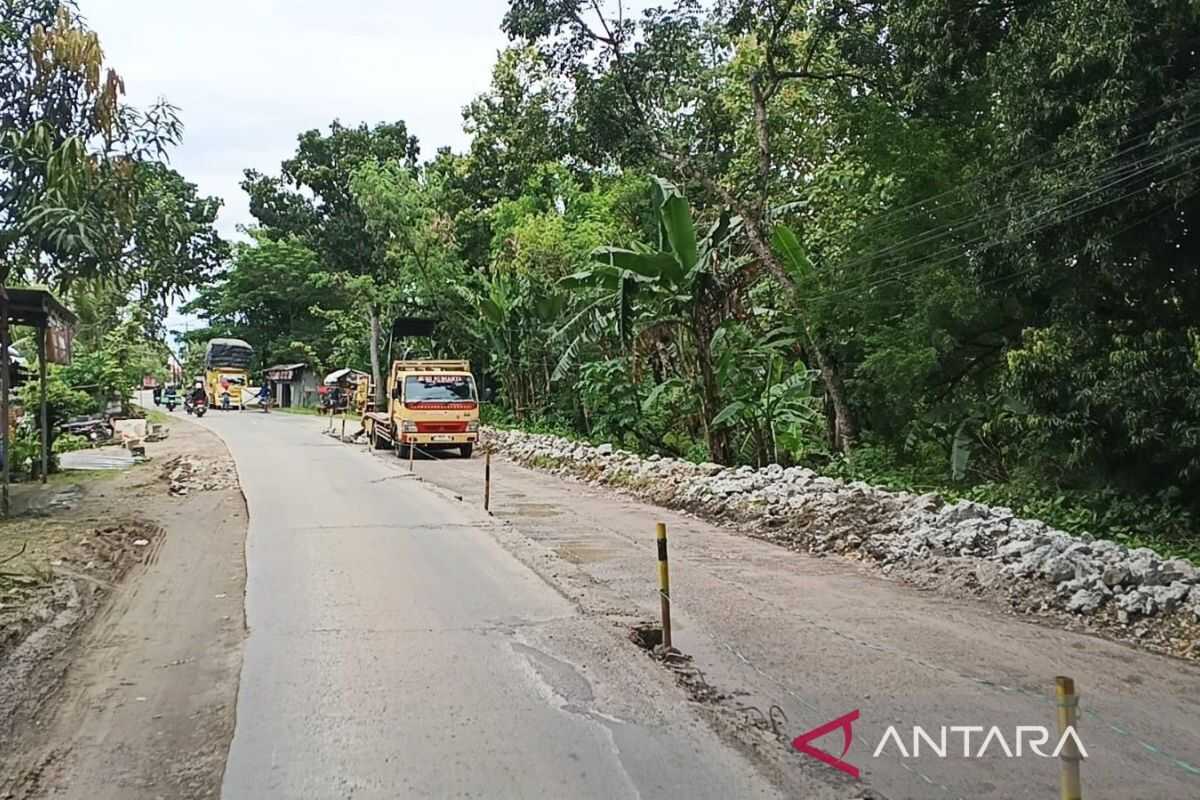
The Public Works and Spatial Planning Agency (DPUPR) of Blora District, Central Java, is carrying out emergency measures to address a land movement phenomenon by installing gabion retaining walls along the banks of the Lusi River, with work now nearing completion.
“The installation of gabion retaining walls along the Lusi River bank has reached 90 per cent progress,” said Surat, Head of Water Resources at Blora DPUPR, in Blora on Thursday.
Based on preliminary assessments, the primary cause of the land movement is believed to be an environmental drainage system that is not directly connected to the river, allowing water to seep into the ground and cause soil saturation.
He disclosed that Blora DPUPR, together with a team from the Pemali Juana River Basin Agency (BBWS), is still conducting further assessments. However, the agency has not yet been able to determine when the ground movement will stop.
“We are monitoring developments — the situation is still dynamic. If it hasn’t stopped, we will take other technical measures,” he said.
The land subsidence phenomenon in Buluroto Village, Banjarejo Sub-district, Blora District continues to progress and is increasingly approaching residential areas. Elongated ground fissures have reportedly crossed through nine houses, three of which have sustained damage.
A number of affected residents’ homes show ground subsidence reaching two metres below the original surface level. The land movement reportedly becomes more active during periods of high-intensity rainfall.
The nine houses traversed by the ground fissures belong to Sriyono, Sriutajah, Takin, Peny, Sayid, Warni, Masdukin, Suwati, and Dul respectively. The houses that have sustained damage belong to Sriyono, Peny, and Sayid.
Sriyono said he had relocated his house three metres in December 2025 to what was considered a safer location. However, the ground movement has continued.
“It is still moving at present. I am maintaining my house with fill soil and propping it up. I purchased two truckloads and received two truckloads as aid,” he said.
He noted that the land subsidence phenomenon has been occurring for approximately six months. In October 2025, he had to jack up his house every two days to maintain the building’s stability.
Meanwhile, Peny said the worst conditions occurred in early February 2026. He used six truckloads of fill soil to counter the subsidence and has ordered additional supplies.
“The depth has reached approximately two metres. Fortunately, the bathroom is still functioning normally,” he said.
Another resident, Masdukin, has installed bamboo sheet piling as an emergency measure, as the fissures are now only approximately two metres from his house. During heavy rain, the ground can sink as much as 10 centimetres in a single day.