
Block Space Scheme Expected to Boost Competitiveness of Container Train Transport
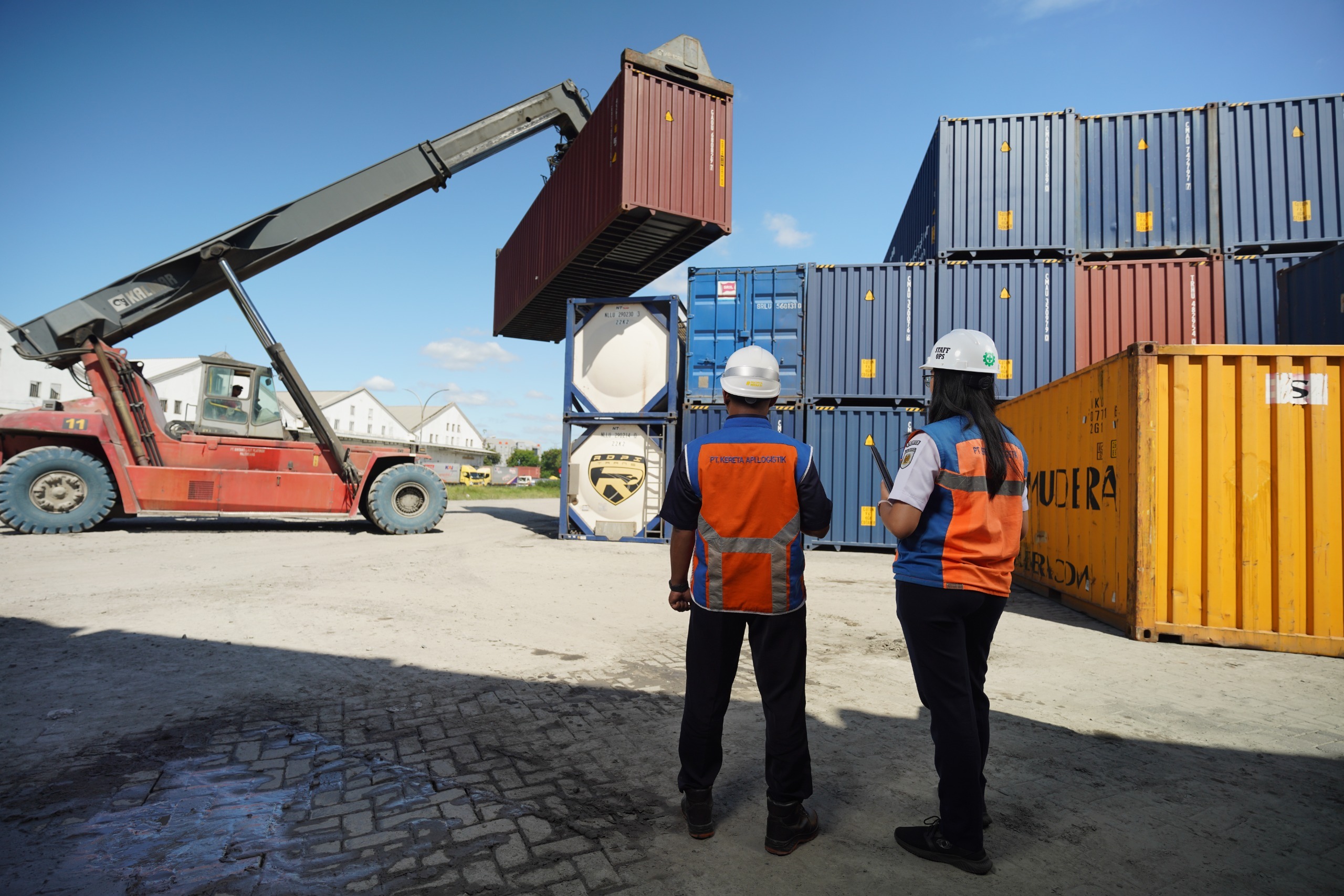
As part of the company’s strategy to enhance the competitiveness of rail transport while promoting logistics cost efficiency for industry players, KAI Logistik (Kalog) continues to strengthen the role of rail transport in the national logistics ecosystem through the optimisation of rail-based container transport services. With the increasing need for efficient and sustainable goods distribution, this state-owned logistics firm is introducing various more flexible service schemes for customers. One of them is through the block space scheme on container transport services, which allows customers to book transport space capacity with specific volumes and periods at more competitive rates. This scheme provides capacity certainty while helping customers plan goods distribution more optimally and efficiently. CONTAINER TRANSPORT SERVICES Commercial Director of Kalog, Fahdel Akbar, explained yesterday that the optimisation of container transport services is one of the company’s business development focuses in responding to increasingly dynamic industry needs. “Through this block space scheme, customers can obtain capacity certainty, operational efficiency, logistics cost stability, supply chain reliability, as well as more competitive rates. This becomes a solution for industry players in planning goods distribution more efficiently and measurably,” he stated. Fahdel mentioned that currently, the company manages 11 container train sets with various return trips (PP) such as Jakarta – Surabaya, JICT - Cikarang Dry Port, Jakarta – Karawang, Karawang – Surabaya, Jakarta – Semarang, Semarang – Surabaya, with a daily capacity per train of 3,600 TEUs PP or equivalent to 64,800 tonnes. In addition to serving general cargo, container train services also handle other commodities such as 12 types of dangerous goods, up to perishable commodities through reefer containers (refrigerated containers). “We are also continuing to enhance competitiveness in terms of services, such as the implementation of RFID on containers and halal certification at 4 terminal points like Sungai Lagoa, Klari, Kalimas, and Ronggowarsito,” he added. According to Fahdel, with this series of initiatives, it is also driving the performance of container transport, which shows a positive growth trend. Throughout 2025, container transport volume was recorded at 2.5 million tonnes, an 8% increase year-on-year compared to the previous year which reached 2.3 million tonnes. Meanwhile, entering early 2026, performance also continues to show significant growth. The company booked container transport volume of 222,000 tonnes, a 44% increase compared to the same period in 2025 which was recorded at 154,000 tonnes. “This increase is also driven by rising production and distribution activities ahead of several strategic religious moments that boost goods mobility in various industrial sectors. In addition to providing capacity certainty and cost efficiency, the use of rail transport is also considered capable of helping to reduce national logistics costs through more efficient, on-time goods distribution, and with large carrying capacity,” he explained. SHIFT IN FOCUS On the other hand, Fahdel said, the current industry trend also shows a shift in business players’ attention towards more environmentally friendly logistics practices or green logistics. Rail-based transport modes have advantages in terms of energy efficiency and lower carbon emissions compared to road-based transport modes. The company sees this opportunity as a momentum to encourage more industry players to switch to using rail modes as part of a distribution strategy that is not only efficient but also sustainable. The optimisation of container transport via rail not only provides benefits in terms of cost efficiency but also contributes to supporting more sustainable logistics practices. “This aligns with the increasing awareness of industry players regarding the importance of green logistics and is highly relevant to our services which are equipped with carbon emission information on customer invoices,” he continued. Looking ahead, Fahdel said, they will continue to strengthen container transport services through capacity increases, development of customer-needs-based services, and optimisation of rail-based logistics networks. This step is expected to further strengthen the role of rail as an efficient, reliable, and sustainable logistics solution in Indonesia. Until the end of June or the first semester of 2025, KAI Logistik recorded positive performance in container transport services with a total volume of 1,148,904 tonnes.