
BKPM Pushes for Tanjung Carat Port Toll Road Development to Enhance South Sumatra's Logistics Efficiency
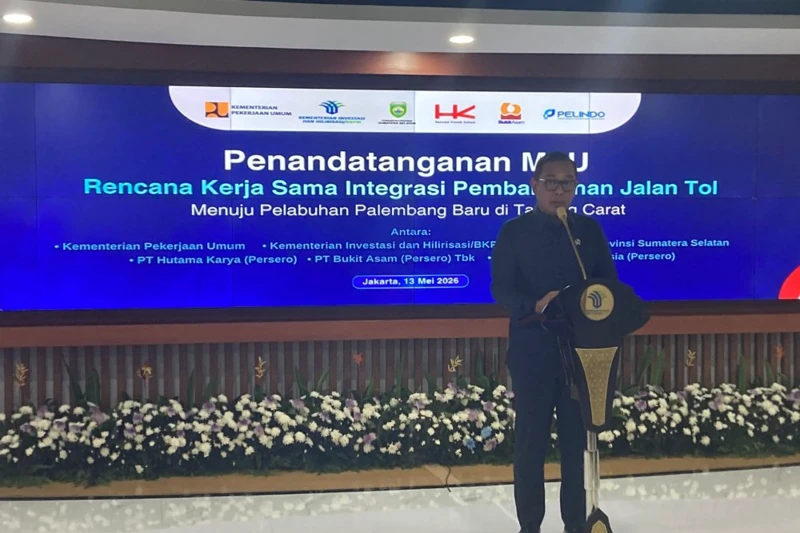
The Ministry of Investment and Downstreaming, through the Investment Coordinating Board (BKPM), is currently prioritising the acceleration of logistics connectivity in South Sumatra. This strategic step is being taken by promoting the construction of a toll road directly integrated with the New Palembang Port at Tanjung Carat.
This initiative was officially launched through the signing of a memorandum of understanding (MoU) on the Plan for Cooperation in Integrating Toll Road Development to Tanjung Carat Port. This important agenda took place in Jakarta on Wednesday, 13 May 2026, as a tangible manifestation of the government’s commitment to improving regional infrastructure.
The signing ceremony involved synergy from various cross-sectoral parties with significant interests in the project. In addition to BKPM, this cooperation also includes the Ministry of Public Works as the policy holder for physical infrastructure development.
Major state-owned enterprises are also participating in this strategic partnership, namely PT Hutama Karya (Persero), which is responsible for toll road development. Furthermore, PT Bukit Asam (Persero) Tbk. (PTBA) and PT Pelabuhan Indonesia (Persero) are involved to align industrial needs and port operations.
Government Focus on National Investment Growth
Deputy Minister of Investment and Downstreaming, Todotua Pasaribu, emphasised that the government currently has three major agendas in strengthening the economy. These agendas encompass the downstreaming of natural resources, the development of integrated economic zones, and the strengthening of the national logistics connectivity network.
Todotua explained that the investment sector plays a crucial role because it contributes around 30 percent to Indonesia’s economic growth. Therefore, robust infrastructure support is an absolute requirement to ensure that investment figures can continue to grow optimally.
Here are the three main pillars that are the government’s focus in promoting national investment:
Implementation of natural resource downstreaming programmes to increase the added value of domestic products before exporting them to global markets.
Development of integrated economic zones that combine industrial areas with efficient supporting facilities in one region.
Strengthening national logistics connectivity through the construction of interconnected toll roads and ports to facilitate goods distribution.
These three points are expected to create a more stable and attractive business ecosystem for both local and foreign investors. The government believes that efficient logistics will be the backbone of successful investment in the future.
Logistics Challenges in South Sumatra Region
According to Todotua, the construction of toll road access to Tanjung Carat Port is very urgent given the vast natural potential in southern Sumatra. This area is known to be rich in flagship commodities such as petroleum and natural gas, coal, palm oil, coffee, and rubber.
Unfortunately, this wealth of natural resources has not yet been maximised due to constraints in goods transportation infrastructure. The main problem often faced is limited access, which hampers and makes distribution inefficient.
This condition results in logistics costs in the region remaining high compared to other areas with more advanced infrastructure. The subsequent impact is that the competitiveness of products from South Sumatra becomes weak when competing in national and international markets.
Todotua highlighted that this distribution issue must be resolved immediately so that the flow of goods from upstream to downstream can run more quickly. With the integration of toll roads and ports, it is hoped that these logistics obstacles can be fully addressed soon.
Local Government Support and PSN Status
The Secretary of South Sumatra Province, Edward Candra, stated that the local government fully supports the creation of this integrated logistics ecosystem. He revealed that the aspiration to build Tanjung Carat Port has actually been initiated since the tenure of five previous governors.
This long struggle has finally borne real fruit after the project was officially included in the list of National Strategic Projects (PSN) in 2025. This designation provides legitimacy and higher priority for accelerating development in the field by the central government.
Details of preparations and land support for the Tanjung Carat Port project are as follows:
[Note: The original article appears to reference a table or list here, but no specific data is provided in the text.]
This data shows the thorough readiness from both administrative and physical aspects that has been carried out by the provincial government. Synergy between central and local governments is expected to minimise technical obstacles during the construction process.
Infrastructure Integration for Economic Progress
Edward Candra added that the presence of this toll road will not only connect Tanjung Carat Port but also strengthen other logistics points. This access will integrate the Kayuagung and Palembang areas to the Tanjung Api-Api industrial zone more efficiently.
The local government’s full support will also focus on aligning regulations and intensive communication with district and city governments. This is done to ensure that all routes passed by the project do not encounter permitting obstacles.
The integration of toll roads to the port is expected to be the main key in reducing operational costs for businesses in South Sumatra. If transportation costs are cheaper, investment value in the province will automatically experience significant strengthening.
The signing of this MoU is considered a concrete initial step in realising a modern goods transportation system in Sumatra. The government is optimistic that this cross-agency collaboration will provide broad positive impacts for the welfare of the local community in the future.