
Bimas Buddha regards the spread of eco-enzymes as a practical expression of ecotheology
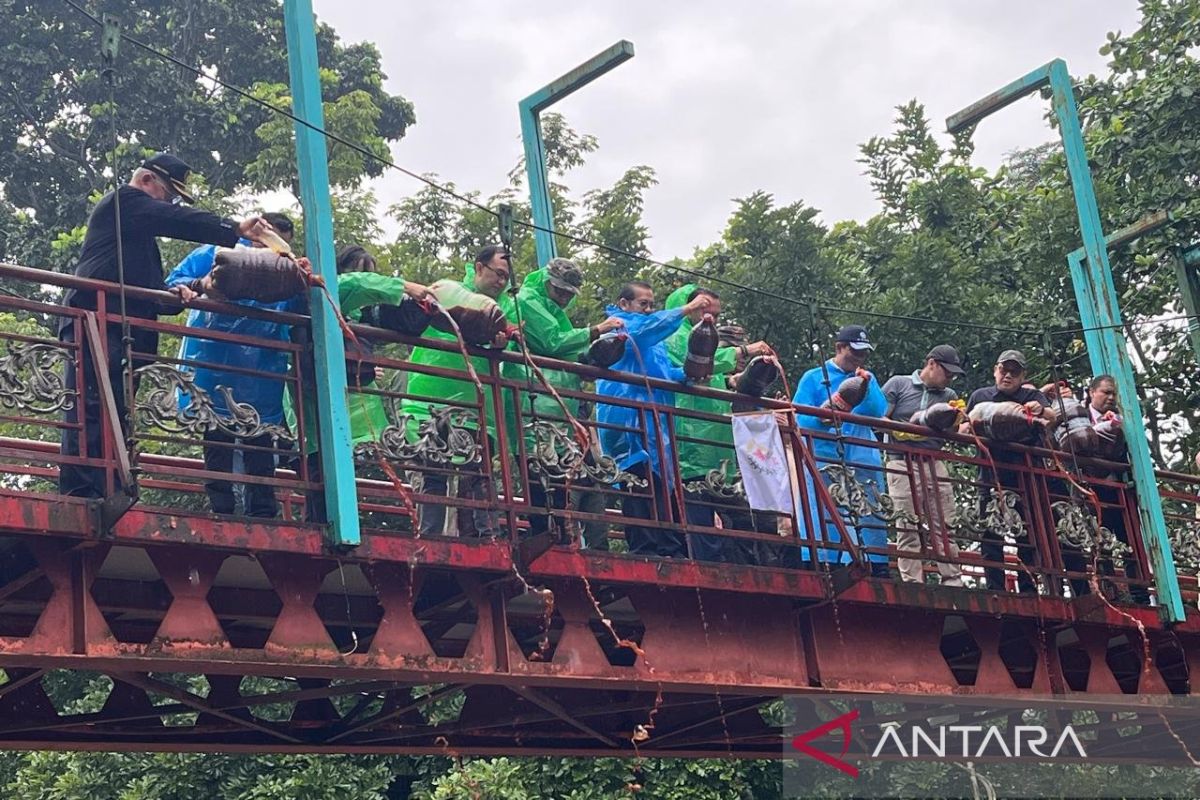
Jakarta (ANTARA) — Supriyadi, Director-General of Buddhist Community Guidance at the Ministry of Religious Affairs, stated that the spread of eco-enzymes by Generasi Muda Buddhis Indonesia (Gemabudhi), the Ministry of Environment and Forestry, and the Ministry of Religious Affairs at Sungai Jeletreng, a river polluted by pesticide, is a concrete practice of ecotheology.
“This is a tangible form of ecotheology as directed by the Minister of Religious Affairs. We hope this movement will continue to grow because friends are committed to continuing to produce eco-enzymes,” Supriyadi said during the eco-enzyme distribution at Sungai Jeletreng in South Tangerang City on Sunday.
Sungai Jeletreng was contaminated by pesticide following a fire at a warehouse storing such materials in February. Firefighting water mixed with chemical residues and flowed into the river, polluting it. The river flows into the Cisadane River.
Supriyadi explained that Buddhist teachings emphasise the importance of protecting nature, because humans live in and depend on the environment. There is a value emphasising the obligation to care for nature, including forests and other natural resources. “In Buddhist religious practice we are taught to protect forests. There are teachings emphasising the importance of caring for the environment because from the universe we obtain the sources of life,” he said.
Moreover, the Paticca Samuppada concept, or interdependence, teaches that all living beings are interconnected. “The principle is interdependence or interbeing. All beings relate to one another and should be respected and cared for,” he added.
He also noted that the Directorate General of Buddhist Community Guidance has mobilised Buddhists to produce eco-enzymes more widely, including in preparation for Vesak.
“Later we will have a massive eco-enzyme production movement. The results will be used in places that truly need them, not only in Sungai Jeletreng,” he said.
The action of spreading 10,000 litres of eco-enzyme was recorded in the Museum Rekor Dunia Indonesia (MURI) as the largest eco-enzyme discharge into a river. The activity was led by Environment Minister Hanif Faisol Nurofiq, accompanied by the Director-General of Buddhist Community Guidance, Supriyadi, Gemabudhi Chairman Bambang Patijaya, the Deputy Mayor of South Tangerang, and the Chairman of the South Tangerang Regional Parliament (DPRD).
The action took place to commemorate Gemabudhi’s 40th anniversary and as part of efforts to restore the Cisadane River’s water quality. “Today MURI witnessed the actions of Indonesian Buddhist youths pouring eco-enzymes in celebration of Gemabudhi’s 40th anniversary,” said Jusuf Ngadri, MURI’s Operations Director.