
Big Data, Scattered Fate
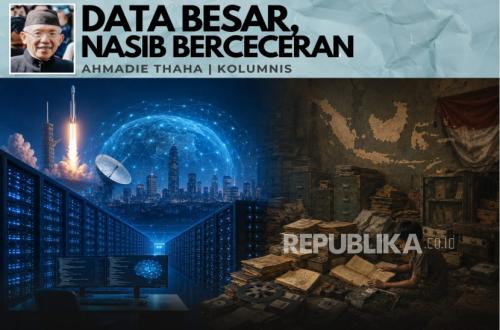
In America, data is like a new oil field. The difference is that while oil must be extracted from the earth, data can be extracted from human habits.
People’s coughs are recorded. People’s anger is analyzed. People’s shopping habits are observed. People with insomnia are mapped. Even people who stalk their ex every night are unknowingly contributing billions of dollars to the artificial intelligence industry.
Meanwhile, in our country, data is still treated like a pair of sandals in front of a mosque: scattered, lost, sometimes missing a pair. Elon Musk, a man whose words sometimes sound like those of a technology prophet and sometimes like those of a WhatsApp group admin who has just gone through a breakup.
Three months ago, he still called Anthropic a “wicked,” “misanthropic,” and even anti-Western civilization company.
But the world of AI is changing faster than campaign promises. This week, Musk is actually leasing his massive supercomputer to Anthropic, with a business value of around three to four billion dollars per year.
Amazing. Yesterday they were enemies. Today they are leasing servers, massive data infrastructure. This is how digital capitalism works. There are no eternal enemies. Only the electricity bills of data centers are eternal.
What is interesting is not just that Musk has changed his mind. What is interesting is the direction of that change. In the past, people competed to create the smartest AI model. Now, people are starting to realize that the most powerful are not just the creators of AI, but the owners of data infrastructure.
Whoever controls the data center, controls the future of artificial intelligence. So Musk is slowly shifting. From an AI player to an AI landlord. From a fighter in the ring to the owner of the stadium. From a noodle seller to the owner of the shop and the parking lot at the same time.
And that is more frightening. Because modern AI does not live on air and the prayers of pious people. It lives on three things: data, electricity, and GPUs. All of which are expensive. All of which are energy-intensive. All of which require a scale that is almost unreasonable.
Imagine a data center containing hundreds of thousands of Nvidia GPUs working day and night like thousands of students memorizing books without sleep. The heat is tremendous. The electricity consumption could rival that of a small town. And all of that is built just to train a machine to answer questions like: “What are the signs that a wife still loves her husband?”
Humans are indeed a strange species. But that is where the greatest economic value of this century is born. Data is no longer just an archive. Data has become fuel for geopolitics, economics, the military, culture, and even ideology.
America understands. China understands. Europe is starting to understand. What about us? We are still busy debating about the haram of photocopying ID cards.
In fact, Indonesia is a data paradise that has not been seriously harvested. A population of hundreds of millions. Diverse languages. Rich traditions. Unique habits. Abundant digital conversations. Thousands of hours of religious lectures every day. Piles of ancient manuscripts. Layered local cultures.
But all of that is scattered like a library warehouse that has been hit by a flood.
Data from one ministry is not connected to data from another agency. Cultural archives are still mostly dead PDFs. Damaged manuscripts are eaten by termites. Recordings of local languages are slowly disappearing along with the death of the older generation.
Sometimes the country is even faster at recording the violations of its citizens than at recording the knowledge of its own nation.
It is ironic. We are a large country that lives on a mountain of digital gold, but we are busy selling shovels.