
Beware: Major War Could Erupt as Indonesia's Two Nuclear Neighbours Heat Up Again
Tensions between two South Asian nuclear powers, India and Pakistan, have peaked again exactly one year after a four-day aerial conflict erupted in May 2025. Although both sides claimed strategic victories, analysts warn that the short war exposed serious vulnerabilities at the heart of both countries’ defences.
Citing Al Jazeera, Pakistan marked the start of May with various posters and banners honouring military leadership deemed successful in guiding the nation’s defence. In a ceremony in Rawalpindi on Thursday (7/5/2026), the Pakistan Air Force (PAF) officially commemorated their success in downing an Indian fighter jet in what they called “Truth Battle Day”.
However, across the border, India also insists it was the victor in the conflict. Indian Prime Minister Narendra Modi changed his profile picture on social media platform X to the official logo of Operation Sindoor, India’s military operation against Pakistan, and called on his people to do the same as a tribute to the bravery of their armed forces.
“One year ago, our armed forces demonstrated unmatched courage, precision, and resolve. Today, we remain as steadfast as ever in our determination to defeat terrorism and dismantle its support ecosystem,” Modi wrote on his X account on Thursday.
Victory Claims Amid Military Wounds
The conflict, triggered by an attack on tourists in Kashmir on 22 April 2025, left a heated debate about who truly prevailed on the battlefield. India launched Operation Sindoor on 7 May 2025 by striking locations inside Pakistan, which was then retaliated against by Pakistan through Operation Bunyan al-Marsoos.
Indian Air Marshal Awadhesh Kumar Bharti claimed in a press conference in New Delhi that his forces had destroyed 13 Pakistani aircraft and attacked 11 airfields. Nonetheless, he acknowledged the loss of fighter jets, including a Rafale downed by Pakistan’s Chinese-made J-10C, as inevitable in battle.
“Losses are part of combat,” Bharti stated flatly when admitting the downing of an Indian aircraft on the first day of the battle.
On the other side, Pakistan’s Inter-Services Public Relations (ISPR) Director General, Lieutenant General Ahmed Sharif Chaudhry, stated that his country had defeated an enemy five times its size. He emphasised that Pakistan had only shown a fraction of its military potential.
“We have defeated the enemy and shown only 10 percent of our military potential. We are ready. If anyone wants to test us, they are welcome to do so,” Chaudhry asserted in a press conference in Rawalpindi.
Pakistan’s Defence Gaps and BrahMos Missiles
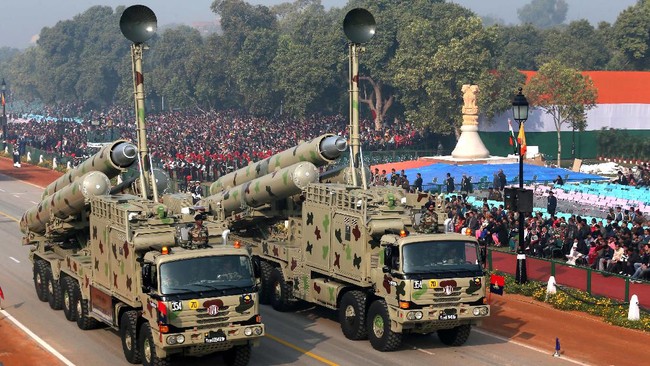
Despite claiming aerial victory, Pakistan had to face the bitter fact that its air defence system failed to stop India’s long-range BrahMos missile. The supersonic missile successfully struck key airbases in Rawalpindi and Sindh province, proving a major gap in Pakistan’s interception technology.
Defence analyst Tughral Yamin revealed that geography no longer provides strategic protection in the era of long-range precision weapons. This has prompted Pakistan to accelerate the operationalisation of the Army Rocket Force Command (ARFC) and introduce new missile systems such as Fatah-III, Fatah-IV, and Fatah-V, with ranges up to 1,000 km.
“The conflict showed that geography alone no longer provides strategic depth in the era of long-range precision weapons, drones, cyber capabilities, and satellite-guided systems,” Yamin said.
Muhammad Faisal, a Sydney-based defence analyst, added that while Pakistan’s air force performed exceptionally at the outset, India’s missile strikes on airbases highlighted failures in ground defences. Pakistan is now forced to increase its military budget by 20 percent to 2.55 trillion Pakistani rupees, equivalent to US$9 billion (Rp156 trillion), to plug these gaps.
Water War Threat and Trump Diplomacy
Beyond physical battles, India took a radical step by suspending the Indus Waters Treaty (IWT) in April 2025, an agreement regulating river water sharing between the two countries. This move poses an existential threat to Pakistan, which heavily relies on those river flows for its agricultural sector.
Pakistan’s Minister of Planning, Development and Special Initiatives, Ahsan Iqbal, described India’s action as using water as a serious political pressure tool for national security. Meanwhile, India asserts the treaty will remain suspended until Pakistan takes concrete action against cross-border militant groups.
“India’s efforts to use water as a pressure instrument highlight a serious external dimension for Pakistan’s water security,” Iqbal said in a government meeting.
Amid this deadlock, Pakistan gained diplomatic advantage through close ties with US President Donald Trump. Pakistan nominated Trump for the Nobel Peace Prize for his role in the ceasefire on 10 May 2025, which paved the way for Pakistan’s Army Chief, Field Marshal Asim Munir, to become a key mediator in the US-Iran conflict in the Middle East.
International policy expert C Uday Bhaskar issued a stark warning that both countries must immediately activate secret diplomatic channels to control future escalation. According to him, if conflict erupts again, it will unfold very quickly and be hard to contain.
“Both sides must invest in Plan B diplomacy and quiet channels to manage escalation. Because when it happens, it will happen