
Beware! IHSG at Risk of Collapsing Again
Jakarta, CNBC Indonesia - The Composite Stock Price Index (IHSG) is vulnerable to plunging below 7,000 again due to the intensifying war in the Middle East, with the latest developments already dragging in Japan and the Houthis.
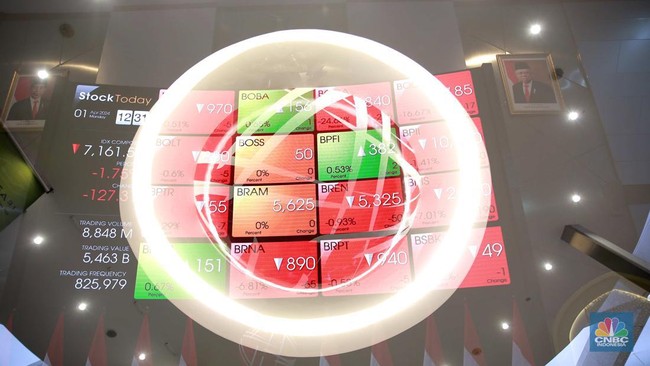
The IHSG closed at 7,097.05 on Friday last week (27/3/2026). It weakened by 0.94%, or was trimmed by 67.03 points in one trading day.
The index once slumped to the day’s lowest level of 7,070.21, although it opened at 7,136.37. Volume and frequency were recorded at 18.73 billion shares changing hands with a frequency of 1.37 million times.
A dominance of the red zone was clearly evident with 396 stocks correcting, while only 292 stocks managed to strengthen.
This drop to the 7,000 level represents a fairly sharp trend reversal compared to the performance at the start of 2026.
The current position is equivalent to the IHSG level around May - June 2024.
For context, the IHSG once hit an All-Time High of 9,174.47 in January 2026. This means that from its highest point this year, the IHSG has already corrected by around 22.6%.
In the current conditions, the room for the IHSG to rise is still very limited due to the absence of strong positive catalysts from the global side.
The market is essentially waiting for clear signals such as a ceasefire in the Middle East, the reopening of major energy routes like the Strait of Hormuz, and oil prices falling back below US$80 per barrel.
As long as those factors have not occurred, the IHSG will tend to struggle to experience a significant rebound because external pressures still dominate.
The escalation of the conflict itself is now entering a more complex phase with the emergence of double chokepoint risks.
If previously the market was only focused on the Strait of Hormuz, through which around 20% of the world’s oil passes, attention is now shifting to Bab el-Mandeb after the Houthi group in Yemen became involved in the conflict.
This route is the main connector between Asia and Europe via the Suez Canal and covers around 6-12% of global trade flows. If both routes are disrupted simultaneously, then around 25-30% of global oil supplies could be affected, thereby increasing the risk of global inflation and heightening the likelihood of a recession. In this scenario, oil prices could remain high for longer.
For Indonesia, this situation adds further pressure because high oil prices above the ideal fiscal comfort zone of below US$80 per barrel.
Assuming the state budget uses an oil price of US$70 per barrel, every US$10 increase can widen the deficit by around Rp51.8 trillion.
If oil prices reach US$100 per barrel, additional energy subsidies are estimated to reach Rp236 trillion, while additional revenue is only around Rp81 trillion, potentially adding to the deficit by up to Rp155 trillion. This fiscal pressure ultimately also burdens domestic stock market sentiment.
On the other hand, global dynamics are also influenced by the Fed’s policies, which are tasked with keeping inflation and employment in check, but indirectly also play a role in maintaining financial system stability that heavily depends on liquidity.
Unfortunately, liquidity currently feels increasingly tight, where the impact of high oil prices will keep inflation hot, so the higher for longer scenario for interest rates being kept high for a long period has a high chance of occurring until 2027.
Another indicator reinforcing this picture is the rise in the CBOE Volatility Index (VIX), which is currently touching above the 30 level, at its highest since the start of the year.
The VIX is known as the fear index because it reflects the level of fear and uncertainty in the market.
Historically, levels above 30 often signal a danger zone followed by increased volatility and the potential for deeper market corrections.
This rise in the VIX shows that global investors are in risk-off mode, so capital flows tend to exit risk assets like stocks.
With a combination of geopolitical risks, potential disruptions to global energy supplies, pressure on domestic fiscal conditions, and rising market volatility, the IHSG currently remains in a vulnerable phase.
As long as there are no clear positive catalysts, the index’s movements will tend to be limited and at risk of continuing downward pressure in the short term.