
Beware! Here are the Regions Experiencing Heavy Rain from 15-21 February due to the Asian Monsoon, Including Jakarta
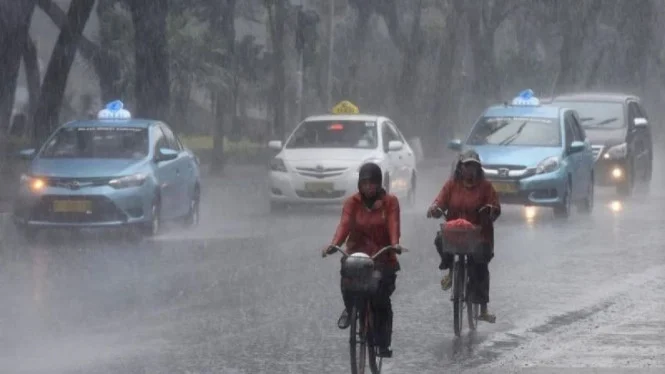
The Indonesian Meteorology, Climatology, and Geophysics Agency (BMKG) has urged the public to heighten their vigilance regarding the potential increase in rainfall across various parts of Indonesia from 15 to 21 February 2026, driven by the strengthening of the Asian Monsoon.
The Acting Deputy for Meteorology at BMKG, Andri Ramdhani, stated in an official release in Jakarta on Sunday that analysis indicates a dominant westerly wind flow, resulting from the Asian Monsoon’s intensification, is accelerating the development of convective clouds in western and southern Indonesia. This situation is further reinforced by the activity of the Madden-Julian Oscillation in the Indian Ocean phase, along with atmospheric Kelvin and Rossby waves, which trigger wind convergence, particularly along the southern coast of Java up to Nusa Tenggara.
According to him, this combination of atmospheric dynamics heightens the risk of moderate to very heavy rain, potentially accompanied by lightning and strong winds, in several areas during this period.
BMKG forecasts that from 15 to 16 February, heavy rain is likely in Aceh, North Sumatra, West Sumatra, Bengkulu, Lampung, Banten, Jakarta, West Java, Central Java, Yogyakarta, East Java, Bali, West Nusa Tenggara, North Sulawesi, Papua Mountains, and Papua.
From 17 to 18 February, similar conditions are expected in Aceh, West Sumatra, Bangka Belitung Islands, Lampung, Banten, Jakarta, West Java, Central Java, Yogyakarta, East Java, Bali, West Nusa Tenggara, East Kalimantan, and North Sulawesi.
On 19 February, regions to watch for heavy rain include the Bangka Belitung Islands, West Sumatra, East Java, West Kalimantan, Central Kalimantan, and Papua Mountains, while from 20 to 21 February, the potential persists in West Sumatra, East Java, Bali, West Nusa Tenggara, and East Nusa Tenggara.
The Acting Director of Public Meteorology at BMKG, Ida Pramuwardani, added that local governments and relevant agencies are encouraged to strengthen preparedness and mitigation measures based on each area’s risk level to anticipate hydrometeorological disasters.
BMKG also reminds the public, especially in areas prone to flooding and landslides, to remain alert, avoid activities near river flows and steep slopes, and monitor the latest weather updates before undertaking land, sea, or air travel.