
Between Schools of Thought and Sectarianism
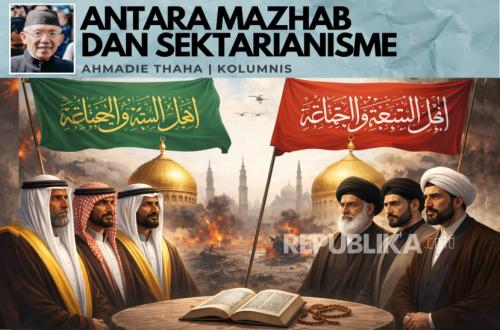
During the raging war between America, Israel, and Iran, there is another echo that is no less loud. But it emerges from much simpler places: coffee shops, WhatsApp groups, and small discussion rooms that are often hotter than UN assembly halls. Suddenly, conversations leap from missiles and the Strait of Hormuz to an old issue ready to ignite at any moment: Shia and Sunni. As if every geopolitical conflict in the Middle East always comes with a ‘bonus conflict’ in the minds of the faithful, which has never truly been resolved for centuries. On one side, voices defending Sunni harden. They stand on long-circulating theological arguments, with reasons of upholding the trust to preserve the purity of faith. Their accusations are classic but still potent: Shia declare takfir on the major companions and the Prophet’s family. This accusation is like an old song that is replayed every time political temperatures rise. Strangely, its discourse always sounds new to generations who have not had the chance to re-examine the sources. Discussions become lively, but never conclude. On the other side, Shia supporters do not remain silent. They firmly reject those accusations, even with equally strong conviction. They affirm that their Islam is no different: the same qibla, the same shahada, the same Al-Qur’an. For them, the accusations are a legacy of historical polemics that continue to be maintained, not the full reality of their current religious practice. Thus, dialogue turns into two long monologues running parallel, but never truly intersecting. Then, amid the clamour, a voice emerges that feels odd, even to some perhaps ‘out of place’. That voice comes from the heart of the Sunni world itself, from a Saudi scholar, Muhammad Abdul Karim al-Issa, whose position now is no small matter. He is the Secretary-General of the Muslim World League. This position is not merely administrative, but a nexus of global influence connecting religious authorities, international diplomacy, and the direction of world Islamic discourse. From the past, this organisation has been a space for major figures like Mohammad Natsir through the Indonesian Islamic Dawah Council network. It even coloured Islamic literature in Indonesia, including the publication of critical books on Shia. Thus, standing in that position is not just about knowledge, but also about balance, courage, and the ability to walk on a tightrope. In Saudi Arabia itself, Al-Issa is not a figure born from a vacuum. He was once Minister of Justice, then emerged as the new face of Saudi’s more open religious diplomacy. He is active in interfaith dialogue, visiting the Auschwitz site as a symbol of rejection of human cruelty, speaking in synagogues, meeting rabbis, and promoting interfaith cooperation.