
Bengkalis Investment Bylaw Committee Holds Coordination Meeting with BKPM Deputy in Jakarta
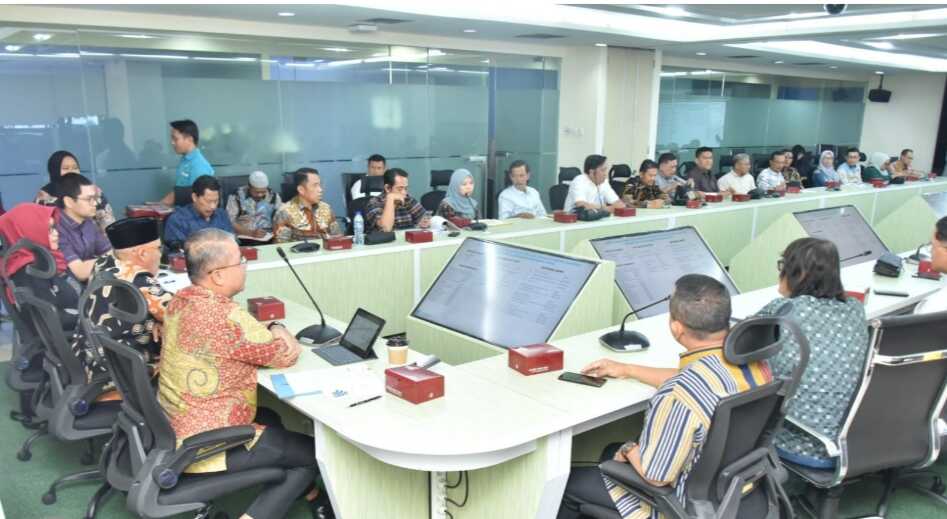
JAKARTA — The Special Committee (Pansus) for the Draft Regional Regulation (Ranperda) on Investment Administration in Bengkalis Regency held a coordination meeting with the Deputy for Investment Climate Development at the Ministry of Investment/Investment Coordinating Board (BKPM) on Thursday, 24 July 2025.
Deputy Chairman III of the Bengkalis Regency DPRD, H. Misno, affirmed that the coordination meeting was an important step to enrich and refine the content of the draft regulation. “This draft regulation still has several shortcomings, so input from BKPM will be very helpful in perfecting this regulation,” he told reporters on Saturday (26/7/2025).
Committee Chairman Tantowi Saputra Pangaribuan revealed that corporate contributions to Bengkalis’s Locally Generated Revenue (PAD) remain low. He highlighted the use of vehicles registered outside the region, an imbalanced workforce composition, and minimal returns from Bengkalis’s oil wealth. “We have a regulation on worker composition, but implementation has not been optimal. We need input so this draft regulation can significantly increase PAD,” he said.
Deputy Committee Chairman Febriza Luwu added that the unique geography of Bengkalis Regency — comprising mainland and island territories such as Bengkalis Island and Rupat Island, which directly border Malaysia — is a key factor in drafting the regulation. “Our geographical position is different, and this is a primary consideration to ensure the regulation aligns with actual conditions on the ground,” he explained.
Febriza also noted that his team had conducted a comparative study in Bandung, West Java, to examine the implementation of similar regulations. The findings are expected to enrich the substance of the Bengkalis draft regulation, particularly in boosting PAD. He also highlighted the absence of firm regulations governing vessels from neighbouring regencies docking in Bengkalis waters, as well as the large number of companies in Mandau District using vehicles registered outside Riau. “We do not want Bengkalis to merely be a spectator. We want to attract investors with the right regulations, which will ultimately increase PAD,” he stressed.
Sosi Lestari from the Bengkalis Regency One-Stop Integrated Services and Investment Agency (DPMPTSP) noted changes in the scope of the draft regulation. “We want to ensure these changes comply with higher-level regulations, particularly regarding small and micro-scale investment,” she said.
Meanwhile, Ismail from the Bengkalis Regency Cooperatives Agency requested clarification on the allocation of business sectors in Article 5 of the draft regulation relating to partnerships with cooperatives and SMEs. He emphasised the importance of alignment with national programmes, such as the establishment of “Merah Putih” village and sub-district cooperatives directly linked to the oil and gas sector.
Bengkalis Regent’s Expert Staff member Ed Efendi added that despite the existence of a supervisory team, there is no robust regulation on sanctions. He highlighted the large number of heavy equipment vehicles registered outside the region and the minimal CSR contributions from companies holding Industrial Plantation Forest (HTI) concessions. “We need a strong legal umbrella so that companies make fair contributions to the region,” he said.
Suhartono, Director of Regional Potential Development at BKPM, stated that the drafting of the regulation must align with the President’s vision and mission whilst considering Bengkalis’s priority sectors. “To determine priority sectors, an in-depth, comprehensive study meeting scientific standards must be conducted. The findings will be incorporated into an investment potential and opportunity map that forms the basis for strategic policies, including the provision of incentives,” he explained.
He added that the drafting process should also reference regulations in other regions that have undergone consultation with BKPM to avoid conflicting with central government provisions. Investment supervision, he continued, is conducted on a risk basis to ensure compliance with licensing, environmental, safety, and investment realisation requirements.
With a robust investment regulation grounded in academic study and aligned with central government policy, it is hoped that Bengkalis Regency can enhance its competitiveness as an attractive and competitive investment destination.