
BEI Opens Transparency on Shareholder Register, IHSG Slumps More Than 3.5 Per Cent
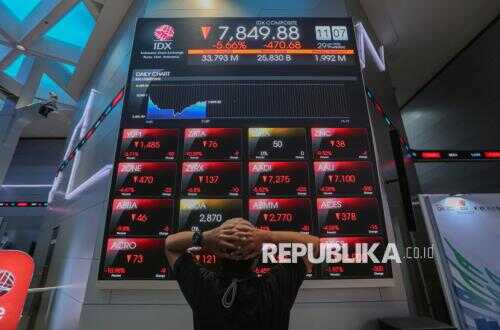
Jakarta, 4 March 2026 — The Jakarta Composite Index (IHSG) of the Indonesia Stock Exchange (BEI) opened the morning session weaker as investors adopted a risk-off stance in anticipation of higher crude oil prices on the global market. Domestically, BEI, together with PT Kustodian Sentral Efek Indonesia (KSEI), has published information on ownership of shares in listed companies above 1 percent that will be published every month through BEI’s official site.
IHSG opened down 43.39 points, or 0.55 percent, at 7,896.38. Meanwhile, the LQ45 index fell 3.29 points, or 0.41 percent, to 802.31. The IHSG then declined further to 7,655.94, down 3.57 percent.
“Technically, the IHSG is almost reaching the 7,900–7,840 support area. Brace your portfolio for the possibility of a deeper break (bearish flag). Volatility will remain high in the next two weeks; a wait-and-see approach remains more advisable,” said Liza Camelia Suryanata, Head of Research at Kiwoom Sekuritas Indonesia, in her Jakarta-based note on Wednesday, 4 March 2026.
Liza said global market sentiment was dominated by risk-off after the Middle East conflict entered its fourth day, with escalating exchanges between Iran, the United States, and Israel.
Iran’s attacks on energy facilities and tanker ships in the Gulf region, and the threat to close the Strait of Hormuz—which channels about a fifth of the world’s energy supply—fueled fears of global supply disruption.
Brent crude rose to around $81–82 per barrel, while West Texas Intermediate (WTI) rose to the $74–75 per barrel range, after briefly spiking nearly 10 percent intraday and reaching its highest level since 2024–2025.
“The oil price surge reinforces concerns about global inflation as energy is a key component of production and transport costs,” Liza said.
Moreover, investors began to price in a longer-than-expected duration for the conflict, heightening energy inflation risks while potentially slowing global growth.
“The surge in oil prices is seen as an energy supply shock that could push inflation higher globally and compel central banks to maintain tight monetary policy for longer,” she added.
Consequently, market participants no longer fully expect a Fed rate cut by September 2026. Fed Fund Futures imply around a 56 percent probability that rates will be held in June 2026.
Meanwhile, the US dollar strengthened sharply as a safe-haven asset, hitting multi-month highs against the euro, the pound, and the Japanese yen.
On the other hand, global gold prices fell as the dollar strengthened and investors locked in profits on the metal.
Geopolitical tensions are also triggering broader trade disruptions, particularly in energy and logistics. The Hormuz Strait threat could disrupt around 20 percent of global oil supply and large LNG volumes.
Shipping disruptions are also pushing up freight rates and energy prices.
The conflict has led to the closure of several major Middle East aviation hubs such as Dubai, Doha, and Abu Dhabi, with more than 21,300 flights cancelled and tens of thousands of passengers stranded.
Separately, US President Donald Trump announced that the U.S. Development Finance Corporation would provide political risk insurance and guarantees for maritime trade crossing the Gulf, particularly energy shipments. Trump also stated the US Navy stands ready to escort tankers through Hormuz if necessary to ensure global energy supply.
Domestically, BEI and KSEI published information about share ownership above 1 percent that will be published monthly via BEI’s official site. With this information, BEI hopes investors will have more accurate references for investment decisions and that it will strengthen confidence, integrity, and credibility in Indonesia’s capital market.
In European trading on Tuesday (3 March), markets broadly fell. The Euro Stoxx 50 declined 3.64 percent, the UK’s FTSE 100 fell 2.75 percent, Germany’s DAX down 3.44 percent, and France’s CAC 40 down 3.46 percent.
Wall Street’s major indices also finished lower on Tuesday, with the Dow Jones Industrial Average down 0.83 percent at 48,501.27, the S&P 500 down 0.95 percent at 6,816.63, and the Nasdaq Composite down 1.09 percent at 24,720.08.
In Asia-Pacific, early morning trade saw the Nikkei down 1,653.80 points or 2.94 percent at 54,625.30; the Shanghai Composite down 29.50 points or 0.73 percent at 4,094.17; the Hang Seng down 433.34 points or 1.68 percent at 25,334.74; the Kuala Lumpur Composite down 4.29 points or 0.25 percent at 1,707.66; and the Straits Times up 82.39 points or 1.68 percent at 4,835.25.