
Behind Grab Indonesia's On-Demand Ecosystem: Choice, Participation, and Digital Economic Growth
Indonesia’s digital economy continues to develop and has become one of the important drivers of national economic growth. Application-based services or on-demand services have now become an inseparable part of daily life for the public, ranging from transportation, food delivery, logistics, to digital financial services.
This development not only provides convenience for consumers but simultaneously opens income-generating opportunities for millions of people from various backgrounds. Platform-based business models enable individuals to remain productive without being bound to formal employment relationships with fixed working hours, a phenomenon known as the gig economy.
The gig economy encompasses a broad range of professions, from content creators, freelance writers, graphic designers, photographers, musicians, makeup artists, hair stylists, to porters, couriers, and online transportation drivers (ride-hailing). They work independently and have the flexibility to determine their own level and intensity of activity.
Grab is one of the gig economy platforms in the ride-hailing industry, continuously expanding its positive and inclusive impact on people from various social strata. Since arriving in Indonesia in 2014, Grab has reached millions of users across the country. Through an integrated digital services ecosystem, Grab has now reached more than 300 cities and regencies in Indonesia.
According to an ITB study (2023), the ride-hailing and online delivery industry contributed Rp382.62 trillion, or 2% of Indonesia’s total GDP in 2022, and Grab contributed approximately 50% to the online transportation and delivery industry (Oxford Economics, 2024), reflecting the substantial economic impact generated by Grab’s overall service ecosystem.
Within Grab Indonesia’s ecosystem itself, the partner profile reflects the platform’s function as an open and inclusive economic access point. Approximately 1 in 2 driver partners were previously retrenchment victims or had no source of income. More than 50% of partners are over 36 years old, with the majority having secondary school (SMA or SMK) as their highest educational background. Approximately 182,500 female driver partners are registered, with many of them being single mothers and sole breadwinners. Additionally, more than 700 partners with disabilities are also registered on the platform.
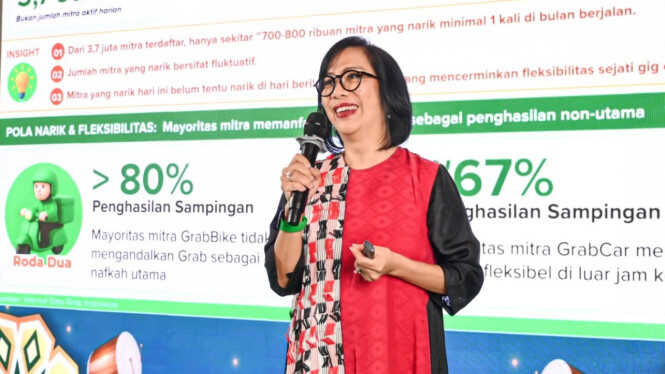
Internal Grab data as of December 2025 shows that total registered driver partners reached 3.7 million people. However, the number of driver partners who completed at least one order in the current month is approximately 700-800 thousand partners, or around 19-22% (both two-wheeled and four-wheeled partners) of the total. This figure is monthly data and is subject to fluctuation. Partners who complete orders today may not necessarily complete orders the following day, and vice versa. This is the natural characteristic of the gig economy—participation is flexible and follows individual needs.