
Becomes the Youngest Self-Made Billionaire: This Woman Built a Rp185 Trillion Business from Scratch
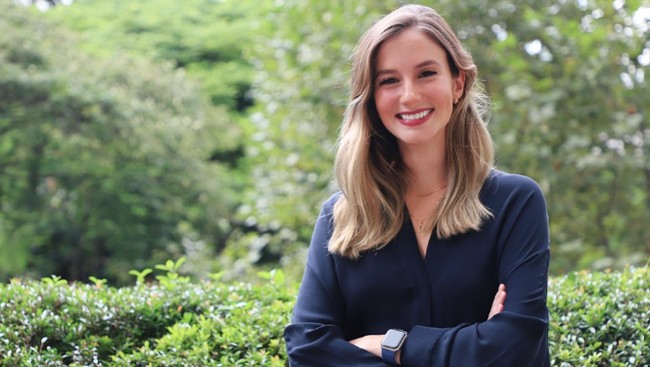
Luana Lopes Lara’s life journey is far from ordinary. A computer science graduate from the Massachusetts Institute of Technology (MIT), she spent a challenging adolescence as a professional ballet dancer before eventually building a billion-dollar technology company in just six years. Now, at 29, the Brazilian-born woman has been named the world’s youngest self-made female billionaire. She reached that milestone after the prediction market company she co-founded with her partner, Kalshi, secured new funding that lifted the company’s valuation to US$11 billion, about Rp185 trillion. Despite a string of major achievements, Lopes Lara says high school was the toughest period of her life. Lopes Lara described her high school years as ‘the most intense years of my life.’
Extreme Ballet Training
According to Forbes, on Sunday (8 March 2026), before venturing into technology and business, Lopes Lara trained in ballet at the Bolshoi Theater School in Brazil. Training there was notoriously rigorous. She recounts how ballet instructors sometimes held a lit cigarette under her thigh while she performed extreme ballet moves, lifting one leg to touch her ear, to test how long she could hold the position without getting burned. Competition among dancers was fierce. She said fellow dancers sometimes hid shards of glass inside each other’s shoes to gain an edge. Beyond the intense training, daily schedules were packed. She had academic lessons from 07:00 to 12:00, then ballet classes from 13:00 to 21:00. Yet behind all this, Lopes Lara had bigger ambitions. She aspired to be like Steve Jobs.
Academic Achievements and Ballet Career
Motivation to pursue academic excellence partly came from her family background. Her mother was a mathematics teacher, while her father was an electrical engineer. Inspired by her parents, Lopes Lara often studied late into the night to compete in various academic contests. Her efforts bore fruit. She won a gold medal in the Brazilian Astronomy Olympiad and a bronze medal in the Santa Catarina Mathematics Olympiad. After finishing high school in December, Lopes Lara briefly pursued a career as a professional ballet dancer in Austria for nine months. But she later decided to quit ballet to chase her dream of working in the United States and continue her studies at MIT.
From MIT to a Billion-Dollar Startup
While studying at MIT, Lopes Lara studied computer science and undertook summer internships at several major investment firms, including Ray Dalio’s Bridgewater Associates and Ken Griffin’s Citadel Securities. On campus she met Tarek Mansour, a Lebanon-born student who would become her business partner. Both were in the same social circle at MIT and studied the same subject, computer science. Mansour, who had experienced the Lebanon conflict in 2007 and taught himself English while preparing for the SAT, recalls how Lopes Lara always sat at the front of the class. Their closeness grew when Mansour began sitting next to her to study together. The bond strengthened when they both secured internships at Five Rings Capital in New York in 2018. On the way back to their internship apartment in the Financial District one night, an idea emerged that would give birth to Kalshi.
“We saw that most trading activity occurs when people have views about the future, and then try to translate that into markets,” Lopes Lara told Forbes. She explained that traders often consider events such as election results or the possibility of natural disasters when deciding how to invest.
Kalshi’s Birth
Starting from the idea that people should be able to trade the probability of an event directly, Lopes Lara and Mansour applied to the Y Combinator startup accelerator program in 2019 and were accepted. But their journey was not easy. The legality of prediction markets at the time was unclear. Michael Seibel, emeritus partner at Y Combinator, recalls that the two young founders faced major challenges from the outset. When they realised the company needed federal approval to operate legally, Lopes Lara and Mansour contacted more than 40 law firms. But none were willing to help because the founders were still too young and the company too small. “As soon as we graduated, we took a huge risk. Two years without a single product launched, and if we couldn’t obtain regulatory approval, the company could be worth zero,” Lopes Lara said.
During the pandemic, Lopes Lara built the business from London while Mansour was in Beirut. Mansour was even in the city when the Beirut port explosion killed more than 200 people. For several weeks, he worked on Kalshi at night, while by day helping clear debris and search for survivors.
Regulatory Approval
Their journey changed after a lawyer agreed to help. Jeff Bandman, a former official of the Commodity Futures Trading Commission (CFTC), helped Kalshi prepare the federal approval application while confronting regulator concerns. In November 2020, Kalshi finally gained approval from the CFTC to operate as a designated contract market (DCM). The approval classified their prediction market as a type of derivatives.