
BCA monitors debtors affected amid global dynamics
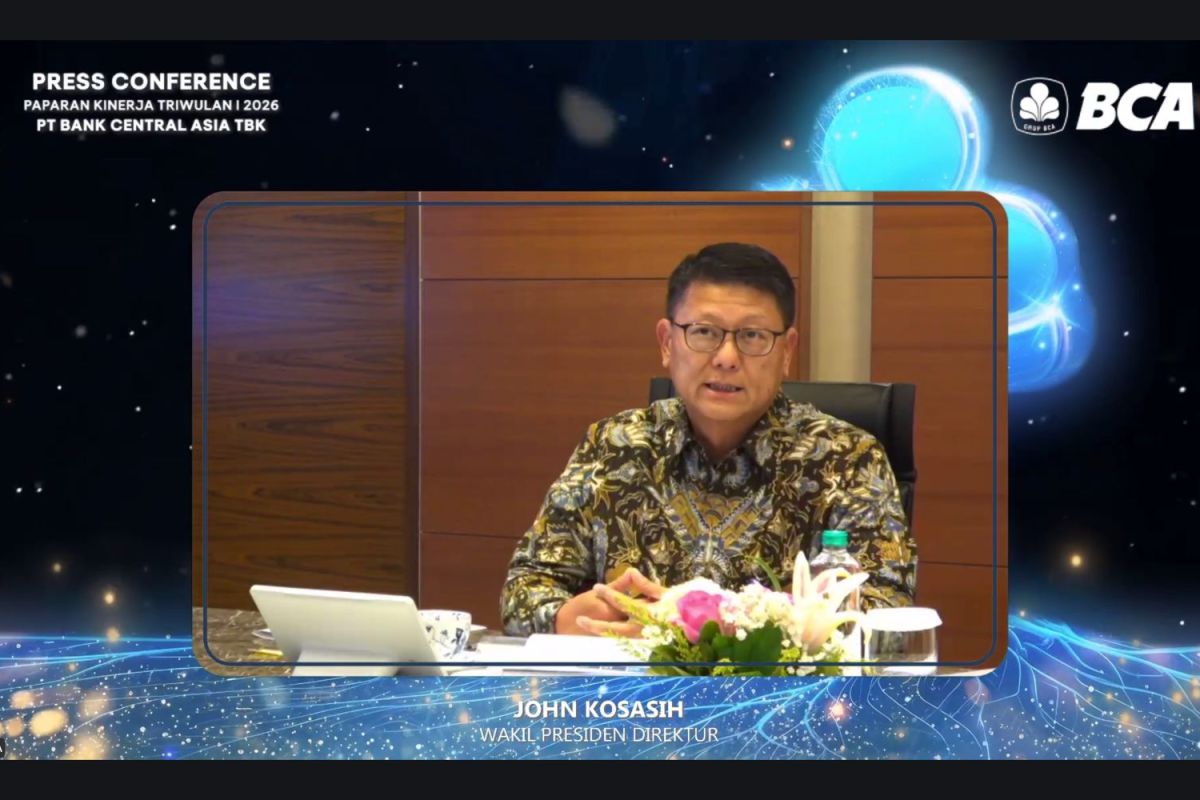
Jakarta (ANTARA) - PT Bank Central Asia Tbk (BCA) is strengthening its monitoring of debtors in affected sectors to ensure credit quality remains intact amid the Middle East conflict and global uncertainties.
BCA Vice President Director John Kosasih noted that one sector beginning to feel the impact is the plastics industry, following the rise in raw material prices triggered by the global oil price surge.
“Of course, we continue to coordinate with our customers to assess their current conditions. And of course, we also ask about the mitigation measures that our customers will take,” John said in response to media questions during a press conference in Jakarta on Thursday.
John added that so far, risks are still well-managed, and customers continue to operate normally, so the bank will keep monitoring developments in the situation.
Regarding the impact on future corporate credit performance, he assessed that the commodity price surge, particularly in energy, has actually been anticipated by debtors from the start.
According to him, the global conditions filled with uncertainties have led customers to prepare for various possibilities, so the impact does not occur suddenly.
Therefore, John said, BCA continues to strengthen coordination with customers to maintain readiness in anticipating various risks that may arise.
Regarding the rupiah’s depreciation, John mentioned that foreign currency credit exposure remains relatively small, at around 4.9% of BCA’s total portfolio, so the situation remains stable.
Thus, the rupiah’s weakening is deemed not to have a significant impact. In fact, according to John, it can benefit export-oriented customers, although business players still hope for exchange rate stability.
Meanwhile, BCA Director Subur Tan assured that the company has also conducted stress tests in line with regulator recommendations, and the results are still considered quite positive.
Subur noted that in terms of capital, the capital adequacy ratio (CAR) is in a range far above the minimum requirement, while the non-performing loan (NPL) ratio remains stable at 1.8% as of March 2026.
Regarding the potential for an NPL increase in the future, he views it as too early to conclude, but the company remains confident in maintaining good credit quality.
On the other hand, Subur acknowledged a slight increase in loan at risk (LAR), but the situation is still very much under control and supported by adequate provisioning.
As of the end of March 2026, BCA’s total credit grew 5.6% year-on-year (yoy) to Rp994 trillion.
By segment, corporate credit grew 9.1% (yoy) to Rp483.8 trillion. Meanwhile, commercial credit grew 5.7% (yoy) to Rp145.2 trillion.
Corporate credit holds the largest share at BCA, at 48.7% of total credit. Meanwhile, the commercial credit share is 15.6% of total credit.
By sector, manufacturing credit reached Rp213.7 trillion (up 2.7% yoy), followed by the trade sector at Rp195.1 trillion (up 3.6% yoy).
BCA’s loan at risk (LAR) and non-performing loan (NPL) ratios are stable, at 5.1% and 1.8%, respectively. Meanwhile, the provisioning ratios for LAR and NPL are at solid levels, at 69.7% and 174.6%, respectively.