
BAZNAS and BKKBN Invite Public to Donate for Stunting-Free Generation
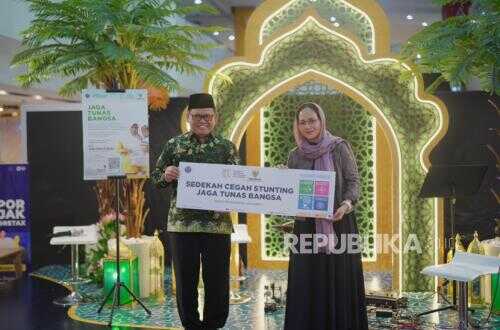
The National Zakat Board (BAZNAS) of the Republic of Indonesia, together with the Ministry of Population and Family Development (Kemendukbangga)/BKKBN, has relaunched the Sedekah Genting (Stunting Prevention Parent Guardianship Movement) charitable service. The service aims to encourage public participation in addressing stunting across Indonesia.
The relaunch was presented at a talkshow entitled “BAZNAS and Kemendukbangga/BKKBN: Nurturing the Nation’s Shoots - Charity for a Stunting-Free Generation” held at Atrium Senen Shopping Mall in Jakarta on Friday (27 February 2026). Speakers included Mohamad Arifin Purwakananta, Deputy I of BAZNAS for Fund Collection, and Yuni Hastutiningsih, Acting Director of Community Participation Development at Kemendukbangga/BKKBN.
Arifin explained that this collaboration represents a synergy between the management of social and religious funds and an institution with technical competence in family health and population matters. BAZNAS serves as a bridge between capable members of society (muzaki) and low-income families vulnerable to stunting. He stressed that this cooperation is essential to ensure stunting is addressed comprehensively and with precision targeting. He noted that poverty remains the primary cause of high stunting rates in Indonesia.
“BAZNAS has many programme areas, but our primary focus is poor and destitute beneficiaries with broad dimensions, including family health. Poverty can lead to stunting conditions, so zakat becomes one solution to bridge these needs,” Arifin stated.
He added that zakat and charitable fund management are conducted methodically through collaboration with institutions that have proven track records and expertise in their fields. On stunting issues, Kemendukbangga/BKKBN serves as a strategic partner to ensure assistance provided is not merely charitable in nature but delivers long-term impact.
In implementation, BAZNAS provides a special donation wallet for Sedekah Genting, enabling the public to channel assistance specifically designated for stunting prevention programmes through Kemendukbangga/BKKBN.
Regarding beneficiary selection, Arifin explained that verification is conducted using integrated data from Kemendukbangga/BKKBN and the Ministry of Social Affairs. “We use both datasets to ensure the assisted beneficiaries are genuinely well-targeted,” he said.
“We invite all Indonesians to give charity through this Sedekah Genting programme. Hopefully this becomes not merely a momentary social activity, but a sustainable movement,” Arifin said.
Yuni Hastutiningsih noted that the Genting programme focuses on families at risk of stunting, particularly from economic deciles 1 to 3. Research shows that nearly 50 per cent of stunting prevalence originates from low-income families.
She explained that the movement aligns with the government’s efforts to support the Indonesia Gold 2045 vision. According to her, the quality of future generations must be prepared now because children who will be productive in 2045 are currently in their growth and development phase.
“A golden generation cannot appear suddenly; it must be prepared early. That is why we must massively promote this movement now,” Yuni said.
She also called on the business world and broader society to participate. “Until now we have been waiting for corporate social responsibility, but it has not been evenly distributed. Now it is time for capable members of society to become guardian parents for families at risk of stunting. This collective concern will accelerate the reduction in stunting rates,” she added.