
Batam Industrial Estate Operators Push for Revision of Two Government Regulations to Boost Investment
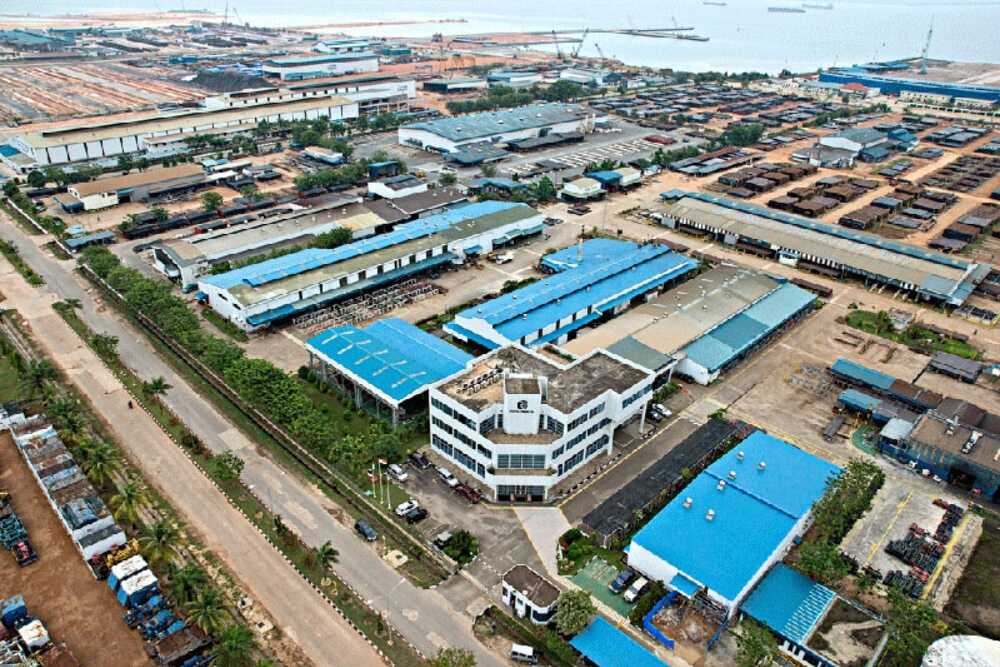
Bisnis.com, BATAM – Industrial estate operators in Batam are urging the central government to promptly revise at least two regulations deemed to be obstructing investment flows and licensing processes in Batam.
Coordinator of the Batam-Karimun Industrial Estate Association (HKI) Adhy Prasetyo Wibowo said the revision of the two government regulations is believed capable of strengthening the competitiveness of industrial estates, particularly in Batam.
“The two are Government Regulation (PP) No. 5/2021 on Risk-Based Business Licensing and PP No. 41/2021 on the Administration of Free Trade Zones and Free Ports (KPBPB),” he said in Batam on Wednesday.
Adhy explained that the proposal emerged as a response to structural barriers in the licensing system and KPBPB governance, which are considered ineffective in driving investment flows and industrial expansion.
“The revision of these two regulations is crucial for strengthening the competitiveness of industrial estates and accelerating investment realisation, particularly in Batam,” he said.
According to Adhy, the implementation of both regulations still presents significant obstacles on the ground. One key concern is the centralised licensing system through the risk-based Online Single Submission (OSS), which has yet to accommodate the special characteristics of KPBPB areas such as Batam.
As a KPBPB area, Adhy added, Batam requires different regulatory treatment. However, to date, the Batam Authority (BP Batam) as the zone administrator does not yet have full authority to issue standard certificates or conduct technical verification of environmental permits.
One consequence on the ground is that several industrial estates in Batam face serious obstacles in submitting amendments to environmental impact assessments (amdal) and issuing operational permits. Dependence on the central government slows the process, delaying business expansion and industrial infrastructure development.
“This situation creates uncertainty for investors and diminishes Batam’s competitiveness as a regional investment destination,” he said.
HKI, Adhy continued, is pushing for licensing authority — such as amdal for foreign investment (PMA), as well as land and maritime spatial utilisation conformity (KKPR) — to be transferred from the central government to BP Batam.
The withdrawal of strategic licensing authority to ministries and agencies at the central level has eroded Batam’s privileges as a KPBPB. This imbalance risks becoming a serious barrier to Batam’s competitiveness in facing regional competition in Southeast Asia.
“Without regulatory reform, Batam will lose momentum in facing regional competition. Vietnam, Malaysia and Thailand have taken more progressive steps with decentralised licensing systems that support efficiency and legal certainty. Indonesia must not fall behind,” he stressed.
Beyond licensing simplification, Adhy also noted the government needs to align regulations with zone characteristics, clarify authority structures, and ensure the OSS digital system is truly inclusive and adaptive to various types of industrial estates.
“Batam’s potential as a national industrial and logistics hub will not be optimised without responsive regulatory support. With its strategic geographical position, competitive infrastructure and industrial human resources, Batam has great capacity to become a primary driver of national economic growth,” he said.
The revision of PP 5/2021 and PP 41/2021 is key to elevating Batam’s competitiveness to a higher level, as investors operating in Batam are generally regulation-compliant businesses.
“They are ready to comply with applicable provisions, as long as the licensing process — especially basic licensing required for operations — can be conducted efficiently and facilitated,” Adhy said.
BP Batam Head Amsakar Achmad previously stated that his office is pushing for the transfer of several central licensing authorities to the region. “We are making efforts for national-level licensing services to be transferred to Batam, such as amdal licensing for foreign investment,” he said.
Another licence receiving attention from Amsakar is the maritime spatial utilisation conformity approval (PKKPRL), which has been held by the Ministry of Marine Affairs and Fisheries (KKP).
He is optimistic this can be achieved due to the issuance of Presidential Regulation (Perpres) No. 21/2025 on Land Provision in the Batam KPBPB. According to Amsakar, the central government has already shown commitment to supporting investment growth in Batam through this regulation.
“I would point out that there is Perpres 21/2025. That policy represents the central government’s partiality towards regional services. Forest area release in Batam no longer requires provincial approval,” he said.
With the introduction of this regulation, it is hoped to bring renewed momentum for Batam. “This is important not only for forest area management but also for contributing to increased investment in Batam,” Amsakar explained.
Before this new regulation was issued, applications for approval of forest area release in Batam to the Ministry of Environment and Forestry (LHK) could only be submitted by ministers or heads of agencies, senior officials of ministries, governors, regents/mayors, autonomous authorities, heads of legal entities or individuals, and community groups, in accordance with Minister of Environment and Forestry Regulation No. 7/2021.
Under the latest presidential regulation, Amsakar added, the Head of BP Batam has become a party that can submit applications for approval of forest area release in the Batam KPBPB to the Ministry of Environment and Forestry, alongside ministers, governors and senior ministry officials.
“Meanwhile, other parties as listed in the previous regulation can no longer do so. They must submit through BP Batam,” he explained.
According to data from the Batam Central Statistics Agency (BPS), the distribution of gross regional domestic product (GRDP) by sector in Batam in 2024 showed manufacturing contributing 56.83 per cent, an increase from 56.38 per cent the previous year.
In terms of tax revenue, manufacturing also made the largest contribution. Based on data from the Riau Islands Regional Tax Directorate General Office, its realisation amounted to Rp2.59 trillion. Manufacturing’s contribution to tax revenue in Riau Islands stood at 59.2 per cent of the total Rp4.38 trillion, with year-on-year growth of 19.33 per cent.