
Basic Food Prices Predicted to Rise Despite Safe Stock Ahead of Eid
President Prabowo Subianto has summoned several ministers to evaluate and ensure the availability of basic food stocks and petroleum energy supplies ahead of Eid. In response, Eliza Mardian, a researcher at the Centre for Reform on Economics (Core) Indonesia, has cautioned that national food stock availability does not guarantee price stability in the market. According to her assessment, problems within Indonesia’s national food system extend beyond stock availability to encompass distribution, supply chain structure, and market expectations.
Mardian identifies distribution as a frequent point of failure. If inter-regional distribution runs poorly or supply imbalances occur in certain areas, prices remain likely to rise despite adequate national stocks.
“Therefore, even with safe stocks, prices retain the potential to rise during Ramadan and ahead of Eid,” Mardian told Media Indonesia on Tuesday (10 March).
Mardian also highlights the problem of information asymmetry in food management. She notes that truly real-time food stock data from the field is often unavailable with accuracy and precision, making it difficult for the government to track stocks throughout each supply chain link.
Weather factors further influence food price dynamics. High rainfall can disrupt harvests of numerous commodities, particularly horticulture, whilst hampering shipments from production centres to markets. Should production suffer minor disruptions and distribution falter, market supply may decline, pushing prices upward and ultimately driving food inflation.
Historically, this pattern occurs nearly every year, Mardian continues. During Ramadan, inflation in the volatile food group typically increases due to surges in household demand, whilst supply cannot adjust quickly.
“Therefore, despite government assurances of safe stocks, the potential for basic commodity price increases remains,” she states.
For this reason, she contends that the most critical efforts extend beyond ensuring stock availability to encompassing smooth distribution, strengthening real-time food stock monitoring, and conducting swift and well-targeted market operations when prices begin rising. Coordination between the central government and regional authorities is deemed crucial, given that price pressures frequently occur at regional rather than national levels.
According to her view, market operations prove effective only when conducted early, performed regularly, and reaching lower-middle-income populations whose purchasing power requires protection. When implemented after prices have already risen, the impact typically remains limited as the market has already established new price points.
She therefore emphasises the importance of early intervention through daily price monitoring and stock distribution to regions experiencing price pressure.
The government has strengthened oversight of food prices, safety, and quality ahead of the end of Ramadan and the National Religious Holiday (HBKN) of Eid al-Fitr 1447 H.
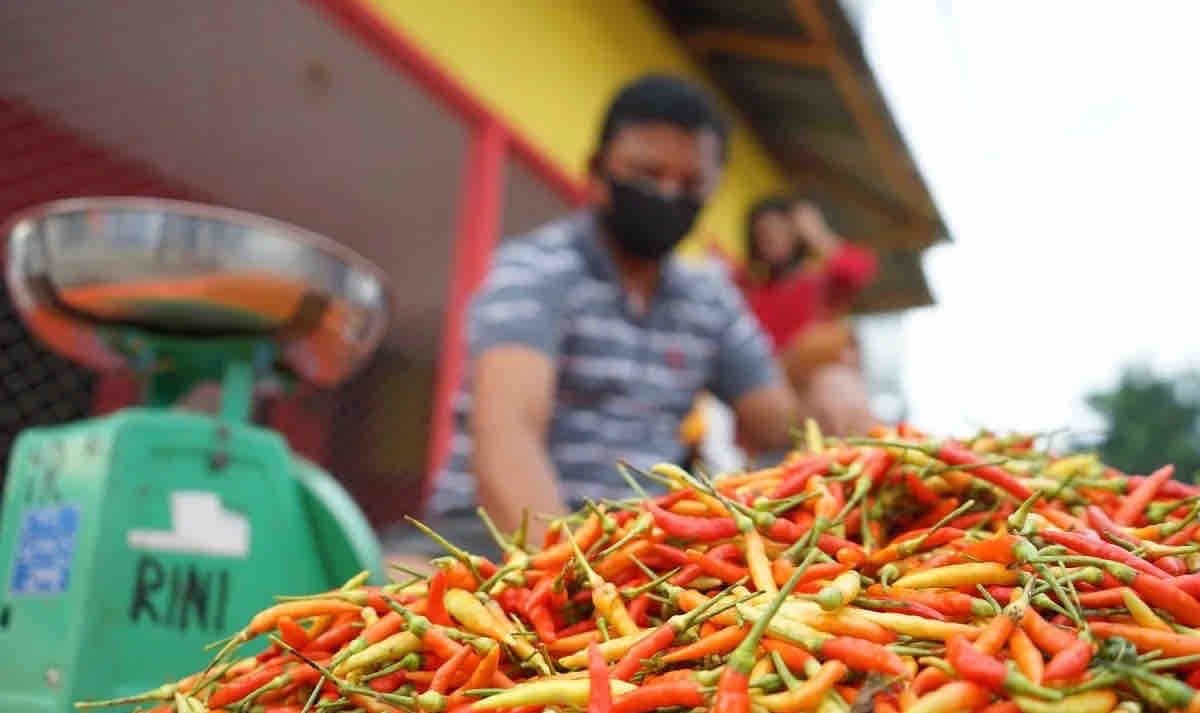
Ahead of Ramadan, prices for red chilli, eggs, rice, chicken meat, and vegetables in numerous traditional markets have climbed steadily, prompting many shoppers to complain. Two weeks after Eid al-Fitr or Eid 2025, on Monday (14 April), chilli prices in Purwokerto, Central Java remained elevated. Food price increases represent a seasonal pattern frequently occurring at Eid. Such increases are expected to continue over the following week.
Deputy Chair of Commission IV of the House of Representatives Abdul Kharis Almasyhari has criticised the food price increases recurring ahead of Ramadan and Eid al-Fitr.
Though curly red chilli prices have risen, Jakarta Governor Pramono Anung is striving to maintain stable basic commodity prices. Pramono has guaranteed that Jakarta’s food stocks remain safe ahead of Eid 2026, pledging government steps to keep meat prices stable. The Minister of Energy and Mineral Resources, Bahlil Lahadalia, stated that his report to the President includes energy supply conditions and basic commodity prices.
Basic commodity stocks remain safe ahead of Ramadan and Eid al-Fitr 2026 despite heightened tensions between the United States, Israel, and Iran. Rice reserves of 136,000 tonnes stand ready to maintain price stability. The DKI Jakarta provincial administration anticipates surges in food demand ahead of Ramadan and Eid al-Fitr 2026, particularly in chicken eggs, meat, shallots, and cooking oil.