
Barongsai Thrives as Symbol of Diversity and Achievement in Indonesia
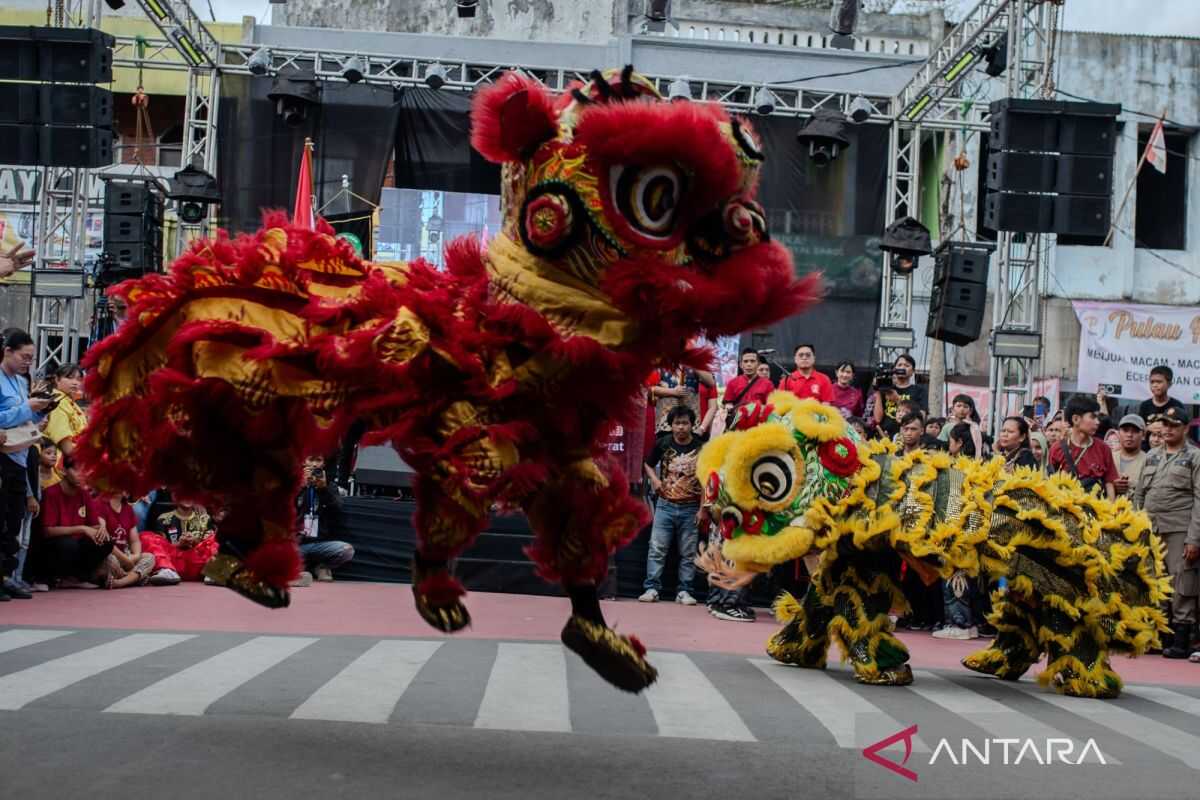
Cultural observer and researcher of Chinese-Indonesian studies Alexander Raymon, also known as Alex Cheung, told ANTARA that barongsai serves not only as a performing art but also as a medium to express spirit, hope, optimism, courage, and unity.
As a symbol of the brave lion, barongsai is believed to possess mystical powers capable of warding off evil spirits and bringing good fortune, prosperity, happiness, and peace.
“In the past, the Chinese community believed that the dancing lion had the power to drive away evil. That is why during Lunar New Year or other Chinese celebrations, lion dance performances are presented,” he said.
A manifestation of harmony
Barongsai (Wǔshī in Mandarin), or commonly referred to in parts of Java as samsi, literally means lion dance. Its presence in Indonesia has been known alongside the arrival of ethnic Chinese communities in the archipelago.
No longer limited to Chinese traditions, barongsai has become a symbol of Indonesia’s cultural diversity and harmony.
Since the Reform era, barongsai and dragon dance performances have been freely staged in Indonesia, not only during Lunar New Year, Cap Go Meh, or other Chinese festivals, but also at various cultural events organised by institutions, community groups, and even private celebrations.
According to Cheung, the art of barongsai in Indonesia continues to develop with local cultural influences, as seen in the current commodification process marked by the emergence of variations such as Javanese-style barongsai, the use of pop music accompaniment, and collaborations with modern dance.
“This does not diminish Chinese identity and culture, but instead enriches the identity of barongsai as a performing art with distinctive characteristics in each region of Indonesia,” he said.
He noted that Chinese associations such as Hoo Hap Hwee, Hokkian Hwee Koan, Sin Ming Hui, Kuo Chi Yen Chiu She, Khong Kauw Hwee, Shantung Kung Hui, and Kwong Siew Wai Kuan have played an important role in sustaining barongsai performances in Indonesia.
Many barongsai communities have also consistently promoted and preserved the art. In Indonesia, barongsai groups emphasise inclusivity by welcoming members regardless of ethnicity, religion, or race.
This principle is upheld by the Kong Ha Hong Barongsai Foundation, one of the communities that has developed barongsai performances in Indonesia for more than 20 years and has won five world championship titles.
Chairperson of the Kong Ha Hong Barongsai Foundation Ronald Sjarif told ANTARA that the foundation welcomes anyone interested in joining, with a minimum age requirement of around eight years.
Public interest in joining barongsai groups often increases after watching performances at shopping centres or malls.
“We do not selectively screen members. The important thing is having new members. We usually accept children from around eight years old and do not differentiate based on ethnicity, religion, or race. We train them until they can perform,” he said.
Tradition and platform for achievement
The barongsai performance, which features two dancers inside a lion costume synchronising their movements to the rhythm of drums, cymbals, and gongs, serves not only as a cultural tradition but also as entertainment and a platform for achievement.
Barongsai Kong Ha Hong coach Andri Wijaya explained that barongsai performances are staged not only for Lunar New Year celebrations but have also been recognised as a sport by the Indonesian National Sports Committee (KONI).
“There is a difference because one is for entertainment or sport, while the other is for cultural purposes,” he said.
The coach, who is also affiliated with the Indonesian Barongsai Sports Federation (FOBI), explained that barongsai as a cultural practice maintains traditional rituals. In practice, this may include praying, visiting temples, and following specific procedures.
“Barongsai originated from culture, so there are certain rituals. For example, during a store opening, there is a ritual of plucking the greens, which carries particular meaning. These traditions still exist,” he said.
Meanwhile, barongsai as entertainment at malls and festivals focuses on captivating audiences, with choreographed performances and uplifting background music.
On the other hand, barongsai in Indonesia has become a platform for achievement after being recognised as a sport in 2013. It was first contested at the 19th National Sports Week (PON) in West Java in 2016. The Indonesian Barongsai Sports Federation (FOBI) was established to oversee the sport.
“Barongsai as a sport involves technical skills. As it has developed as a sport, the level of difficulty has increased. It keeps getting more challenging,” Wijaya said.
Today, many barongsai performances incorporate elements of traditional arts and martial arts such as Kungfu or Wushu, resulting in movements that are visually appealing and harmonised with music.
Looking ahead, he expressed hope that barongsai will continue to be included in sporting events, encouraging more young people to take up the art and become athletes, thereby increasing opportunities for achievement.
“We hope that with barongsai recognised as a sport, more young generations will grow to love barongsai,” he said.