
Bapanas: Strategic staple food prices declining and stabilising
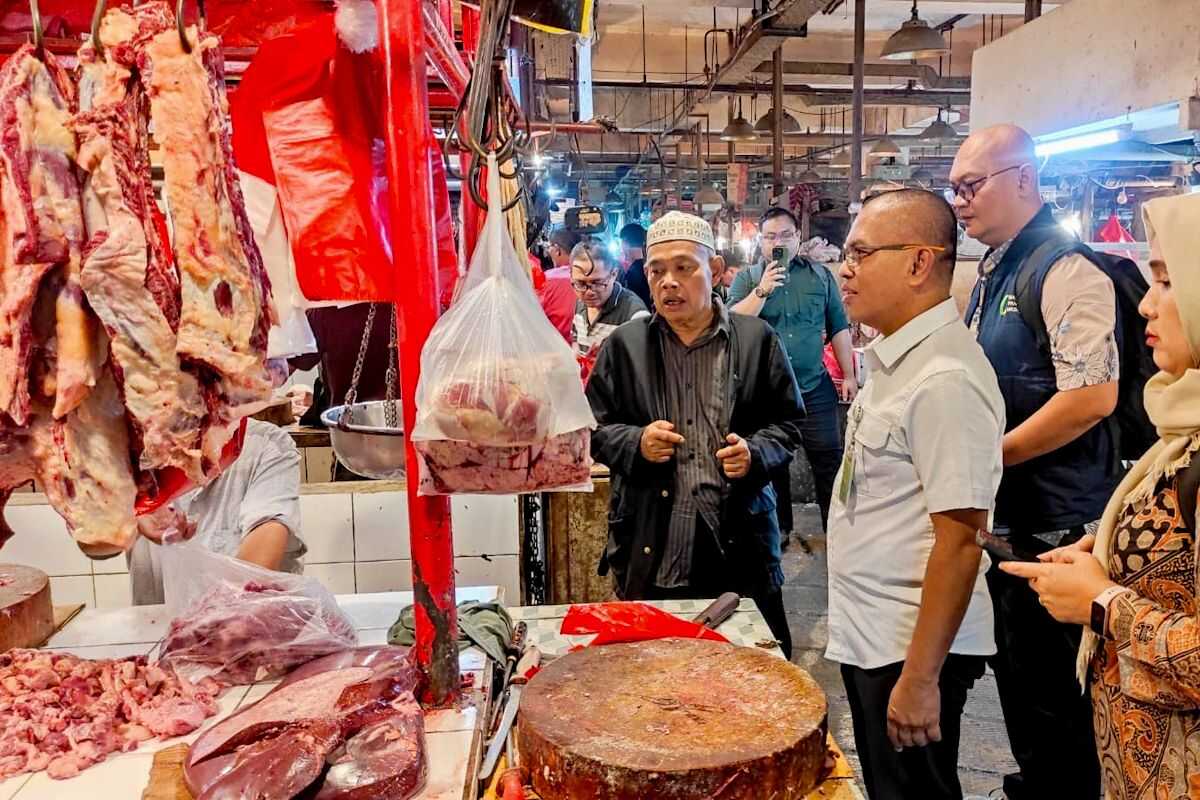
Mataram, West Nusa Tenggara — The Deputy for Food Availability and Stabilisation at the National Food Agency (Bapanas), I Gusti Ketut Astawa, has stated that monitoring of staple food prices in the market shows declining and stabilising prices with safe and adequate stocks maintained.
“I believe all staple foods are stable. Stocks are safe. So hopefully, as we enter Eid al-Fitr with market monitoring, prices can continue to decrease. Although they do vary, we are seeing the trend is already declining and beginning to stabilise,” Ketut said in a statement received in Mataram, West Nusa Tenggara, on Saturday.
He noted that the volatility of strategic staple food prices during the first week of Ramadan 1447 Hijriah continues to be closely monitored by the government. The dynamics of food price movements must not be allowed to fluctuate excessively, so that the purchasing power of society can remain stable.
“Stocks are also safe. The government is optimistic that food prices through Eid al-Fitr can continue to be maintained,” he said.
He cited the results of an inspection at Pasar Senen in Jakarta, where most strategic staple foods were within the highest retail price range (HET) and consumer-level price reference guideline (HAP). Beef prices were noted as relatively stable ranging from Rp130,000, Rp135,000 to Rp140,000 per kilogramme. Chicken was Rp40,000 per kilogramme, and red bird’s eye chilli was Rp100,000 per kilogramme.
“Red bird’s eye chilli has already declined from Rp110,000 yesterday. Then eggs vary, some at Rp29,000, some at Rp30,500,” Ketut elaborated.
To control food price volatility, the government through Bapanas and state logistics company Perum Bulog continue to implement various food intervention programmes. Economic stimulus programmes such as food assistance and subsidised rice provision are expected to act as an economic buffer for low-income households.
“Food assistance will be pushed this year, with 33.2 million beneficiary families (KPM) to receive it in March. We are providing this. We are preparing everything, so all our programmes will be pushed forward, so that this food assistance is then implemented,” Ketut explained.
The total budget prepared by the government for the food assistance programme of rice and cooking oil amounts to Rp11.92 trillion. The number of food assistance beneficiaries has been increased dramatically to 33,244,408 recipients throughout Indonesia.
The five provinces with the largest number of recipients are West Java with 6,093,530 recipients, followed by East Java with 5,638,478 recipients and Central Java with 5,071,126 recipients. These are followed by North Sumatra with 1,756,846 recipients and Banten with 1,298,597 recipients.
Meanwhile, the number of food assistance recipients in eastern Indonesia has also been increased. Maluku province has been expanded by 142,978 recipients compared to the previous programme, bringing the current total to 266,500 recipients. North Maluku has been increased by 55,017 recipients to reach 112,428 recipients.
Papua province has increased by 50,973 to a total of 118,076 recipients. West Papua has increased by 30,197 to 74,044 recipients. For Southwest Papua, it has increased by 35,030 to 78,965 recipients.
The total recipients in Highland Papua has increased by 112,805 to 265,356 recipients, Southern Papua has increased by 26,041 to 73,601 recipients, and Central Papua has increased by 55,997 to 228,654 recipients.
Bapanas expects that with the distribution of rice and cooking oil food assistance to low-income households, this can support consumption needs during Ramadan. This can also lead to a shift in consumption spending by food assistance recipients towards other items that are also basic needs or other productive purposes.
Furthermore, Bapanas is ensuring that the Food Supply and Price Stabilisation Programme (SPHP) for rice continues throughout 2026. Previously, Bapanas extended the rice SPHP programme for 2025 until the end of February 2026.
This subsidised rice provision programme will continue from March onwards. The budget prepared for the 2026 rice SPHP programme amounts to Rp4.97 trillion, equivalent to the price subsidy costs provided by the government for total SPHP rice purchased by the public amounting to 828,000 tonnes.
Separately, Bapanas Head and Agriculture Minister Andi Amran Sulaiman emphasised that no party should create price anomalies for staple foods, particularly during Ramadan 1447 Hijriah.
“All staple food sectors in the holy month of Ramadan must comply with existing price regulations. Do not disturb the people,” Amran stated firmly.
Meanwhile, the Central Statistics Agency (BPS) recorded that up to the third week of February 2026, 23 provinces were still experiencing increases in the Price Development Index (IPH). However, of these 23 provinces, only seven experienced IPH increases exceeding 2 per cent.
These seven provinces are Central Java with an IPH increase of 2.23 per cent, West Java 2.39 per cent, East Java 3.13 per cent, Bali 3.23 per cent, Yogyakarta Special Region 3.61 per cent, Bangka Belitung Islands 4.57 per cent, and West Nusa Tenggara 5.47 per cent.