
Bapanas proposes increasing Minyakita DMO to 60 percent for price stability
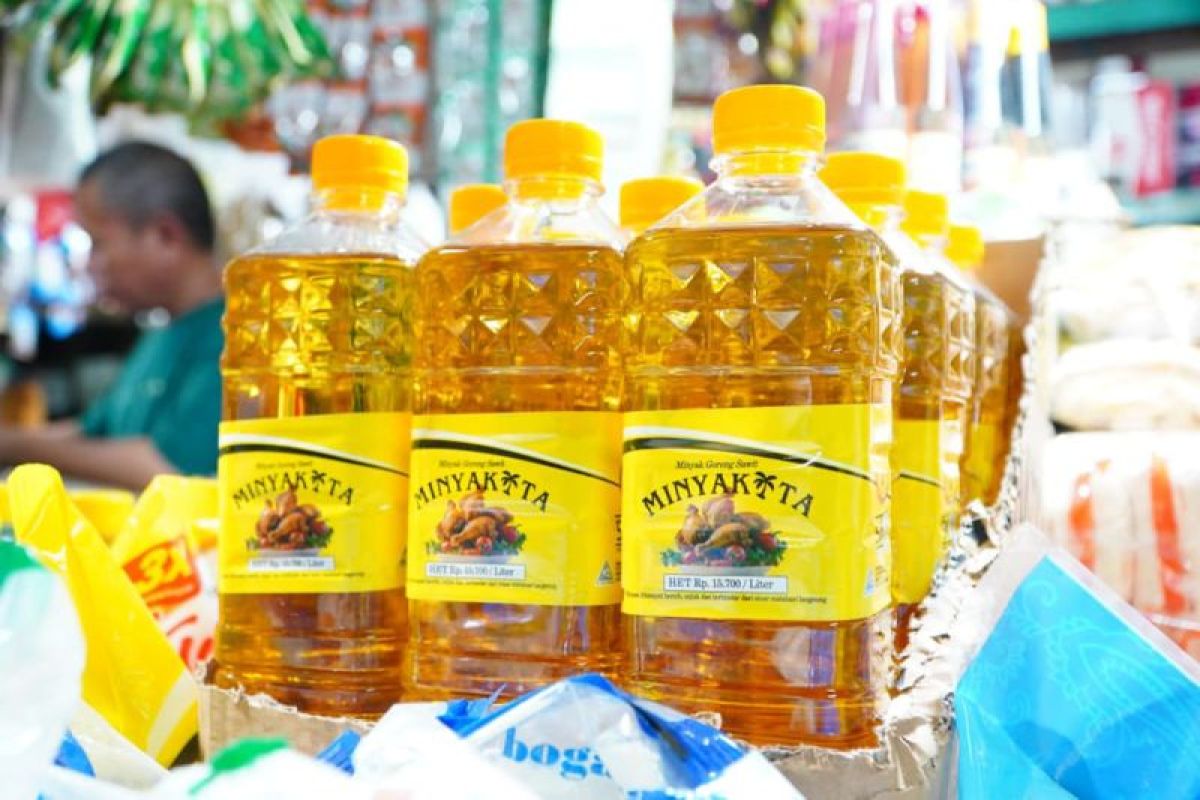
Jakarta (ANTARA) - The National Food Agency (Bapanas) has proposed increasing the domestic market obligation (DMO) portion for Minyakita cooking oil products allocated to state-owned food enterprises from 35 percent to 60 percent to strengthen distribution and maintain price stability in the market.
“We propose that state-owned food enterprises can receive up to 60 percent DMO (Minyakita), which will facilitate government monitoring of distribution to markets,” said Deputy for Food Availability and Stabilisation at Bapanas, I Gusti Ketut Astawa, when contacted in Jakarta on Tuesday.
Nevertheless, he noted that government monitoring in various markets shows that prices for the people’s cooking oil brand Minyakita are beginning to decline.
“For Minyakita, prices have started to drop. Currently, the DMO uptake is also divided for food assistance,” he stated.
He mentioned that based on data from the Ministry of Trade (Kemendag), the national average price of Minyakita as of 17 April stood at Rp15,982 per litre.
Although slightly above the highest retail price (HET), 28 provinces have average Minyakita prices in line with the HET.
Ketut also said that according to Kemendag reports, the realisation of Minyakita DMO through state-owned food enterprises as first-line distributors (D1) has reached 228.2 thousand tonnes, or 50.07 percent.
Perum Bulog has absorbed 182.7 thousand tonnes and ID FOOD 45.5 thousand tonnes from 26 December 2025 to 17 April 2026.
“Minyakita is not a government subsidy programme. It is a contribution from domestic palm oil producers to first meet the domestic cooking oil market in order to obtain export permits,” he explained.
Ketut clarified that the fulfilment of the minimum 35 percent DMO distribution realisation to state-owned enterprises has been carried out by 53 producers nationwide.
Meanwhile, 10 other producers have yet to meet the minimum 35 percent DMO threshold.
Bapanas is also pushing for a shortening of the Minyakita supply chain.
With the strengthening of Minyakita DMO through state-owned enterprises, it is hoped that distribution can directly target people’s markets without going through first- and second-line distributors, allowing the final price to align more closely with the HET of Rp15,700 per litre.
“If our proposal is accepted that Bulog and ID FOOD receive 60 percent DMO, it will be easier for us to monitor. This way, the network won’t be too elongated. Usually, what causes prices to be too high is from producers to D1, then D2. It should go directly to retailers,” Ketut explained.
According to him, there is a practice of free marketing in the Minyakita supply chain that he has observed in the field.
He emphasised that this adds to the distribution channels and results in higher final prices for Minyakita at the consumer level.
To address this, Ketut continued, the government is relying on state-owned food enterprises to directly distribute Minyakita to people’s markets.
Previously, the Central Statistics Agency (BPS) reported fluctuations in cooking oil prices in 207 districts/cities up to the third week of April 2026.
“As a note on cooking oil, this increase occurred in 207 districts/cities; in the second week, it was only 177 districts/cities. Now, it has become 207 districts/cities. So, the increase is quite significant,” said Deputy for Distribution and Services Statistics at BPS, Ateng Hartono.
In response, the central and regional governments are urged to pay more intensive attention and intervene to dampen cooking oil price fluctuations across all regions.