
Bapanas: Food Prices in Bulukumba, South Sulawesi Remain Stable Post-Eid
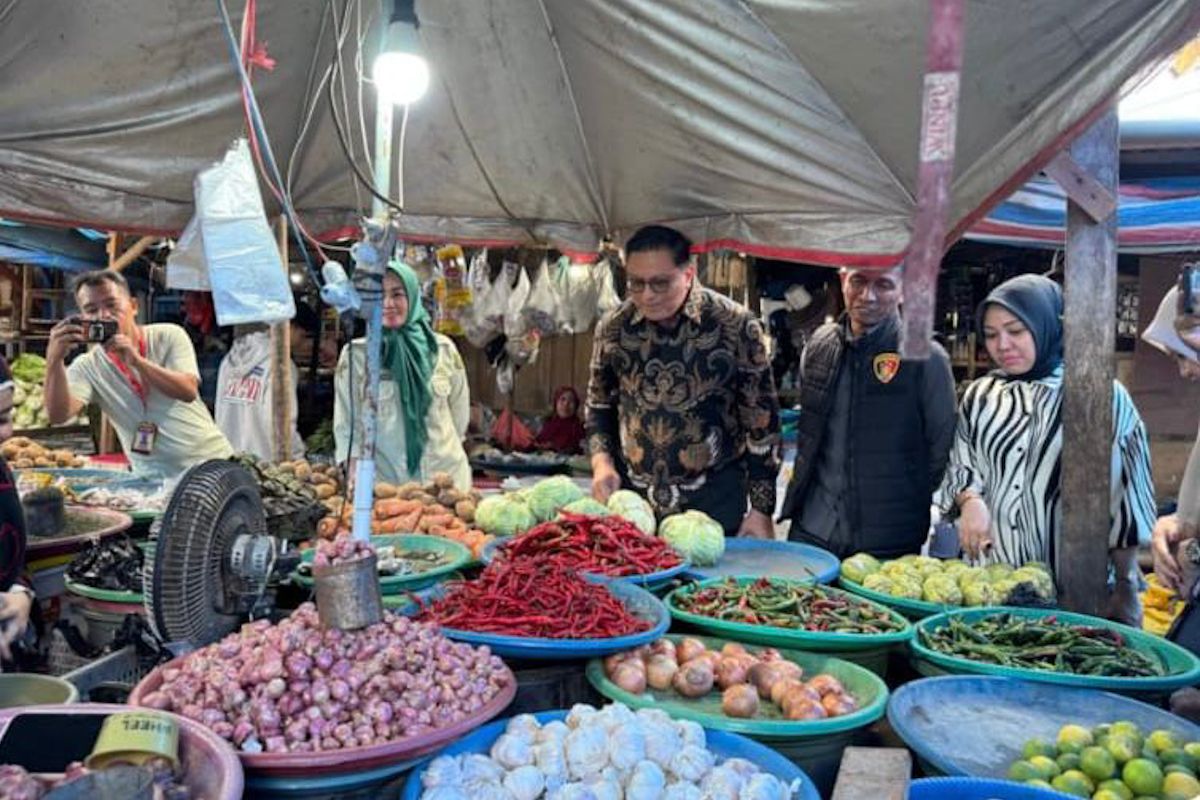
Jakarta (ANTARA) - The National Food Agency (Bapanas) has assured that food prices in the Bulukumba region, South Sulawesi, remain controlled following Eid al-Fitr 1447 Hijriah, supported by smooth distribution which prevents significant spikes in strategic commodities.
“Post-Eid al-Fitr 1447 Hijriah, prices of several food commodities in traditional markets are monitored to remain stable with available supplies,” said Hermawan, Director of Food Safety and Quality Standards Implementation Supervision at Bapanas, in a statement in Jakarta on Thursday.
He explained that his agency, along with the Task Force for Clean Sweep (Saber) on Food Price, Safety, and Quality Violations, conducted direct monitoring at Cekkeng Market in Bulukumba Regency, South Sulawesi, to ensure price movements stay within reasonable bounds.
Hermawan stated that based on the monitoring results at the market, food prices are generally observed to be normal, with most commodities at or below the highest retail price (HET) and reference selling price (HAP).
Key commodities such as Stabilisation of Food Supply and Price (SPHP) rice are recorded at Rp12,000 per kilogram (below HET of Rp12,500 per kg); premium rice at Rp14,400 per kg (below HET of Rp14,900 per kg), and medium rice at Rp12,200 per kg (below HET of Rp13,500 per kg).
Other commodities like shallots at Rp35,000 per kg and garlic at Rp35,000 per kg are also below HAP. Meanwhile, chicken eggs and consumption sugar are recorded in line with HAP, while Minyakita cooking oil is around Rp15,700 per litre in accordance with HET.
He emphasised that the Food Task Force will investigate the causes if there is a widespread price increase, from upstream to downstream, to ensure no violations occur in the food distribution chain.
To maintain this controlled condition, the government is also strengthening various intervention instruments, including the Affordable Food Movement.
Bapanas recorded that up to early March 2026, the implementation of the Affordable Food Movement has realised 789 activities spread across 24 provinces and 153 regencies/cities, as part of efforts to bring affordable food access closer to the public.
On the other hand, the SPHP rice distribution programme continues to be intensified, with realisations in South Sulawesi and West Sulawesi as of 25 March 2026 reaching 2.22 thousand tonnes or about 5.71 percent of the target in the South Sulawesi-West Sulawesi region.
In addition, the government is carrying out food aid distribution to maintain people’s purchasing power. As of 25 March 2026, national rice food aid realisations have reached 7.5 thousand tonnes and cooking oil at 1.5 million litres, received by 378 thousand Food Aid Recipients (PBP).
These various measures are part of an integrated stabilisation policy, both through strengthening supply, distribution, and direct interventions to the public, to ensure prices remain controlled and food availability is maintained post-National Religious Holiday (HBKN).
Separately, the Head of the National Food Agency and Minister of Agriculture Andi Amran Sulaiman emphasised that food stabilisation efforts ultimately aim to maintain balance for all actors in the food supply chain.
“We want everyone to smile. Farmers smile because the price of their harvest is good, traders smile because goods are available and can be sold, and the public also smiles because food prices are affordable. That is the government’s goal in maintaining food,” said Amran.
As a follow-up step, the Saber Food Task Force will continue to deepen investigations into the supply chain of commodities experiencing price increases, including at the producer and distributor levels, and encourage inter-regional distribution interventions to maintain supply balance.
The government also urges the public to continue shopping wisely and avoid panic buying.
With strengthened supervision and support from various stabilisation instruments, the government ensures that food prices remain controlled and supplies are maintained, so that post-Eid economic activities for the public can run well.