
Bapanas: Food Price Stability and Reasonableness Key Factors in Controlling Inflation
Jakarta (ANTARA) - Deputy for Food Availability and Stabilisation of the National Food Agency (Bapanas), I Gusti Ketut Astawa, stated that the stability and reasonableness of food prices are the primary factors in maintaining inflation.
“The decline in inflation in March is certainly good news. The inflation rate continues to be positively controlled, with no deflation occurring. This means that all food supply chains, from farmers and livestock breeders to traders and the public, are comfortable together,” said Ketut in Jakarta on Wednesday.
According to him, the government continues to strive to maintain a balance in food prices from producers to consumers.
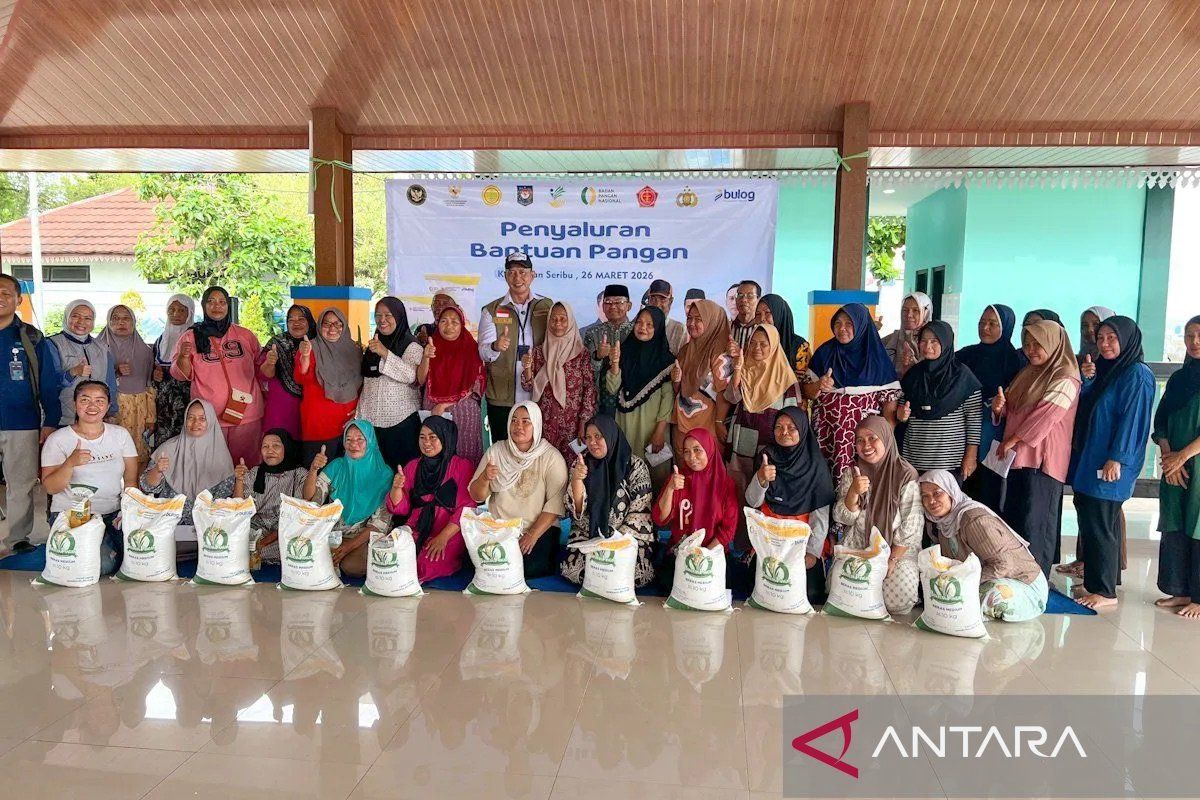
Various efforts are being made to maintain food stability, including the distribution of rice and corn under the Stabilisation of Food Supply and Price (SPHP) programme, food aid (rice and cooking oil) allocated for February-March 2026 to 32.3 million beneficiary families.
The distribution of rice and cooking oil food aid carried out by Perum Bulog so far has reached 864,041 recipients, equivalent to 17.28 million kilograms of rice and 3.45 million litres of cooking oil.
Furthermore, the realisation of rice sales under the SPHP programme in March reached 66.84 thousand tonnes. With this rice supply in the market, he said, it can serve as an affordable rice consumption option for the public compared to other rice brands.
The government is also strengthening the implementation of affordable markets through the Cheap Food Movement (GPM) programme. In collaboration with local governments, state-owned enterprises (BUMN), regional state-owned enterprises (BUMD), the private sector, and business associations, the GPM has been carried out 1,161 times in 202 districts/cities across 34 provinces throughout March 2026.
At the upstream level, Ketut said, the government, together with Perum Bulog, is actively supporting rice and corn farmers by absorbing their produce for the Government Food Reserve (CPP) stock.
Finally, the government has tightened food price monitoring in the market during Ramadan until the end of Eid al-Fitr 1447 Hijriah. The total monitoring activities from early February to the end of March 2026 have reached 64,548 points.
He emphasised that the intensive monitoring by the Task Force for Sweeping Clean Price, Safety, and Quality Food Violations contributes to controlling food prices.
“This is in line with the directives of the Head of Bapanas, Mr Andi Amran Sulaiman,” said Ketut.
Ketut stated that the government continues to maintain inflation stability during Ramadan up to Eid al-Fitr and also Nyepi 2026.
Not only is the general inflation cooling, but the inflation of volatile food price components or food inflation is also controlled without experiencing deflation, unlike the patterns that often occurred in previous years.
The Central Statistics Agency (BPS) recorded a monthly general inflation rate in March 2026 at 0.41 per cent, down from 0.68 per cent in February 2026.
“Inflation in March 2026, coinciding with the Eid al-Fitr moment, experienced month-to-month inflation of 0.41 per cent. This is lower compared to February 2026,” said Deputy for Distribution and Services Statistics of BPS, Ateng Hartono, in Jakarta on Wednesday.
Ateng explained that general inflation is driven by the contribution of volatile price component inflation, dominated by strategic staple food commodities such as broiler chicken meat, rice, broiler eggs, cayenne pepper, and beef.
“The contribution of food component inflation is the highest compared to core inflation and administered price inflation,” he said.
He noted that March 2026 inflation of 0.41 per cent was mainly driven by volatile price component inflation. The volatile price component experienced inflation of 1.58 per cent, contributing the largest share of 0.27 per cent.
Looking at the trend over the last three years, he said, the post-Eid al-Fitr period is usually followed by food deflation. In 2024, food inflation in March was recorded at 2.16 per cent, but it turned into deflation of 0.31 per cent in April.
A similar pattern occurred in 2025, where inflation was 1.96 per cent in March, changing to a slight deflation of 0.04 per cent in the following month.
However, in 2026, this pattern has been successfully altered. Food inflation remains positively and reasonably controlled at 1.58 per cent. This reflects more controlled supply and price stability.
Previously, the Head of Bapanas, Andi Amran Sulaiman, who is also the Minister of Agriculture, emphasised that his agency will always prioritise strengthening national food resilience through accelerating domestic food production.
According to him, if food availability for the public can be supported by the efforts of domestic farmers, the government can control food, including the implementation of various food intervention programmes.