
Bapanas: Beef prices at Kosambi Market comply with government reference prices ahead of Lebaran
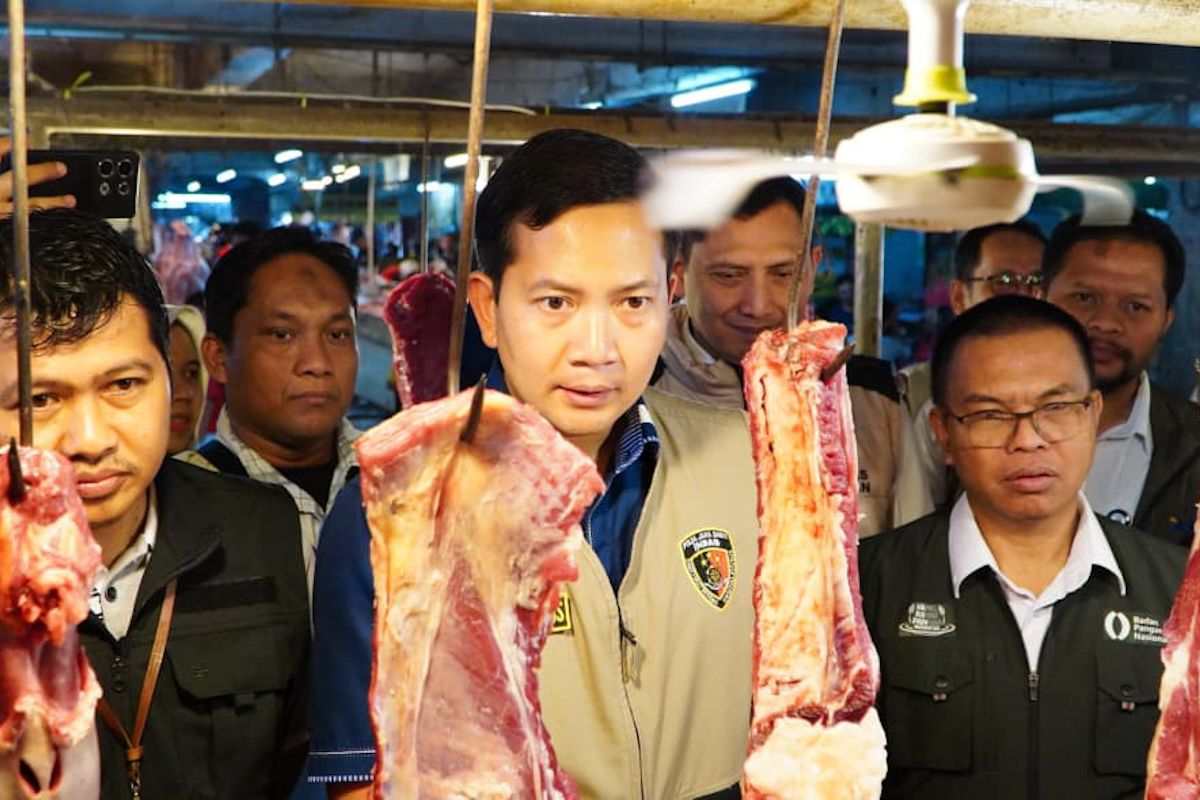
Jakarta—Indonesia’s National Food Agency (Bapanas) has ensured that beef prices at Kosambi Market in Bandung, West Java, comply with the government-set Harga Acuan Penjualan (HAP, or Reference Sales Price) ahead of Eid al-Fitr 1447 Hijriah/2026 to maintain food price stability and consumer purchasing power.
I Gusti Ketut Astawa, Deputy for Food Availability and Stabilisation at Bapanas, stated that beef, a commodity in high demand during the Eid holiday period, continues to be monitored by the government to ensure that price fluctuations remain controlled and stable in the market.
“For this reason, the West Java Food Quality and Safety Task Force (Satgas Saber Pangan) conducted an inspection of Kosambi Market in Bandung, West Java,” Ketut said in a statement received in Jakarta on Sunday.
He said the inspection targeted beef that had previously been reported to have reached Rp160,000 per kilogram.
“However, the facts uncovered revealed that beef traders at Kosambi Market are still selling in accordance with the HAP consumer price level,” he said.
He emphasised that beef sold above the HAP is typically premium-quality meat that falls outside government price regulations, characterised by being free of fat.
Meanwhile, beef regulated under government provisions is standard-quality beef that still has some fat attached to the meat. The beef HAP in accordance with regulations is Rp140,000 per kilogram.
“The price situation here is relatively good, and stock is relatively adequate. In reality, the beef sold by traders is premium beef. However, there is also beef still being sold in accordance with HAP at between Rp130,000 and Rp140,000. This is what concerns us,” Ketut said.
He said that what the task force discovered was that traders at Kosambi Market frequently process beef by cleaning off fat residues. This is done to meet consumer demand.
However, standard-quality beef can still be purchased by consumers at prices regulated by the government.
Wirdhanto Hadicaksono, Director of Special Criminal Investigation at West Java Regional Police (Polda Jabar), stated that the inspection results showed beef prices at Kosambi Market remain in compliance with government regulations, particularly for front leg and hind leg cuts that follow the Reference Sales Price.
He explained that some traders clean the fat (gajih) from beef, resulting in cleaner meat that is then marketed as select or premium-quality beef.
Nevertheless, traders continue to stock standard-quality beef at prices in accordance with the HAP at around Rp130,000 to Rp140,000 per kilogram, ensuring that the public’s needs for various beef quality levels are met.
“So there is consumer demand there for premium meat. It is simply a matter of treatment. The fat is removed, the meat is cleaned more thoroughly, it is selected more carefully, and so on. This is certainly a different matter,” said Wirdhanto.
The West Java Food Quality and Safety Task Force also provided intensive advisories to traders at Kosambi Market to consistently adhere to the selling prices set by the government.
“The goal is clearly to allow the public as consumers to celebrate Eid al-Fitr more peacefully and comfortably without the burden of fluctuating staple food prices,” Wirdhanto said.