
Banyuwangi Accelerates Simultaneous Rice Planting to Anticipate Prolonged Dry Season
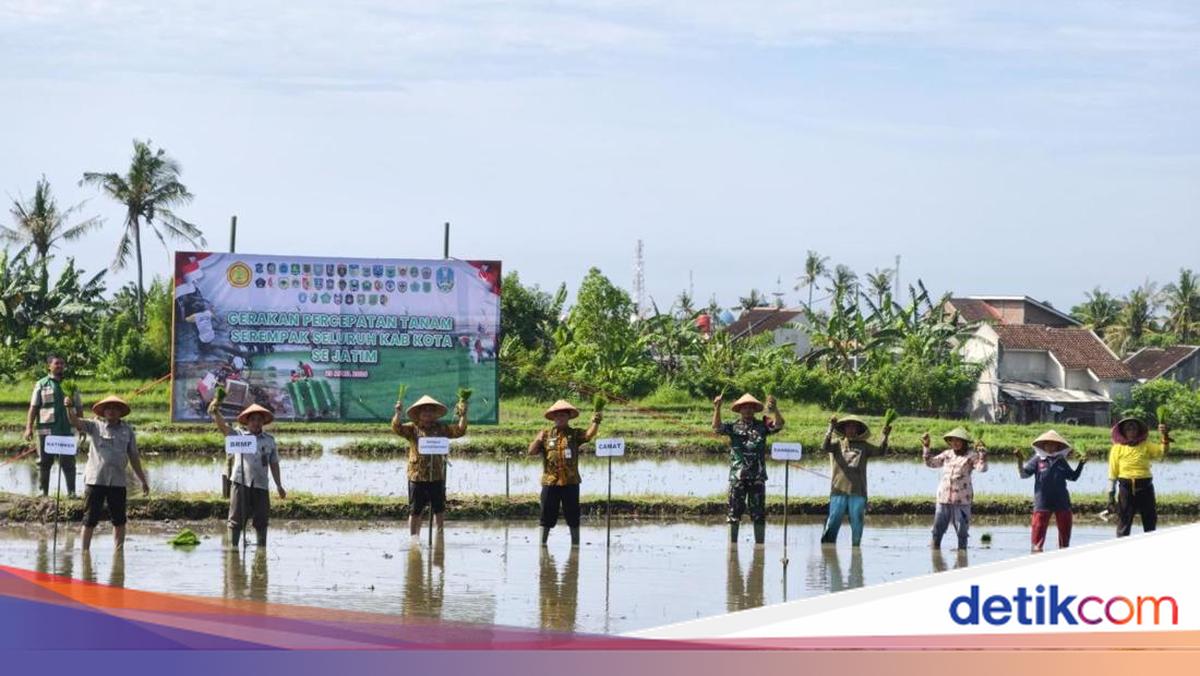
The Banyuwangi Regency government is accelerating rice planting across all regions. The aim is to anticipate facing the potential for a prolonged dry season this year.
Banyuwangi Regent Ipuk Fiestiandani stated that this simultaneous planting movement is a follow-up to the Ministry of Agriculture’s directive, held simultaneously in East Java on Thursday (23/4/2026).
“This is one of the anticipatory measures to face the long dry season by accelerating the planting season before the peak of the prolonged dry season,” said Ipuk in a written statement on Friday (24/4/2026).
Meanwhile, the Head of the Agriculture and Food Service of Banyuwangi, Danang Hartanto, said that in Banyuwangi, the joint rice planting action is centred on the land of the Gunung Saprojo Farmer Group (Poktan), Penganjuran Ward, Banyuwangi Sub-district, covering 2.5 hectares.
“Overall, the area of simultaneous planting in Banyuwangi Regency in this period reaches 672 hectares,” he stated.
This effort is being carried out to support the acceleration of East Java’s Additional Planting Area (LTT) target, which is currently recorded at 46.16 percent or equivalent to 173,320 hectares.
Danang emphasised that the accelerated planting is done by utilising the remaining rainy season, predicted to continue until the end of April.
“We have sent a circular letter to the farmer groups to accelerate the planting period. Because the current water availability is still sufficient to support the initial growth of rice before the water discharge decreases due to the dry season,” he explained.
This appeal responds to the release of the 2026 dry season prediction from the Meteorology, Climatology, and Geophysics Agency (BMKG) as well as the Letter from the Minister of Agriculture of the Republic of Indonesia Number B-73/TI.050/M/03/2026 in order to anticipate the impact of the dry season.
“We urge to increase vigilance and conduct routine monitoring of crop conditions (standing crops) and water source availability in each region,” Danang concluded.