
Banking Sector on Guard Against Rupiah Pressure and Global Turbulence
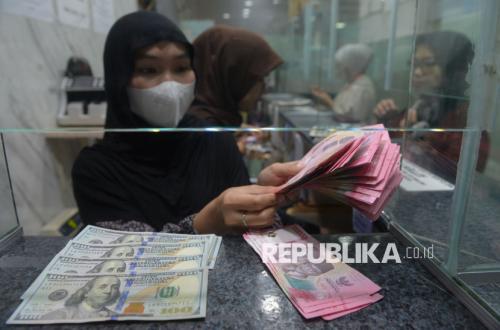
Pressure on the rupiah and the domestic financial market is beginning to concern the banking industry. Amid global uncertainties, major banks are opting to strengthen their business fundamentals while maintaining optimism about national economic growth.
Permata Bank’s Chief Economist, Josua Pardede, stated that the current global turbulence is not only triggered by trade wars but also by Middle East conflicts that directly impact energy prices, financial markets, and global capital flows.
According to him, these conditions are causing global investors to shift funds to safe-haven assets and putting pressure on the currencies of emerging countries, including the rupiah.
“The main theme is actually not that the rupiah is the only currency weakening against the US dollar, but rather the global conditions that are under pressure,” Josua said during an economic briefing by the Permata Institute for Economic Research on Tuesday (12/5/2026).
As of early May 2026, the rupiah has weakened by around 3.9% year-to-date. Meanwhile, foreign capital outflows from the domestic stock market continue due to high global uncertainties and investor concerns about domestic market conditions.
Permata Bank assesses that this pressure needs to be heeded as it can affect inflation, energy import costs, and the government’s fiscal space. The Middle East conflict, which has pushed global oil prices above 100 US dollars per barrel, is seen as potentially eroding people’s purchasing power if it persists.
Nevertheless, Josua believes Indonesia’s domestic economy still has resilience, supported by strong public consumption and relatively robust domestic demand.
“What business actors hope for is not the rupiah at a certain level, but exchange rate stability,” Josua said.
A similar view was expressed by Bank Central Asia (BCA). BCA’s Executive Vice President for Corporate Communication and Social Responsibility, Hera F Haryn, said that current market volatility is still influenced by global dynamics and investor sentiment.
Therefore, the financial services industry is deemed to need to continue strengthening coordination with the government and regulators to maintain market stability.
“In principle, share price fluctuations in the capital market are influenced by various factors, including global dynamics, geopolitical conditions, and market sentiment,” Hera told Republika.