
Banking Credit in Bali Grows Nearly 7 Percent
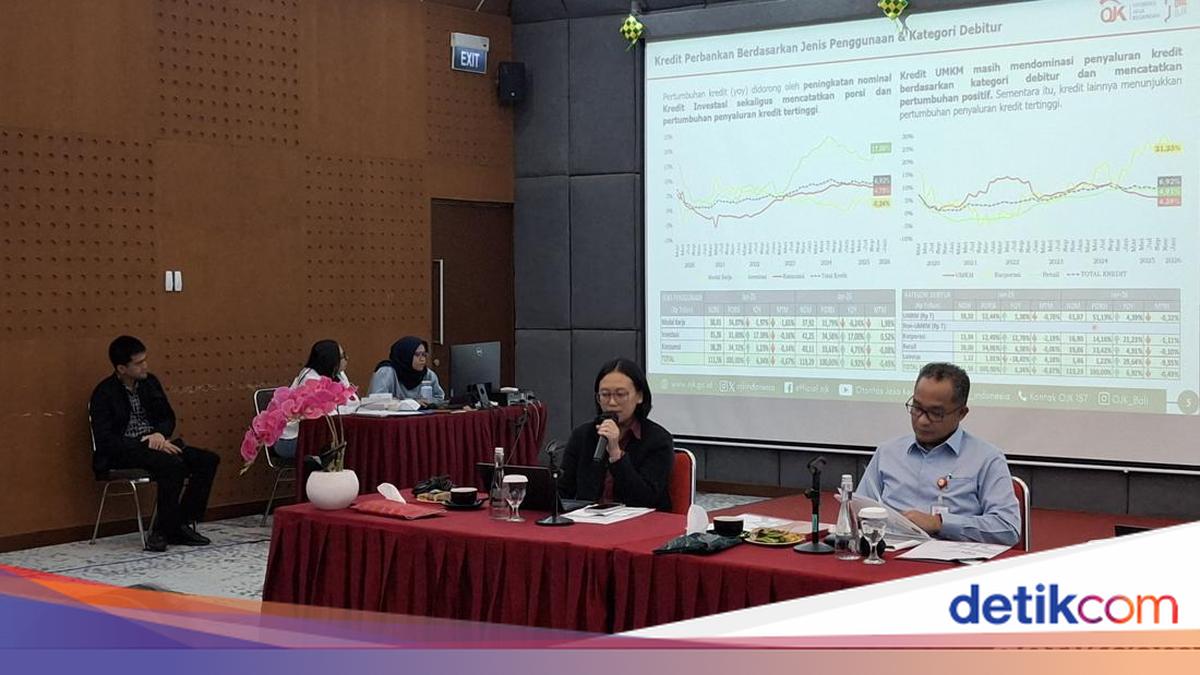
The banking industry in Bali recorded growth in January 2026. Several key indicators showed positive trends, from credit growth to banking credit quality.
Head of the Financial Services Authority (OJK) Bali Province Division 3 Supervision, Ni Made Novi Susilowati, stated that overall, the banking conditions in Bali remain in the good category.
“Overall, the performance of banking in Bali can be seen from credit growth, then fund growth, intermediation function, and credit performance. Well, if we look at this credit growth, it’s still okay, still good,” she told the media at the OJK Bali Province office on Friday night (10/4/2026).
Based on January 2026 data, credit growth in Bali, for both general banks and Rural Credit Banks (BPR), was recorded at 6.92 percent year-on-year (yoy). When reviewed based on project locations, the growth even reached 7.11 percent year-on-year (yoy).
Novi explained that the banking intermediation function in Bali is still running well. This is reflected in the loan-to-deposit ratio (LDR) at 58.38 percent in January 2026.
“This is how the intermediation function works, the bank’s ability to collect funds and then channel them back in the form of productive assets, in the form of credit. This figure reaches 58.38 percent in January 2026,” she added.
In addition to good credit performance growth, the credit quality of banking in Bali also showed improvement. The ratio of problematic credit or non-performing loan (NPL) was recorded to decrease from 3.14 percent in January 2025 to 2.6 percent in January 2026.
“In terms of quality, it’s still well maintained. The NPL ratio even dropped from the previous 3.14% to 2.6% in January 2026. In January 2025, it was recorded at 3.14%,” she clarified.
Meanwhile, banking capital remains strong with capital adequacy ratios (CAR) at 15.17 percent and 33.37 percent respectively.
Viewed by type of use, credit in Bali is still dominated by investment credit. The accommodation provision, food and drink, and real estate sectors became the main supports for that growth.
“It seems still the same as previous periods in investment credit, and especially supported by the accommodation, food and drink provision sector and real estate,” she revealed.
Credit distribution is also still dominated by the MSME sector with a portion reaching 51.19 percent. MSME credit was recorded to grow by 4.39 percent year-on-year (yoy).
Based on economic sectors, the largest credit distribution was in the non-business field category at 33.63 percent, followed by the wholesale and retail trade sector at 27.31 percent. Meanwhile, the accommodation and food and drink provision sector became the main contributor to credit growth in Bali.
Among current accounts, savings, and deposits which are third-party funds (DPK), savings became the largest contributor with a portion of 54 percent of total banking DPK in Bali.