
Bank Indonesia on Alert Round the Clock to Shield Rupiah from Dollar Onslaught
Pressure on the rupiah exchange rate against the US dollar that is currently occurring has prompted Bank Indonesia (BI) to strengthen its policies to maintain exchange rate stability in the financial markets.
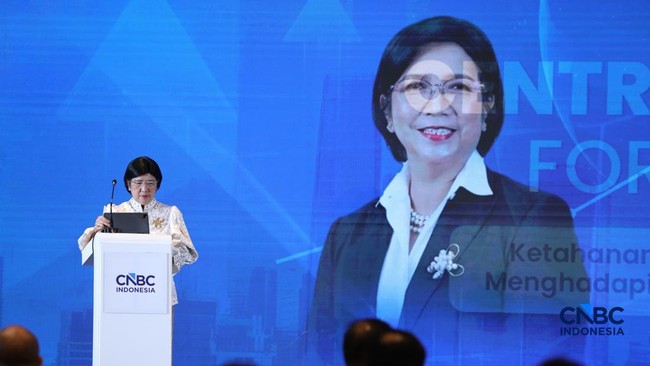
Senior Deputy Governor of Bank Indonesia (BI) Destry Damayanti said the central bank continues to optimise all monetary policy instruments to maintain the stability of the rupiah’s movement against the US dollar.
“In a measured manner, BI will continue to enter the market, spot, NDF, DNDF, we will also expand the participant base later for NDF outside. Today the NDF is flying above Rp17,100/US$. There are no real transactions there yet,” said Destry at the Central Banking Forum 2026 CNBC Indonesia event on Monday (13/4/2026).
In fact, BI’s intervention policy steps abroad, according to Destry, are now on standby 24 hours. This means BI can at any time take measured steps to maintain the rupiah’s exchange rate movement against the US dollar in various countries.
“So BI 24 hours, because for example when the Singapore market opens, we are open too. We close at 3 pm, Europe market is still running. At 9 am US, America opens, we are alert, we optimise branches abroad in London and New York. But while we maintain liquidity,” said Destry.
As is known, the rupiah exchange rate opened weaker against the US dollar on the first trading day of the week, Monday (13/4/2026), in line with the strengthening of the US dollar in the global market.
Referring to Refinitiv data, the Garuda currency started trading in the red zone at Rp17,100/US$ or depreciated by 0.09%. This weakening occurred after on the last trading day, Friday (10/4/2026), the rupiah also closed slightly weaker by 0.03% to Rp17,085/US$.
On the other hand, the US dollar index (DXY), which measures the strength of the greenback against six major world currencies, at 09:00 WIB was observed to strengthen 0.37% to 99.010.
The rupiah’s movement in today’s trading is expected to still be influenced by external sentiment, especially the strengthening of the US dollar in the global market.
The US dollar surged against major world currencies as investors returned to hunting safe-haven assets after lengthy talks between Washington and Tehran did not yield a peace agreement. This condition has left the market overshadowed by uncertainty that has lasted into the seventh week.