
Bank Indonesia narrows the gap in financial literacy and inclusion through the AKSI KLIK programme
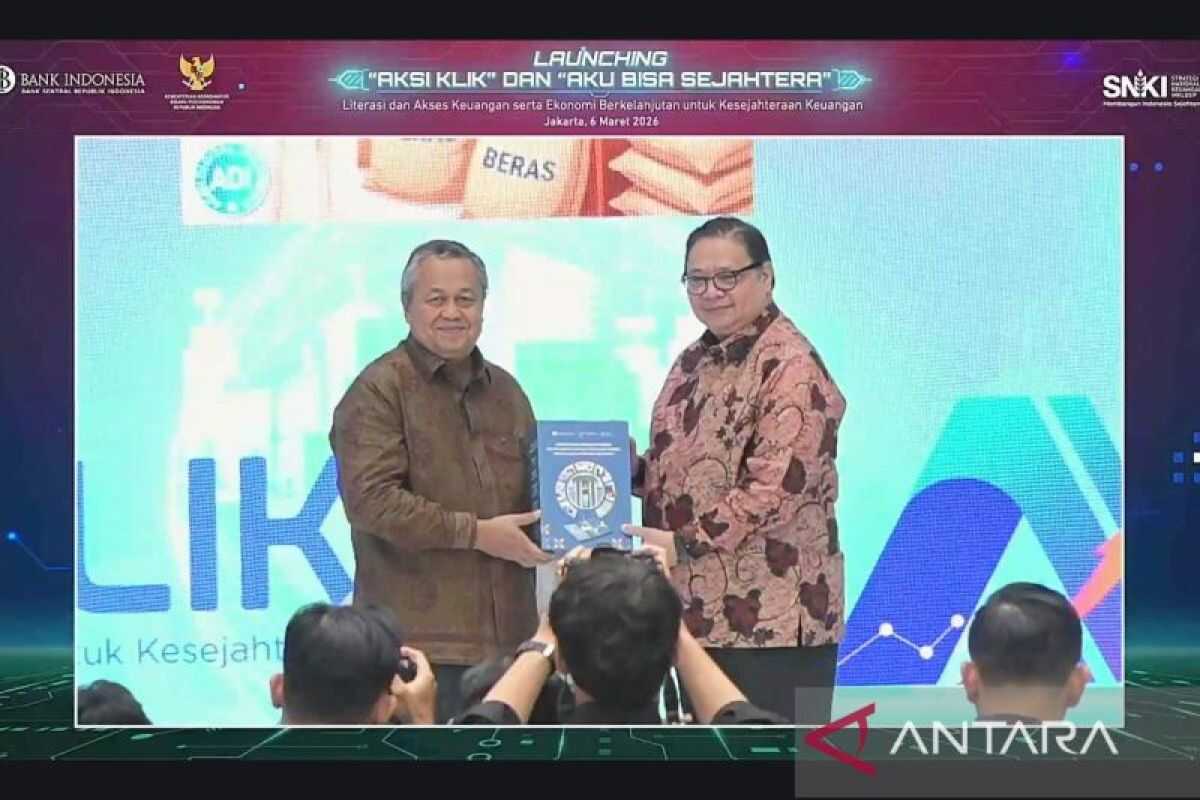
The problem is not merely whether people can use accounts, QRIS, or other financial services, but how literate they are.
Jakarta (ANTARA) – Bank Indonesia (BI) launched the programme Aksi Kuatkan Literasi dan Inklusi keuangan untuk Kesejahteraan (AKSI KLIK) to narrow the gap in financial literacy and inclusion among the public amid rapid digitalisation of financial services.
“Increasing financial inclusion should ideally be accompanied by an improvement in financial literacy. The problem is not only that people can access products such as accounts and QRIS, but how literate they are,” said Governor Perry Warjiyo at the AKSI KLIK and AKU BISA SEJAHTERA launch, attended online in Jakarta on Friday.
Referring to the 2025 National Survey on Financial Literacy and Inclusion (SNLIK), the level of financial inclusion in Indonesia is higher than the level of financial literacy.
If calculated using indicators of financial products and payments under the supervision of the OJK and BI and including products from BPJS and other financial service institutions, the inclusion index reaches 92.74 percent. By contrast, the literacy index remains at 66.64 percent.
Perry underlined the importance of boosting financial literacy in the face of rapid digitalisation of financial services. In his view, literacy is needed so that people not only access financial products but also understand risks and are protected from various digital crimes, including illegal online lending.
In this context, BI continues to push up financial literacy and inclusion through a range of programmes, both internally and in synergy with the Coordinating Ministry for Economic Affairs, OJK, banks, and other relevant ministries and agencies.
These efforts accompany the acceleration of digitalisation in the payments system, including the implementation of the Quick Response Code Indonesian Standard (QRIS), BI-Fast, and others.
“QRIS is now being used on a nearly massive scale this year, with users approaching 60 million. Around 50 million of these users are MSMEs. Therefore, the acceleration of payments digitalisation must be balanced with strengthening financial literacy,” Perry said.
As part of AKSI KLIK, BI has prepared three books: a strategy and education programme for digital financial literacy towards financial wellbeing, a guide module for digital financial education for basic training, and guidelines for implementing a sustainable MSME business model.
Anastuty K., Head of BI’s Department of Inclusive and Green Economy, explained that the first book emphasises three main targets for achieving financial wellbeing: meeting financial needs and obligations, financial resilience, and financial sustainability.
Meanwhile, the second book targets seven priority segments, including MSMEs; low-income communities (MBR); pupils, students, santri, and youths; welfare recipients; people in 3T areas; women; and migrant workers.
Contents cover money, budgeting, financial transactions, financial products and services, and protection against financial risks.
The third book refines BI’s Green MSME Development Guidelines launched earlier, aligned with Indonesia’s Sustainable Finance Taxonomy (TKBI) version 3.
The latest book focuses on mitigation actions to help MSMEs transition to more sustainable business practices. Through these guidelines, it is hoped that MSMEs will understand sustainability standards, improve chances of green certification, and broaden access to green financing from the banking sector.
At the same event, BI also launched Financial Access through Business Matching and Literacy for Financial Well-being (AKU BISA SEJAHTERA).
Anastuty explained that the programme is motivated by a slowdown in credit disbursement to the MSME sector. Latest data show that MSME credit growth contracted by as much as minus 0.53 percent.
She noted the decline is driven by two factors: on the supply side, banks have been more cautious in lending, particularly to micro-sector; on the demand side, weakening purchasing power among the lower-income groups has led MSMEs to restrain expansion and refrain from taking on more debt.
Through the AKU BISA SEJAHTERA programme, BI aims to facilitate financing matching between MSMEs and financial institutions.
Anastuty said the activities will be carried out intensively from this month until August, involving a range of ministries and agencies that oversee MSME programmes.