
Bank Indonesia Governor's Lament: 2025 Is a Very Difficult Year
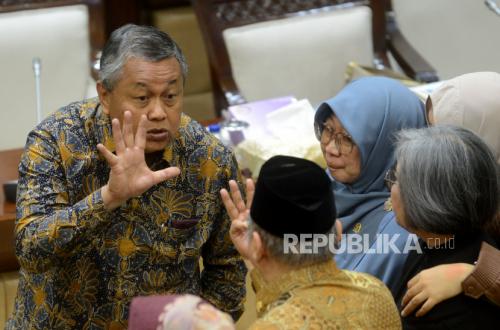
REPUBLIKA.CO.ID, JAKARTA – Bank Indonesia Governor Perry Warjiyo presented a report on economic developments and BI’s policy mix for 2025 to Commission XI of the House of Representatives (DPR RI) on Wednesday (8/4/2026). Perry stated that 2025 has become a difficult year, impacted by the implementation of the United States’ (US) reciprocal tariff policy.
“2025 is indeed a year that for us (BI) is very difficult, particularly since we celebrated Eid al-Fitr last year (1446 Hijri/2025 CE). While we were travelling home for the holidays, US President Donald Trump announced a unilateral tariff policy called reciprocal tariffs,” Perry said during his presentation at the Working Meeting with Commission XI of the DPR RI at the DPR RI complex on Wednesday (8/4/2026).
Perry explained that the US reciprocal tariff policy has completely altered global conditions, affecting Indonesia’s economy. This also impacts BI in fulfilling its mandate under the Law to maintain rupiah stability while promoting economic growth.
“The global economy in 2025 is indeed shrouded in uncertainty, influenced by escalating trade wars and ongoing geopolitical tensions,” he said.
He elaborated that the world economy in 2025 moved stagnantly around 3.3 per cent, the same as in 2024 and 2023. In 2025, not only was growth stagnant, but fragmentation also increased.
US economic growth was only 2.2 per cent in 2025, lower than the previous year’s 2.8 per cent. China’s economic growth remained stagnant at 5 per cent. The ASEAN-5 economies (including Indonesia) also slowed from 4.6 per cent in 2024 to 4.4 per cent in 2025.
“Then, regarding inflation, in 2025 it should have declined faster, but due to the tariffs, global inflation in 2025 fell from 4.9 per cent to 3.5 per cent. It should have been lower still,” Perry said.
This restrained decline in inflation is seen to affect the speed of interest rate reductions, which were slower than expected, although global policies remained generally accommodative. For example, the ECB paused at interest rates of 2.5 and 2 per cent since the second quarter of 2025. The US Federal Reserve, initially expected to be more aggressive, also proceeded more slowly.
“The next impact is the volatility of capital flows to and from emerging markets. From early February to April or May, there was a wave of outflows from emerging markets, both in stocks, bonds, and other instruments,” he said.
This situation made policy implementation in emerging market countries by central banks more complex. For BI itself, carrying out pro-stability and pro-growth tasks certainly became more challenging.
“One, how to balance stability and growth; we cannot focus only on growth because global pressures threaten stability in various countries. Two, how quickly capital policies adjust because there are interconnected impacts. Three, regarding exchange rate stability and capital flows,” he explained.
Amid these various challenges, Perry expressed gratitude that Indonesia’s economic conditions remained relatively good. The economy grew by 5.11 per cent in 2025, with fourth-quarter 2025 growth reaching 5.39 per cent.
The drivers of Indonesia’s economic growth were consumption, accounting for about two-thirds, including private consumption and various sources related to investment. Exports also experienced fairly positive growth of around 7.8 per cent.
In 2025, Perry also noted that BI managed to maintain foreign exchange reserves. Recorded at the end of 2025, Indonesia’s foreign exchange reserves stood at $156.5 billion, higher than the end-of-2024 position of $155.7 billion.
“In essence, amid global turbulence, we are grateful that overall our economic growth is still quite good, inflation and exchange rate stability are relatively controlled, and foreign exchange reserve resilience is still adequate. For 2026, we still project economic growth of 4.9–5.7 per cent,” he emphasised.