
Bank Indonesia Commits to Advancing Financial Literacy and Inclusion in Indonesia
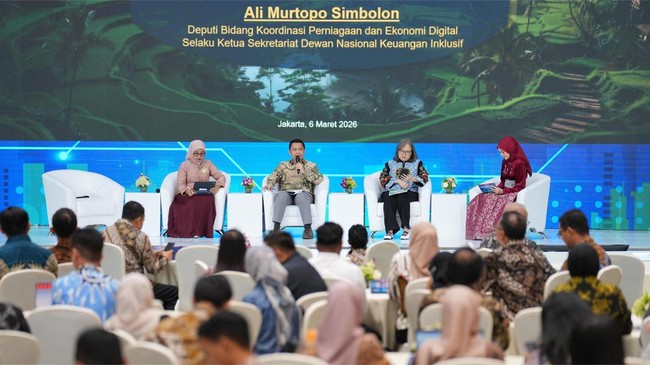
Bank Indonesia (BI) together with the government continues to strengthen financial literacy and inclusion as a foundation for improving public welfare, especially for micro, small, and medium-sized enterprise (MSME) operators. To develop financial literacy, BI has published three digital financial literacy guidebooks and launched the Access to Finance through Business Matching and Financial Literacy for Wellbeing (AKU BISA SEJAHTERA) initiative alongside the Action to Strengthen Financial Literacy and Inclusion for Wellbeing (AKSI KLIK) programme.
These initiatives form part of BI’s efforts to strengthen public understanding of financial services whilst expanding access to financing, particularly for MSME operators.
BI Governor Perry Warjiyo explained that according to the 2025 National Survey on Financial Literacy and Inclusion (SNLIK), the national financial inclusion rate reached 92.74 per cent. However, this figure still needs to be increased to achieve the 2045 target of 98 per cent.
“The challenge is to increase financial inclusion and ideally this should be balanced by improvements in financial literacy,” said Perry at the AKSI KLIK event on Friday, 6 March 2026.
Perry stressed that financial literacy is crucial to ensure the public not only accesses financial products, but also understands their benefits, risks and consumer protections. He noted that poor understanding of financial products makes the public vulnerable to various financial crimes, including illegal lending and digital fraud.
“The issue is not merely about opening accounts or using QRIS and so forth. The main thing is also protecting people from various crimes,” he said.
According to Perry, improving financial inclusion should ideally be matched with improvements in financial literacy. It is not simply about the public having many accounts or knowing how to use QRIS, but also understanding how to utilise financial services wisely.
The 2025 SNLIK shows Indonesia’s current financial literacy rate stands at only 66.46 per cent. For this reason, Perry believes that synergy amongst stakeholders is vital to improve public understanding of financial products and services.
“Strengthening financial literacy forms part of efforts to support the acceleration of Indonesia’s payment system digitalisation, including through QRIS and BI-Fast,” Perry said.
The Importance of Strengthening Financial Literacy and Inclusion
Government efforts to promote financial literacy and inclusion continue. It is unsurprising that financial literacy and inclusion rates in 2025 have increased. This can be seen from the results of the 2025 National Survey on Financial Literacy and Inclusion (SNLIK), which shows an increase in the financial literacy index to 66.46 per cent and the financial inclusion index to 80.51 per cent. The 2025 SNLIK results represent an improvement compared to the 2024 SNLIK, which showed a financial literacy index of 65.43 per cent and a financial inclusion index of 75.02 per cent.
Even Coordinating Minister for Economic Affairs Airlangga Hartarto noted that Indonesia’s current financial inclusion achievement has exceeded the average of developed OECD nations. Nevertheless, he believes that public financial literacy levels still need to be improved so that people not only have access to financial services, but are also able to manage their finances wisely.
According to him, financial literacy is important for helping people understand risks, manage cash flow, and plan their finances for the future.
“Nearly 97 per cent of our workforce work in micro, small, and medium-sized enterprises (MSMEs), which presents a challenge because we must encourage MSMEs to provide workers whose salaries can increase,” he said.
For this reason, Airlangga said the government will continue to promote various financial education programmes whilst expanding access to financing for business operators, particularly MSMEs.
Formation of the National Council for Financial Wellbeing
Deputy for Coordination of Commerce and Digital Economy at the Coordinating Ministry for Economic Affairs and Chair of the Secretariat of the National Council for Inclusive Finance (DNKI), Ali Murtopo, said the government is currently preparing a number of strategies to strengthen the resilience and financial wellbeing of the public. One of these is through plans to establish a National Council for Financial Wellbeing (DNKK).
Ali explained that the government has completed a draft government regulation concerning the formation of a National Committee for Financial Inclusion and Literacy. However, in accordance with the President’s directive, this policy will be transformed into a National Council for Financial Wellbeing.
“Currently the process is still in the stage of cross-ministerial and inter-agency discussions with public participation. We hope it can soon be submitted to the State Secretariat to obtain Presidential approval,” he said.
Concrete Actions by BI to Promote Financial Literacy and Inclusion
BI’s efforts to promote financial literacy and inclusion are strengthened through strong cooperation and synergy amongst various parties, both government and private sector.
This was stated by the Head of the Department of Inclusive and Green Financial Economics at Bank Indonesia, Anastuty Kusumowardhani.
She said Bank Indonesia cannot work alone in supporting financial inclusion and literacy, despite having 46 regional offices.
“It is important for us to work comprehensively and there should be a map to identify which areas still have gaps and which need to be filled so that the gap between financial inclusion and literacy can narrow and we can achieve the 2045 targets set in the National Medium-Term Development Plan,” said Anastuty.
Strengthening financial inclusion and wellbeing is expected to serve as a foundation for improving household economic resilience whilst supporting efforts to alleviate poverty in Indonesia. For this reason, BI has launched AKSI KLIK and formalised the Access to Finance through Business Matching and Financial Literacy initiative.