
Bandung Faces Major Earthquake Threat from Lembang Fault, Here Are the Critical Points
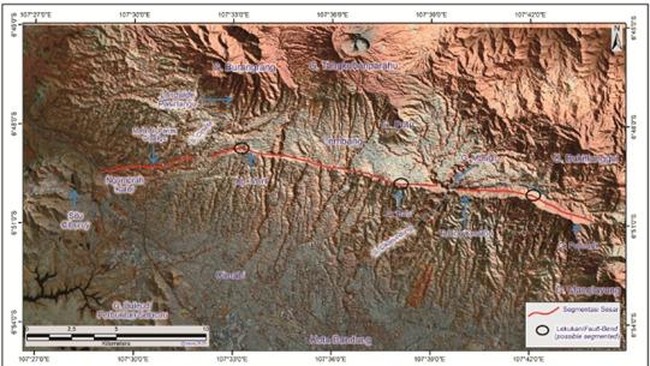
The greater Bandung region faces the potential threat of a major earthquake measuring approximately 6.5-7.0 magnitude from activity on the Lembang Fault. This active fracture, which extends nearly 29 kilometres along the northern edge of Bandung, has become the focus of geological researchers due to its complex characteristics and proximity to densely populated areas.
The Geological Agency of the Ministry of Energy and Mineral Resources disclosed this during a webinar entitled “Comprehensive Analysis of the Lembang Fault Based on Geology and Geophysics for Earthquake Mitigation” held recently. The discussion examined the latest survey results on the condition of the Lembang fault and disaster mitigation efforts in the greater Bandung region.
Edy Slameto, Head of the Geological Survey Centre at the Geological Agency, stated that the agency conducted integrated geological and geophysical surveys in late 2025 to study the Lembang Fault’s characteristics in greater depth. The research combined various methodologies, ranging from remote sensing and field surveys to subsurface analysis.
According to the official ESDM website, the survey employed various geophysical methods, including Ground Penetrating Radar (GPR), geoelectric, detailed geomagnetic surveys, and deeper geophysical methods such as gravity surveys and microseismic monitoring. This approach was undertaken to map fault structures more accurately.
Based on the findings, the Geological Agency has divided the Lembang Fault into three main segments: the western segment, the central segment, and the eastern segment.
The western segment exhibits fault characteristics that are relatively steep at the surface but tend to dip southward at greater depths. The central segment shows fault structures that are also steep but possess different geological characteristics compared to the western segment.
The eastern segment displays a more complex pattern. Data indicates the possible existence of two dip patterns: dipping northward near the surface but becoming steeper at greater depths.
Researchers also highlighted that earthquake risk in the Lembang Fault area stems not only from the primary shock but also from secondary hazards such as ground movement and surface fracturing. These conditions are considered similar to those around the Cugenang Fault, which triggered the 2022 Cianjur earthquake. The area shares similar geological conditions, being composed of relatively fragile young volcanic debris material.
Beyond geological factors, the vulnerability of earthquake-resistant buildings and insufficient mitigation measures can significantly amplify the impact of any future earthquake.
Consequently, the Geological Agency emphasises the need for serious disaster risk reduction efforts in the area surrounding the Lembang Fault, particularly through enhanced earthquake mitigation and increased public awareness of geological hazards in the greater Bandung region.