
Bandung City Government Considers Becoming a Waqf Provider, Grand Mosque of Bandung to Serve as Historical Reference
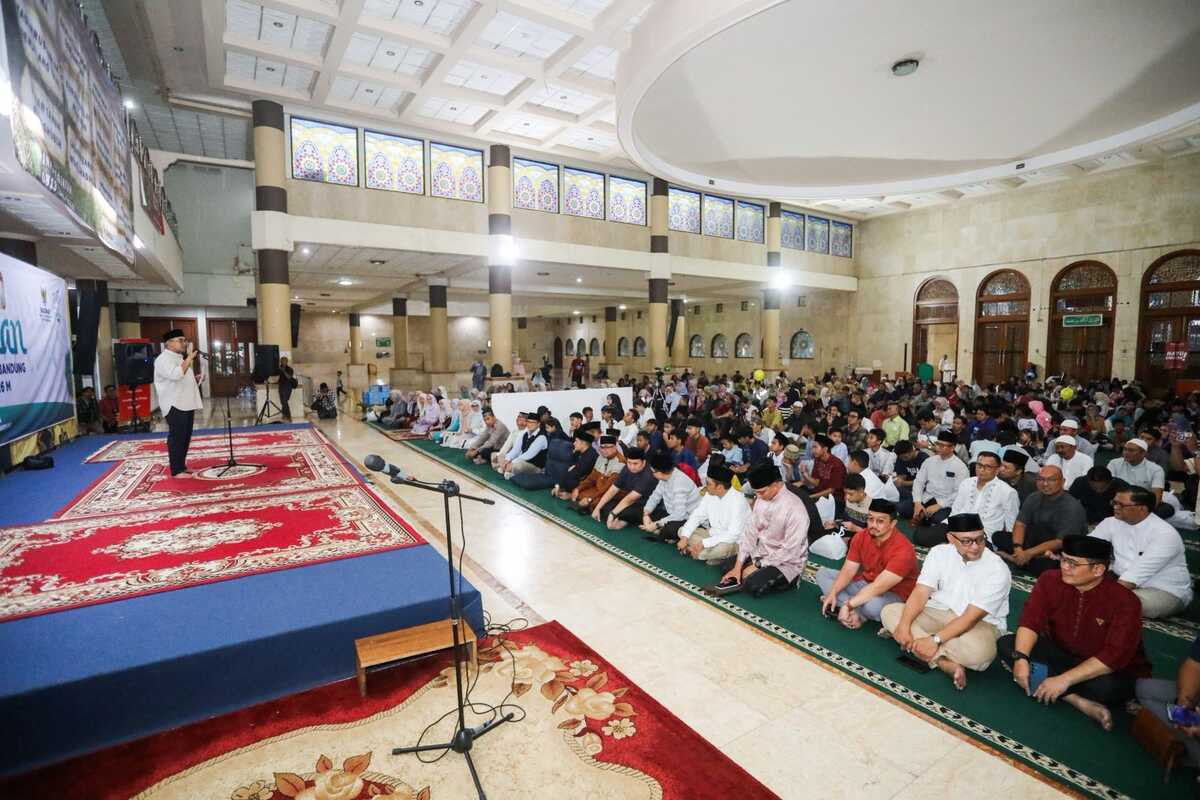
After the West Java Provincial Government ceased financial support for the Bandung Grand Mosque in January 2026, the Bandung City Government is now considering becoming a formal waqf provider in accordance with regulations.
Bandung Mayor Muhammad Farhan stated during a Ramadan visit to the Bandung Grand Mosque on Wednesday (February 25th) that the mosque serves as a prime example of waqf with strong historical and jurisprudential foundations. The land and building were originally donated by the Regent of Bandung for the benefit of the community.
“This mosque is one of the clearest examples of waqf. The land and the mosque were donated by the Regent of Bandung for the community. For over 200 years, the function of this waqf land has remained unchanged. The current administrator is also related to the original donor family,” he explained.
Farhan added that this is what encourages the Bandung City Government to explore the possibility of the government acting as a waqf provider, especially for assets used for places of worship. He cited the Istiqamah Mosque, which stands on land owned by the Bandung City Government, as an example. Due to the limitations of grant regulations and waqf mechanisms, the government still collects rent for the land.
“It feels inappropriate for the government to collect rent on land used for a place of worship. But we cannot violate the regulations,” he said.
According to Farhan, the issue is not about intention, but about regulations. Donating government assets is not easy, while the scheme of government waqf has not been fully clarified. Therefore, he wants to ensure that it is legally permissible for the government to become a waqf provider without violating regional asset management rules. “If the government is allowed to become a waqf provider, that would be interesting. But it must be studied in accordance with existing regulations,” he explained.
Farhan hopes that this study will not disrupt the status of the Bandung Grand Mosque. Instead, the mosque should serve as a reference for formulating future policies. If this study finds a strong legal basis, the government can be more flexible in supporting religious facilities without being hindered by administrative issues.
“I am also committed to continuing to revitalize and prosper the Bandung Grand Mosque through a series of Ramadan activities, which are also part of an effort to strengthen the function of the mosque as a center for the community in the heart of Bandung,” he said.
Farhan said that the enthusiasm of the community in the Ramadan program shows a positive trend. Even though it is held on a working day, the number of attendees remains high and comes from various sub-districts. During congregational prayers, the rows formed are still about two to three rows. However, this is actually a motivation for the government to continue to activate the mosque revitalization program.
“The Ramadan program will continue for 30 full days during Ramadan. The City Government wants to ensure that the Grand Mosque is not only crowded at certain moments, but is active on an ongoing basis,” he added.
After Eid al-Fitr, Farhan hopes that the administrators of the Grand Mosque can submit proposals for community programs. These programs can include regular study groups, social activities, education, and community empowerment based at the mosque. The Bandung Grand Mosque has a strategic position, not only as a place of worship, but also as a symbol of the spiritual life of the people of Bandung. Its location in the Alun-alun area makes it the center of community activity.