
Bamsoet Emphasises the Importance of Building Leadership from a Young Age
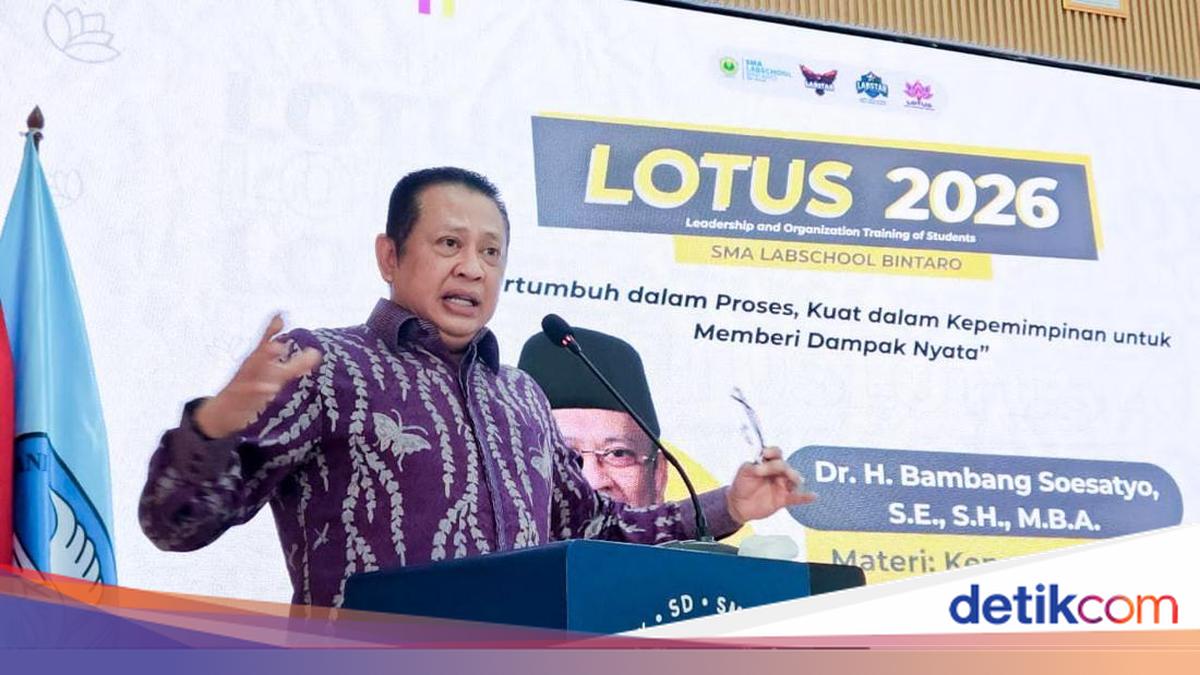
Member of the Indonesian House of Representatives Bambang Soesatyo (Bamsoet) has emphasised the importance of building leadership from a young age as the foundation for facing 21st-century challenges. The youth are deemed not to suffice with academic excellence alone, but must also possess vision, decision-making capabilities, and strong integrity amid global dynamics.
He conveyed this during his speech at the Leadership and Organizational Training of Students (LOTUS) 2026 event at SMA Labschool Bintaro on Thursday (23/4).
According to the World Economic Forum 2025 report, strategic thinking and leadership are two of the ten primary skills that future generations must possess. In line with this, Bamsoet stressed the importance of forming leadership from an early stage.
“Leadership is not something that suddenly emerges when someone holds a position. Leadership is instead formed from a young age, from school benches, from the simple things we do every day,” he stated in a written remark on Thursday (23/4/2026).
He explained that visionary leadership is the primary element that must be instilled in the youth to enable them to formulate the future and mobilise others towards common goals.
Based on data from the Central Statistics Agency (BPS) for 2025, the number of Indonesian youth reaches 66 million people, holding great potential to become the driving force of national development. However, this potential requires sustained nurturing through character education and organisational experience.
“A good leader is one who has vision, has a clear picture of the future to be achieved, and is able to invite others to move together towards that goal,” said Bamsoet.
Bamsoet also emphasised integrity and ethics as the main pillars of leadership. According to him, public trust, including in small scopes like schools, is greatly determined by the consistency between words and actions. The current crisis of trust phenomenon shows how vital integrity is as social capital.
“Integrity is simple, the alignment between what we say and what we do. If a leader lacks integrity, trust will disappear on its own,” he revealed.
He added that ethics in leadership is reflected through attitudes of respecting others, being fair, and serving as a role model. Leadership oriented solely on power is deemed no longer relevant in the modern era.
Conversely, a leadership approach that prioritises moral values and exemplarity has proven more effective in building trust and solidarity, both in educational environments and in wider society.
“A leader is someone willing to sacrifice time, wealth, and feelings. A leader must also be able to read what is not written and hear what is not spoken,” Bamsoet concluded.