
Bamsoet Discusses Competitive Intelligence and SOE Reputation
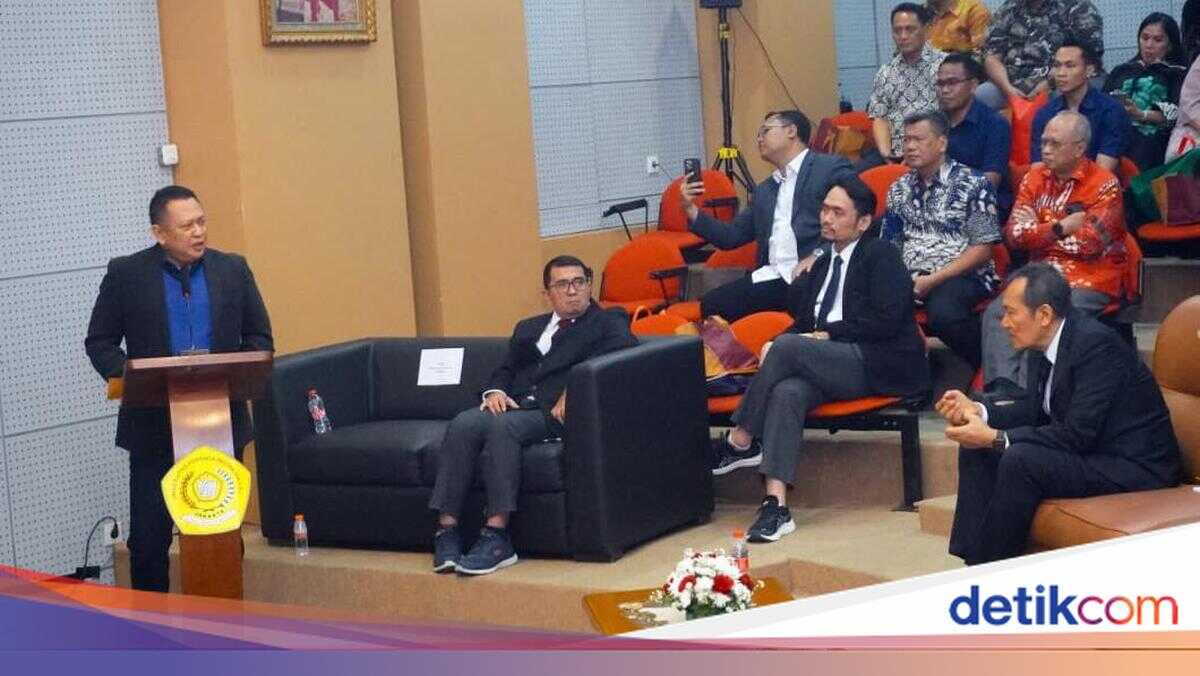
Member of the House of Representatives Bambang Soesatyo (Bamsoet) has emphasised that strengthening competitive intelligence must become a priority agenda in the transformation of state-owned enterprises (SOEs).
Amid the rapid flow of digital information and mounting public criticism of corporate governance, SOE reputation has been identified as a determining factor in business sustainability as well as social legitimacy as managers of state assets.
“SOE reputation is a mirror of the people’s trust in the state. When reputation is disrupted, the impact can extend to investor confidence, market stability, and the social legitimacy of the enterprise,” said Bamsoet in a statement on Thursday (19/2/2026).
“Therefore, SOEs must have a competitive intelligence system capable of reading public sentiment quickly and accurately,” he added.
Bamsoet made the remarks in his address at the Doctoral Promotion Examination in Management Science for Saut Situmorang at Universitas Persada Indonesia Y.A.I. on Wednesday (18/2).
Saut successfully defended his dissertation with distinction, titled ‘The Influence of Competitive Intelligence, Learning Organisation and Competence on Organisational Commitment and Its Implications for Employee Performance at PT Telkom’.
Bamsoet explained that SOE reputation has been under continuous scrutiny in recent years. The case of alleged corruption in the governance of crude oil and refinery product imports at Pertamina, estimated to have caused state losses of up to Rp 285 trillion, serves as a valuable lesson in how governance crises directly affect public perception.
In the digital space, the issue triggered a wave of widespread criticism and significantly affected the corporate image.
“Major cases that emerge must serve as a stern warning. Do not wait for a crisis to escalate before taking action,” said the 20th Speaker of the House of Representatives.
“With competitive intelligence, companies can detect potential issues early, understand media coverage patterns, and prepare data-driven responses before public opinion forms unchecked,” he added.
Bamsoet explained that competitive intelligence in the SOE context is not merely about monitoring business competitors. It also encompasses reputation risk mapping, public perception analysis, and measurement of corporate communication effectiveness.
A PERHUMAS Indicators survey showed that the public rates SOE innovation levels below those of the private sector, at approximately 69% compared to 75.5%. These figures indicate that improvements are still needed in building an image as adaptive and modern corporations.
“Reputation is not built through short-term efforts. Reputation grows from consistent governance, transparency, and the courage to open data to the public. Competitive intelligence must become the foundation of reputation risk management at every SOE,” stressed the Deputy Chairman of the Golkar Party.
Bamsoet added that SOE digital transformation must be accompanied by public communication transformation. In an era where more than 210 million Indonesian citizens are connected to the internet and social media has become the primary space for opinion formation, every corporate policy can be immediately tested by the public.
SOEs that are able to utilise digital sentiment analysis, media monitoring, and public opinion mapping will be better prepared to maintain the stability of their reputation.
“SOEs manage the people’s assets and hold a strategic role in the national economy. Therefore, building reputation through a measured and data-driven approach is imperative,” explained the Chairman of the Board of Trustees of the Padjadjaran University Doctoral Law Alumni Association.
“With strong competitive intelligence, SOEs will be more resilient in facing crises and increasingly trusted by the public,” he added.
The doctoral promotion ceremony was also attended by former Head of the State Intelligence Agency Lieutenant General (Ret.) Marciano Norman, former Corruption Eradication Commission (KPK) Chairman Abraham Samad, former KPK Chairman Agus Rahardjo, former KPK Commissioner Basaria Panjaitan, as well as former KPK Deputy Chairmen Alexander Marwata and Laode Muhammad Syarif.