
Balikpapan RDMP and Tanjung Batu Fuel Terminal Integration Boosts Efficiency
The Downstream Oil and Gas Regulatory Body (BPH Migas) has stated that the integration of the Refinery Development Master Plan (RDMP) Balikpapan and the Fuel Terminal (FT) Tanjung Batu in East Kalimantan can enhance efficiency and energy resilience.
Erika Retnowati, a member of the BPH Migas Committee, explained in Jakarta on Saturday that fuel distribution from Pertamina’s Balikpapan Refinery has entered a new phase, moving away from the previous ship-to-ship (STS) transfer method where fuel was transferred between vessels at sea.
Currently, fuel is transmitted through submarine pipelines to Tanjung Batu Fuel Terminal for subsequent distribution to various regions across Indonesia. This transformation makes fuel distribution more efficient and directly integrated from refinery to receiving terminal.
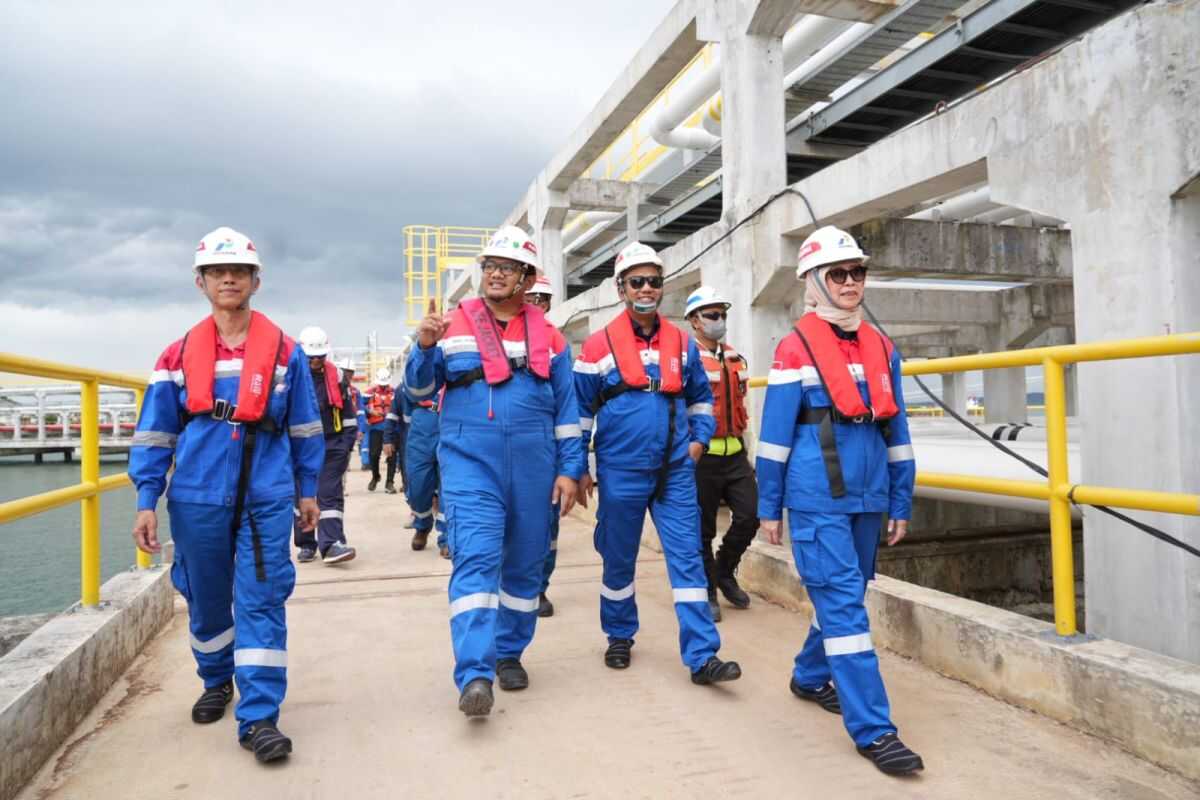
“Balikpapan Refinery fuel products will be pumped here (Tanjung Batu FT) via submarine pipeline. Subsequently, they will be distributed to various regions, not only Kalimantan but also to Makassar, Bali, and other areas,” she stated during a visit to assess the Balikpapan Refinery’s readiness for Ramadan and Eid al-Fitr 2026 at Tanjung Batu Fuel Terminal on Wednesday, 25 February 2026.
Fathul Nugroho, another member of the BPH Migas Committee, added that the existence of the fuel terminal is inseparable from the Balikpapan RDMP.
“We want to ensure that Tanjung Batu FT functions as a supporting system for RDMP development, which has already been inaugurated by the Indonesian President. This means that RDMP and Tanjung Batu FT become one integrated unit,” he stated.
Nugroho expressed hope that the next construction phase, namely the Tanjung Batu-Samarinda pipeline network and Palaran Fuel Terminal, will proceed according to schedule.
“With the pipeline to Samarinda, fuel distribution from Tanjung Batu can certainly proceed smoothly,” he explained.
On Thursday, 27 February 2026, BPH Migas monitored the progress of Balikpapan’s RDMP, which is entering the start-up phase of the residual fluid catalytic cracking (RFCC) unit that will convert heavy oil residue into high-value fuel products.
Eman Salman Arief, a member of the BPH Migas Committee, stated that the RFCC start-up process at Balikpapan Refinery represents a milestone for sustaining national energy independence following its inauguration.
“We pray it proceeds smoothly, thereby supporting national fuel supply,” he said.
The Technical Expert to the Energy and Mineral Resources Minister for Downstream Oil and Gas Governance, Mulyono, reminded staff to maintain compliance with safety regulations, personal protective equipment, and work procedures.
Setyo Pitoyo, Director of Infrastructure Projects and Asset Integrity at PT Pertamina Patra Niaga (PPN), stated that completion of Balikpapan’s RDMP as a national strategic project continues to be pursued.
“We continue to make every effort with RFCC conditions already normalising, and crude intake will be increased gradually to 310,000 barrels of oil per day (BOPD). Once fully completed, crude intake will be optimised to 360,000 BOPD by August 2026,” he said.
Meanwhile, Didik Bahagia, Director of Refinery Operations at PPN, conveyed the readiness of all refineries in facing Ramadan and Eid al-Fitr 2026.
Executive General Manager PPN Regional Kalimantan Isfahani also affirmed readiness for Eid al-Fitr.
As part of its working visits, BPH Migas also monitored fuel stocks and distribution at several fuel stations in Balikpapan to ensure supply readiness ahead of the Eid holiday.
“All fuel stations are ready, and Pertamina Patra Niaga colleagues have already prepared strategies and measures, including fuel provisioning and distribution implementation such as setting up modular fuel stations on congested routes and tourist destinations,” said Eman Salman Arief.