
Bahlil to increase BBM stock storage capacity from 25 days to 90 days
In fact, our energy resilience, our storage capacity, tops out at around 25–26 days, no more than that.
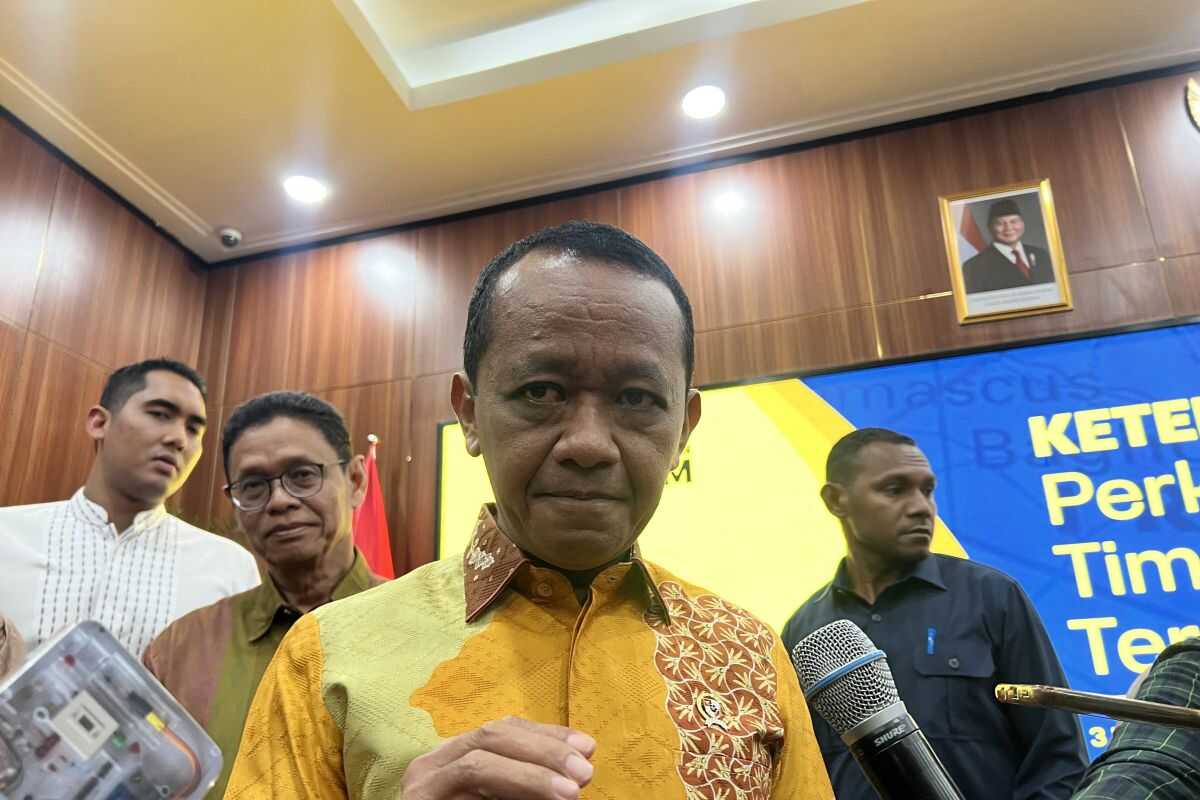
Jakarta (ANTARA) – Minister of Energy and Mineral Resources (ESDM) Bahlil Lahadalia said that storage capacity for motor fuel (BBM) stock would be increased from the current 25–26 days to 90 days, or three months.
“In fact, our energy resilience, our storage, is at a maximum around 25–26 days, no more than that,” he said at the Press Conference on Developments in the Middle East and Implications for the ESDM Sector, held at the Ministry of Energy and Mineral Resources in Jakarta, on Tuesday.
The statement responds to a comparison between Indonesia’s energy resilience and Japan’s, where Indonesia’s BBM stock can last less than 30 days, while Japan has BBM stocks for 254 days ahead.
That gap is caused by Indonesia’s limited storage of BBM.
“Now, if we import that much (as Japan), where would we put (BBM)? That is our problem,” he said.
Therefore, he continued, the government is seeking to build storage with capacity that could reach 90 days or three months, to align with international standards. Currently, a feasibility study into the construction of storage is underway.
Bahlil targets that the storage will commence construction in 2026, and it is planned to be built in Sumatra.
For oil resilience at present, Bahlil said that stocks of crude oil, BBM, and LPG are on average above the government’s minimum resilience standard. The minimum standard set by the Indonesian government is 23 days.
“So, regarding preparations for Eid al-Fitr, the fasting month, alhamdulillah I can say that BBM, crude, LPG stocks are all, on average, above the national minimum standard,” he said.
Indonesia’s energy resilience has come under scrutiny amid the United States–Israel–Iran conflict.
On Saturday (28 February), the US and Israel launched strikes against several targets in Iran, including Tehran. The US and Israel attacks on Iran were reported to have caused damage and civilian casualties. Iran then retaliated by launching missile strikes at areas in Israel and US military facilities in the Middle East.
On Sunday (1 March), US President Donald Trump claimed the death of Iran’s Supreme Leader Ayatollah Ali Khamenei in the joint US-Israel strike. Iranian state television confirmed the death of Ayatollah Ali Khamenei as a result of the attack.
Iranian media reported that the Strait of Hormuz had been “effectively” closed following the US-Israel strikes, though there has been no official announcement regarding a formal blockade.
The Strait of Hormuz handles around one-fifth of the world’s oil trade and large volumes of LNG exports from Qatar and the United Arab Emirates.
Around 20 percent of global daily oil consumption, or about 20 million barrels, passes through this corridor.