
Bahlil States Indonesia Secures Oil Supply from Russia for the Next Year
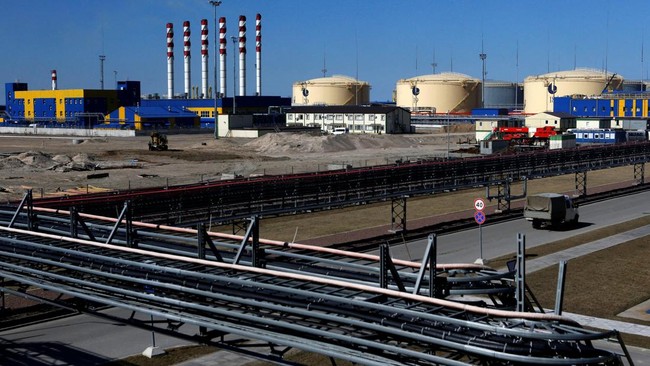
Jakarta, CNBC Indonesia - The Minister of Energy and Mineral Resources (ESDM), Bahlil Lahadalia, has revealed that Indonesia has secured a supply of crude oil from Russia to meet needs for the coming year.
According to Bahlil, this agreement forms part of the government’s strategy to secure supplies and maintain national energy resilience amid global uncertainties due to the war in the Middle East.
“Yesterday we were in Russia. In Russia, we’ve already secured one year clearly. So for our crude stock for the next year, God willing, it’s already sorted,” Bahlil said at the Synergy of IPB Alumni for the Nation event on Saturday (2/4/2026).
He explained that this certainty of oil supply from Russia is one factor enhancing Indonesia’s energy resilience, among several others.
He outlined several factors that can improve Indonesia’s energy resilience amid Middle East turmoil, including diversification of energy sources, the large domestic coal reserves, and optimisation of palm oil utilisation to replace diesel fuel.
He then mentioned that with the government’s efforts, JP Morgan assesses Indonesia’s position as strong in maintaining energy stability.
“JP Morgan issued data quoted by several media outlets that, out of 52 countries surveyed, Indonesia ranks second after South Africa as the country with the best energy resilience,” Bahlil said.
Nevertheless, he believes the national energy situation still faces various challenges and is not yet fully ideal.
He highlighted Indonesia’s shift from being an oil exporter and member of the Organisation of Petroleum Exporting Countries (OPEC) to an importer.
Currently, domestic oil production stands at only 605,000 barrels per day (bpd), while national consumption has reached 1.6 million barrels per day.
“In this situation, we must think creatively about how to achieve energy independence,” Bahlil said.
However, in 2025, Indonesia recorded a different achievement. For the first time in ten years, national oil production exceeded the target set in the state budget.
The production decline is due to thousands of oil wells in Indonesia being very old, some inherited from the Dutch colonial era, left unproductive despite remaining reserves.
Therefore, the government is encouraging Oil and Gas Contractors (KKKS) to use new technology to bring those wells back into production, with compensation in the form of state incentives and involving local communities in legally managing the oil wells.
Oil Supply from Russia
Previously, the President’s Special Envoy for Energy and Environment, Hashim Djojohadikusumo, stated that Indonesia would receive 150 million barrels of crude oil from Russia. This oil supply was obtained at a special agreed price.
The agreement on the price resulted from President Prabowo Subianto’s working visit to Russia. The cooperation is part of efforts to fulfil national energy needs.
During the visit, President Prabowo met directly with President Vladimir Putin. The meeting between the two leaders resulted in an agreement for Indonesia to procure crude oil.
“Indonesia now has a commitment from the Russian government; we can store 150 million barrels in Indonesia to face economic turmoil issues,” Hashim said at the Economic Briefing 2026 event at Patra Jasa Tower, Jakarta, quoted some time ago.
Hashim explained that initially, in the meeting with Putin, Russia agreed to send 100 million barrels at a special price. However, Russia would add 50 million barrels for Indonesia to address global turmoil.
“He (Prabowo Subianto) went to Moscow, met President Putin for 3 hours, and got a commitment from President Putin that 100 million barrels of oil would be sent to Indonesia soon. 100 million barrels at a special price. And if Indonesia needs more, it’s already added 50 million,” he said.
The agreement with Russia regarding the black gold commodity serves as an effort for domestic energy resilience, particularly against the impact of the war in the Middle East, which raises concerns about global oil supplies.