
Bahlil Seeks to Accelerate Electric Motorcycle Conversion, IESR Reveals Significant Challenges
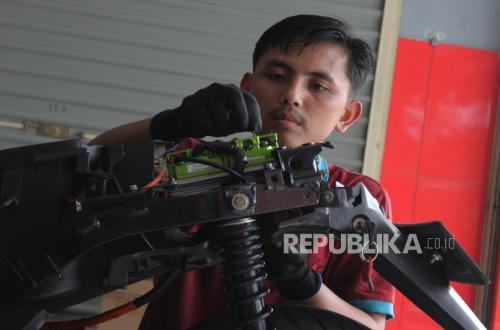
The Indonesian government is preparing anticipatory measures following threats of an oil and gas supply crisis, including LPG, due to Iran’s partial closure of the Strait of Hormuz amid conflicts in the Gulf region. President Prabowo has instructed the acceleration of several programmes. The programmes promoted by Prabowo include the construction of 100 GW of solar power plants (PLTS), the replacement of diesel power plants with PLTS and battery energy storage systems (BESS), and the conversion of 120 million fossil fuel motorcycles to electric motorcycles. Other policies include implementing work from home (WFH) one day per week and accelerating biofuel blending to 50 percent (B50). The Coordinating Minister for the Economy stated that the government is preparing eight measures within the framework of national work efficiency and cultural transformation, including budget savings on official travel, calls for energy conservation, and restrictions on fuel purchases to 50 litres per day. Meanwhile, the Minister of Energy and Mineral Resources assured that national energy reserves are still above the minimum standard and the government has identified alternative supply sources. The Minister of Investment and Downstreaming added the acceleration of renewable energy development, such as solar and geothermal energy, to reduce energy system vulnerabilities. These policies will take effect from 1 April 2026 and will be evaluated in two months. The think tank Institute for Essential Services Reform (IESR) notes that in crisis conditions, various ideas to address short- and long-term pressures are commonly proposed. However, according to IESR Chief Executive Officer Fabby Tumiwa, not all ideas or proposals are feasible due to technical, economic, social constraints, and long-term impacts on the public. Therefore, IESR urges President Prabowo to assess the effectiveness of the programmes proposed by his ministers based on implementation feasibility, ability to reduce fuel dependency in the medium and long term, avoidance of new fiscal burdens, and sustainability post-crisis once the war in Iran ends. One programme scrutinised by IESR is the plan to retrofit 120 million motor vehicles to electric motorcycles. “The success of the 120 million motorcycle conversion programme to electric must consider the ecosystem, economics, as well as public interest and support,” said Fabby in his statement on Wednesday (1/4/2025). Fabby assesses that the plan to convert 120 million fuel motorcycles to electric in a short time is not technically and economically viable and could potentially create a fiscal burden. According to him, the risk of failure in this plan is high, making it ineffective in cutting fuel dependency. Fabby said this programme is not new but a continuation from the previous government. He noted that in 2022, the Ministry of Energy and Mineral Resources targeted the conversion of 120 million as a programme to achieve net zero emission targets and savings on increasing fuel subsidies due to rising oil prices from Russia’s attack on Ukraine. At that time, the Ministry of Energy and Mineral Resources targeted 50,000 units in 2023 and 150,000 units in 2024, and provided subsidies of Rp 7 million, later increased to Rp 10 million per unit. “In reality, those targets were not achieved. Only 1,000 motorcycle units were converted in 2023, and the revised 2024 target of 50,000 was also not met,” said Fabby. Fabby said the failure of this programme should be evaluated by the Ministry of Energy and Mineral Resources and improvements made through strengthening the electric motorcycle conversion ecosystem, consisting of the availability of certified conversion workshops, fast and affordable electric vehicle certification processes, reliable and affordable supply chains for motors, batteries, and battery management systems (BMS), strengthening conversion motorcycle standards, and public interest and participation. Fabby explained that one key factor for the success of the conversion programme is the availability of certified conversion workshops. Without this, conversions cannot be carried out according to regulations and cannot obtain roadworthiness permits. To convert 120 million motorcycles in five years, an average of 24 million conversions must be done each year. “With an estimated workshop capacity of two to three trained mechanics performing 900 to 1,500 units per year, 16,000 to 27,000 certified conversion workshops are needed across Indonesia,” he said. According to Fabby, the current availability of conversion workshops is inadequate, both in terms of number and location distribution. By the end of 2025, he noted there are only 39 certified conversion workshops by the Ministry of Transportation, mostly in Jakarta, Bogor, Bandung, and Bali. Up to 2024, all these workshops have converted 42,000 vehicle units. The cost of converting one motorcycle unit is estimated at Rp 12 million to Rp 16 million, depending on engine capacity, battery, and other components. Fabby said this total cost is not worthwhile compared to the price of new motorcycles and the time required for conversion. To attract motorcycle owners’ participation, according to Fabby, the government has the option to provide subsidies for fuel-to-electric motorcycle conversion costs. “If left to the decision of motorcycle owners, it is certain they will not convert to electric motorcycles due to the high cost,” said Fabby.