
Bagong Dam to Boost East Java's Agricultural Productivity
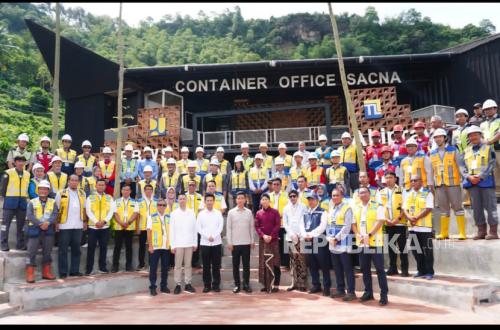
Vice President Gibran Rakabuming Raka has emphasised the importance of accelerating project completion so that the benefits of the Bagong Dam can be felt promptly by the community, particularly farmers and residents of Trenggalek. Gibran made this statement during his inspection of the progress of the Bagong Dam construction in Trenggalek Regency, East Java (Jatim).
“This visit reaffirms the government’s commitment to accelerating the construction of strategic infrastructure to strengthen water resilience, food security, and flood control in southern East Java,” Gibran said, according to a press release from PTPP, on Thursday (30/4/2026).
The Bagong Dam Construction Project Package III, undertaken by PTPP, has a contract value of Rp402.31 billion with a implementation period of 1,473 calendar days, starting from 20 December 2024.
PTPP Corporate Secretary Joko Raharjo stated that the positive progress of this project is the result of meticulous planning, ongoing innovation, and solid collaboration among all stakeholders.
“As of now, the project progress has reached 59.49 per cent from a target of 56.56 per cent, reflecting project performance that is proceeding faster than planned,” Joko said.
Joko explained that the Bagong Dam has a storage capacity of 17.4 million cubic metres, projected to supply irrigation water for 977 hectares of agricultural land in the Bagong Irrigation Area. In addition, the dam will provide raw water at 153 litres per second and play a role in flood control in the Trenggalek Regency area.
“PTPP is committed to completing the Bagong Dam project on time while prioritising quality, occupational safety, and sustainability,” Joko continued.
Joko hopes that this project can provide tangible benefits to the community, particularly in supporting water resilience and increasing agricultural productivity.
In its implementation, Joko added, the Bagong Dam project faces quite complex technical challenges, especially because the dam construction is based on a colluvial layer that requires special engineering to ensure structural stability and safety.
“To overcome these challenges, PTPP is implementing various construction innovations to improve work effectiveness and maintain occupational safety standards,” Joko said.