
Baby Clothes Prices Reported to Rise, Here's What's Found in Tanah Abang
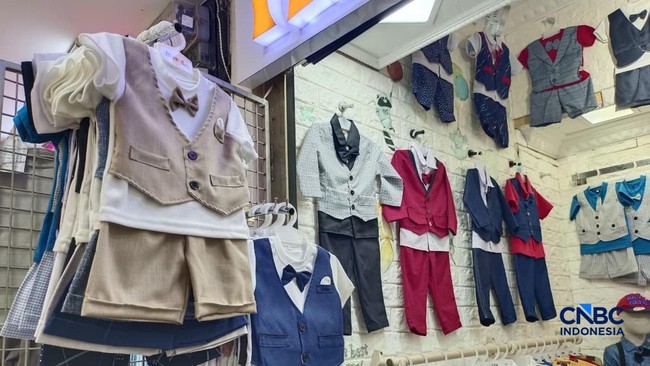
Jakarta, CNBC Indonesia - Prices of children’s clothing in Tanah Abang Market are still being monitored as stable, even though there are predictions of increases in the near future due to the impact of the war in the Middle East on textile raw materials.
From CNBC Indonesia’s observations at Jembatan Blok A, Tanah Abang Market, on Monday (13/4/2026), the prices of several garments, particularly children’s clothing, are still being sold at normal prices. Based on statements from traders, the current selling prices have not yet experienced any changes.
Traders also admit they are still relying on old stock, so they have not yet made price adjustments, even though they have started receiving information about potential increases from the production side.
Alya, a children’s clothing trader who also has a home-based workshop, revealed that news of rising raw material prices has indeed been circulating, but it has not yet affected current selling prices.
“Yes, I have a home-based workshop, so I make these myself. It’s true, yesterday when the production people wanted to buy materials, they were already informed that the fabric prices would rise. But not yet,” said Alya when met by CNBC Indonesia at the location.
Nevertheless, the selling prices of the clothes she offers today are still the same. “Not yet, not yet, still the same. No increase yet,” she emphasised.
Alya admitted she does not yet know when the price increase will start to occur.
“I don’t know yet, but I hope it doesn’t happen. I hope the war ends quickly, so prices don’t rise,” she said.
Currently, she sells children’s clothing at relatively affordable prices. “I sell from Rp50,000 to Rp80,000 only,” she said.
If the increase does happen, she estimates the price adjustment will follow the market, with the increase around 10%.
“I don’t know yet, I haven’t dared to calculate if there’s an increase. But probably following others, maybe 10%. But I’m still hoping there won’t be an increase,” she added.
Something similar was conveyed by Rara, another children’s clothing trader. She assured that the current selling prices are still the same as before.
“That (children’s party clothes) is Rp100,000, but you have to buy 4, so Rp388,000 for 4,” she said.
Rara explained that there has been no price increase even though war issues have emerged, causing textile raw material prices to rise accordingly.
“Not yet, these prices are still the same as yesterday. No increase yet,” she said.
She explained that the materials for the clothes sold are quite varied, one of which is made from satin polyester. It should be noted that polyester itself is a type of fabric whose raw materials are under pressure due to the conflict in the Middle East.
“(The material) satin polyester, yes, there’s chiffon, various kinds,” she said.
However, up to now, she has not received any certainty regarding the price increase. “Not yet. I get the goods, but there’s no info yet whether it’s really going to rise or not,” she emphasised.
Meanwhile, another trader, Satria, also said that clothing prices are still normal even though he has restocked goods.
“Not yet, still normal. I happened to pick up goods yesterday, but they haven’t risen from there either. It seems like maybe later, in one or two months, the clothes will start to rise,” said Satria.
He also assured that no traders around him have raised prices yet, so he has decided not to raise prices.
“Not yet, I checked with friends nearby, and none of them have raised prices. It seems like indeed no one has raised prices yet,” he said.
Notification of Baby Clothes Price Increase
Although conditions in Tanah Abang are still stable, signals of price increases are starting to be felt in other areas. Traders of baby clothes and accessories in one of the malls in Bekasi, West Java, admit they have received notifications from suppliers regarding plans for price increases.
“We’ve already been informed to the boss. That’s why at current prices, if you come again (next month), you won’t be able to get it anymore. Prices will definitely rise,” a shop staff told CNBC Indonesia on Sunday (12/4/2026).
“It’s the same for all (applies to all brands),” she added.
However, she could not yet confirm the exact cause of the increase. And whether it is related to the surge in raw material prices in the petrochemical sector, including plastics and textiles in Indonesia.
“I don’t know either. What’s clear is that there’s already an announcement to the boss,” she said.
Previously, the General Chairman of the Indonesian Filament Fibre and Yarn Producers Association (APSyFI), Redma Gita Wirawasta, warned that fabric prices up to finished garments would rise due to the surge in raw material prices due to the Middle East conflict.
“The price of paraxylene, which is the main raw material for polyester, is currently at US$1,300 per tonne, or up around 40% from two weeks ago. This price increase has not yet fully reached the downstream industry,” he said on Tuesday (7/4/2026).
He explained that the price increase would spread gradually from upstream to downstream.
“The domino effect caused by the rise in textile raw material prices will impact gradually over the next three weeks. In the next one week, this price increase will be distributed to fabric producers, and in the following two weeks, it will be distributed to the finished garment sector,” he stated.
According to him, price increases at the retail level are unavoidable.
“It is estimated that the increase in the retail sector will be around 10%,” he said.
He also added that although the supply of raw materials is still available, the prices are now much higher.
“Up to now, raw materials for both polyester and rayon produced domestically have no issues; the goods are available, only the prices are high,” he said.
With this condition, although clothing prices in Tanah Abang are currently still stable, traders estimate that increases will start to be felt in one to two months as new stock with higher production costs enters the market.