
B50 Accelerated Amid Global Energy Turmoil
Jakarta — The government is accelerating the development of biodiesel, a form of biofuel (BBN), in the face of global energy volatility and fluctuations in world oil prices. After a series of trials since late 2025, nationwide implementation of B50 is targeted to begin on 1 July 2026.
Head of the Biofuel Fund Disbursement Division of the Estate Crops Fund Management Agency (BPDP), Zuhdi Eka Nurrakhman, said that the implementation of B50 is a key part of safeguarding national energy security. Trials of B50 have also been conducted across various modes of transport.
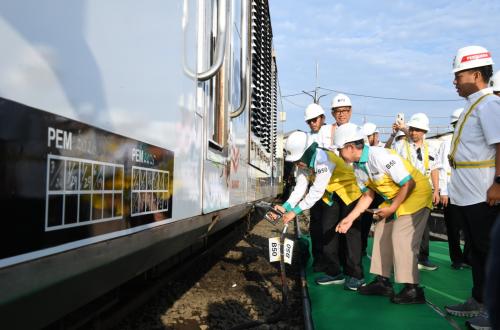
For the automotive sector, road testing of heavy vehicles covering 40,000 kilometres has been completed with stable results. Meanwhile, tests on light vehicles are targeted to be completed by May 2026. Other sector tests, such as storage stability for maritime transport (sea trials), are scheduled for May 2026, with railway tests targeted for completion in October 2026.
“From the trial results, 99.88 per cent of samples met the maximum water content standard of 320 ppm,” Zuhdi said during a webinar on Implementing Support for Downstreaming and Welfare of Palm Growers, organised by Tabloid Sinar Tani in collaboration with BPDP in Jakarta, on Wednesday, 20 May 2026.
He noted that the government is able to maintain the consistency of the biodiesel mandate programme despite global oil price volatility in recent years. In 2023 the government began implementing B35, later increasing to B40 in 2025.
Realisation of B35 biodiesel distribution in 2024 reached 13.14 million kilolitres. In 2025, biodiesel distribution rose to 14.7 million kilolitres as B40 was implemented.
In implementing B50, Zuhdi made clear that the government still faces a number of challenges, including limited production capacity and the need for infrastructure upgrades, particularly at berths, transport, and storage tanks.
“Price disparities between biofuel (BBN) and fossil fuels (BBM) under normal conditions, which significantly affect biodiesel incentives financing, also pose a challenge,” he said.
Zuhdi explained that in the current geopolitical climate, implementing B50 in the second half of 2026 could cause the BPDP financing to run a deficit if global oil prices stay below $100 per barrel, assuming BBN prices remain unchanged. In normal conditions without geopolitical turmoil, the B50 implementation is also expected to exert financing pressure. This is because the gap between the Biodiesel Market Price Index (HIP) and the diesel HIP tends to widen as the biodiesel blend rate increases, while BPDP revenue still relies on the Export Tax (PE).
“Hasil kajian menunjukkan untuk membiayai program B50 pada kondisi normal dibutuhkan sumber pembiayaan dari PE dengan tarif 23,8 persen, sementara tarif PE eksisting sebesar 12,5 persen,” Tuturnya.”>
Therefore, BPDP has proposed several policy options to sustain the biodiesel mandate programme, including financing support through the state budget (APBN), adjustment of the PE rate, setting biodiesel blending ratios in line with financing capacity, and adjustment of retail prices.
Ketersediaan Bahan Baku
Chair of the Post-Harvest and Processing Sub-Group, Directorate for Downstreaming of Palm Product Processing, Directorate General of Plantations, Ani Rahayuni Ratna Dewi, said the availability of raw materials is a key factor in supporting B50 implementation. However, national palm oil productivity remains a challenge, with average production reaching only 3.8 tonnes per hectare per year, whereas its potential could reach 5–6 tonnes per hectare per year.
In 2026, biodiesel demand is projected at 16,085,084 kilolitres for B40 and 20,106,354 kilolitres for B50. Meanwhile, CPO demand is projected at 14,958,105 tonnes for B40 and 18,697,632 tonnes for B50.
By 2028, B50 biodiesel demand is projected to rise to 21,330,831 kilolitres with CPO requirements around 19,836,318 tonnes. It is projected that by 2045 palm oil production will reach 60.03 million tonnes, equivalent to 54.73 million tonnes of CPO, while biodiesel demand is projected to reach 31.15 million tonnes.
“So, in terms of CPO production, there is sufficient supply, but it will affect exports,” Ani said.
She argues that balancing food needs, exports, and biodiesel must be accompanied by increased palm oil production, especially from smallholders. One step currently promoted by the government is the rakyat palm oil replanting programme (PSR).
Gulat Manurung, chairman of the Indonesian Palm Oil Farmers Association (Apkasindo), hopes the government will ease PSR requirements to boost smallholder palm oil productivity. Currently, smallholder palm oil yields average around 400–800 kilograms per hectare per year, whereas potential yields could reach 2.5–3.5 tonnes per hectare per year.
The main aim of PSR is to replace aging or unproductive smallholder palm trees aged 25–30 years with certified high-yielding planting stock with the potential for higher yields. However, implementation remains relatively low.
In 2024, for instance, out of a PSR target of 180,000 hectares, the realisation was only 38,247 hectares. The same in 2025, out of a target of 180,000 hectares, realisation was only around 40,000 hectares.