
Awaiting the OIC Resolution Condemning the US-Israel Attack
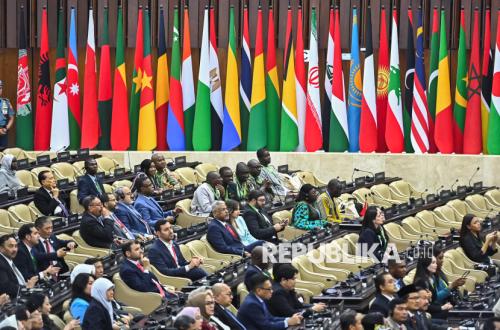
Today, 19 March, the Ministerial Summit of the Organisation of Islamic Cooperation (OIC) is addressing the escalation of Israel-US aggression against Iran and Iran’s response.
Iran’s retaliation not only targeted US military infrastructure in the GCC—comprising Saudi Arabia, Oman, the United Arab Emirates, Qatar, Bahrain, and Kuwait—plus Iraq and Jordan, but also energy infrastructure in the region after closing the Strait of Hormuz, a vital route traversed by international tankers carrying 20 per cent of global oil needs.
The OIC’s decision will determine whether the escalation worsens or has the potential to halt the US-Israel aggression.
On 18 March, Iran launched missile strikes on Qatar’s main gas facility in Ras Laffan, the Habshan gas facility in Abu Dhabi (UAE), and two refineries in Riyadh, Saudi Arabia. This was in response to Israel’s attack on Iran’s South Pars gas field using airspace in the Arab region.
Iranian President Masoud Pezeshkian warned of uncontrollable consequences that could plunge the entire world into turmoil. Iran’s stance cannot be separated from Israel’s assassination of the Head of the Supreme National Security Council Ali Larijani, the Basij paramilitary commander, and Iran’s Minister of Intelligence Ismail Khatib.
The GCC has lobbied US President Donald Trump from the outset not to wage war on Iran, which is an agenda of Israel under Prime Minister Benjamin Netanyahu. However, Trump ignored them, believing that a joint US-Israel tactical strike on Iran would be short-lived because Iran would collapse after its supreme leader, Ayatollah Ali Khamenei, and key military leaders were killed, making regime change possible. When the US-Israel aggression was launched on 28 February, the GCC declared neutrality towards the war and expressed regret that Trump and Netanyahu preferred war over diplomacy.
Their anxiety increased after it became evident that the Trump-Netanyahu war objective had not been achieved, leading to a prolonged war with the GCC, along with Iraq and Jordan—all of which host US military bases—becoming targets of Iran.
Contrary to the expectations of Trump and Netanyahu, Iran’s Revolutionary Guard Corps (IRGC) launched a deadly counterattack. A barrage of Iranian missiles and drones on cities in Israel could not be fully intercepted by Israel’s layered air defence, destroying strategic sites and killing Israeli soldiers and civilians. It did not stop there; the IRGC also targeted all US military bases in the area.
Initially, Iran stated that it still viewed the GCC as friendly nations and only targeted US interests there. But Iran’s targets expanded after the US and Israel attacked Iranian civilian infrastructure, such as schools, hospitals, civilian settlements, and oil depots in Tehran. The attack on a primary school in Minab killed more than 170 pupils, mostly girls.
Although declaring neutrality, the GCC, Jordan, and Iraq did not condemn the US-Israel aggression. They also did not send condolences for Khamenei’s death. Yet, the assassination of a sovereign state’s leaders and officials is not justified under international law.
What also disappointed Iran was that the airspace of countries in the region was freely traversed by Israeli fighter jets and US bombers without being challenged by those Arab countries’ air defence systems. Instead, they shot down Iranian drones and missiles using US weapons.
Thus, Iran began attacking airports in the GCC, Iraq, and Jordan, and closed the Strait of Hormuz accompanied by strikes on international tankers. The US bombing of Kharg Island in the Gulf, which handles 90 per cent of Iran’s oil exports, caused the escalation to intensify rapidly. Moreover, that attack was launched by the US from the UAE. And the situation in the region worsened following the US bombing of Iran’s gas fields. The war has transformed into an economic war.
Iran’s actions against neighbouring countries and the closure of the Strait of Hormuz have eroded the revenues of the GCC and Iraq and weakened their economic performance. This backdrop is what ended Qatar’s patience.
Doha expelled Iran’s security and military attachés after the IRGC attacked its gas field. Saudi Arabia stated that its trust in Iran has vanished and threatened to activate its military pact with Pakistan, which possesses nuclear weapons. Of course, Riyadh will not do so, and Pakistan will not drop nuclear bombs on Iran, a friend of Pakistan with significant support there. Using Pakistan’s nuclear weapons in this context would be suicidal.
The Arab nations do not want the Iranian mullah regime to collapse into pieces, threatening Gulf security. Beyond that, they also do not want Iran to be ruled by Israeli and US puppets while they are weakened, abandoned by the US-Israel duo that has brought disaster to the region. Netanyahu’s long-standing aspiration to become the sole hegemonic power in the region would be realised. Meanwhile, it is difficult to expect Iran to stop the war without a resolution. Will the OIC issue a resolution condemning Iran and calling for it to halt attacks on Arab nations without condemning the US-Israel aggression?
Within the OIC, there are six Arab countries—UAE, Bahrain, Egypt, Jordan, Morocco, and Sudan—that have already made peace with Israel. If the OIC appears to side with the aggressors US-Israel, what will happen is an enlargement of the crisis.
This war is existential for Iran and, although its military capacity has been eroded, Tehran still has sufficient weapon stocks for a long war. What is more dangerous is if the OIC condemns Iran’s actions that harm Arab nations without linking them to the US-Israel aggression, Iran will see it as a danger alarm because the Islamic world is legitimising the Trump-Netanyahu aggression. Thus, Iran’s actions against the GCC, Iraq, and Jordan will become even harsher.
Iran still has new weapons that have not yet been used.