
At Muhammadiyah Halalbihalal, Deputy Minister Fajar: Public Trust Rising, Do Not Stop Improving Quality
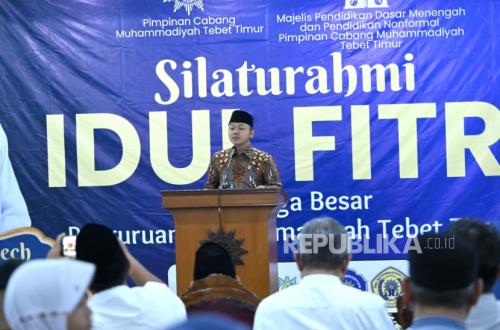
Deputy Minister (Wamen) of Basic and Secondary Education of the Republic of Indonesia, Fajar Riza Ul Haq, stated that the increasing public trust in Muhammadiyah must be met with improvements in quality, including in the field of education. Hitherto, he continued, various schools, pesantren, and universities owned by the organisation have become one of the driving forces of the Islamic da’wah movement. According to the latest data, the number of Muhammadiyah schools from primary school/equivalent to senior high school/equivalent reaches 5,346 school units. The breakdown is: 2,453 primary school/MI units; 1,599 junior secondary/MTs schools; and 1,294 senior high school/MA/vocational school units. Overall, all these units accommodate more than 1 million students. “When recently we see public trust increasing, the demands for quality also rise. Muhammadiyah must respond to that with real excellence,” said the Deputy Minister of Basic and Secondary Education (Dikdasmen) of the Republic of Indonesia, Fajar, while serving as the keynote speaker at the Halalbihalal event at Perguruan Muhammadiyah Tebet Timur, Jakarta, on Tuesday (31/3/2026). He emphasised that since being entrusted to assist Minister of Basic and Secondary Education Abdul Mu’ti, who is also the General Secretary of the Central Leadership of Muhammadiyah, to realise the direction of national education policy under the leadership of President Prabowo Subianto. The Head of State’s vision emphasises the importance of justice in the national education system. As a result, there is no differential treatment between public and private schools. “President Prabowo’s directive is clear: education policy must be just. There must be no gaps in access, attention, and service between public and private schools,” said Deputy Minister Fajar. As an example, the equitable policy continues to be strengthened under the leadership of Minister of Basic and Secondary Education (Mendikdasmen) of the Republic of Indonesia Abdul Mu’ti. This is through various strategic steps that favour the sustainability of the education ecosystem. For instance, the issuance of Minister of Basic and Secondary Education Regulation Number 1 of 2025 on the redistribution of ASN PPPK teachers. This policy allows ASN teachers, both those already holding civil servant (PNS) status and government employees with work agreements (PPPK), to return to teaching at their original schools, including private schools. “This policy is important to maintain the strength of human resources (SDM) in private schools, including schools owned by Muhammadiyah,” he explained.