
Astra Reaffirms Catur Dharma Values
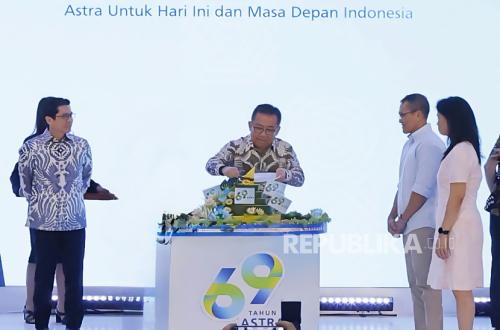
Jakarta — Approaching its 69th year, Astra International has reaffirmed its position as one of Indonesia’s leading national corporations, demonstrating continued growth amid global dynamics. Its lengthy journey has been underpinned not only by business performance but also by a strong foundation of values, human resource strength, and measured expansion strategy.
President Director of Astra Djony Bunarto Tjondro stated that the company’s nearly seven-decade journey reflects a long process built alongside the nation. “Sixty-nine years is not merely a count of time, but a story about millions of steps that have grown and moved together with the nation,” Djony said in an interview with Astra’s Chief of Corporate Affairs Boy Kelana Soebroto on 17 March 2026.
According to Djony, since its establishment, Astra has been built upon a strong philosophy inherited from its founder, William Soeryadjaya. This philosophy is embodied in the Catur Dharma values that serve as a guide in every step of the company. He likened Astra to a “shady tree” — a company that not only grows firmly but is also able to provide benefits to the surrounding community.
The Catur Dharma values, he said, are not merely written principles but are lived out in every business decision and cooperation. “This value serves as a compass for all Astra personnel in ensuring the company’s direction remains clear amidst the dynamics of the era,” he stated.
These values are translated into strategy through the 3P Roadmap encompassing Portfolio, People, and Public Contribution. This framework is designed to balance business performance with long-term sustainability whilst strengthening corporate resilience.
Throughout its journey, Astra has navigated various phases, ranging from national political and economic dynamics, monetary crises, technological disruption, the COVID-19 pandemic, to global geopolitical uncertainty. Djony emphasised that consistency in practising Catur Dharma values has been the key to keeping the company relevant. “The practice of Catur Dharma by Astra’s leaders in every company decision and step is essential. Lead by example,” he said.
He added that value internalisation is conducted continuously through various programmes across all organisational levels. Regular evaluation ensures that corporate culture remains relevant and effective in supporting performance.
Djony emphasised that Astra’s strength lies in its people. The concept of “people legacy” has become an important foundation in maintaining company continuity across generations. “People are the strength of the Astra Group. We must continually seek and develop new talents and prepare leaders who are not only competent but also possess character and loyalty,” he stated.
Astra implements various development programmes, ranging from cross-business rotation to strategic assignments, to provide broad experience for future leaders. Leadership succession processes are prepared well in advance. “Leadership succession does not happen overnight. We prepare it several years in advance to ensure continuity,” Djony said. He emphasised that amid changes in business models and technology, the human factor remains the primary determinant of organisational success. “Companies will always experience generational change, but the values we preserve together will remain as a binding force,” he stated.
Over the past six years, Astra has recorded consistent performance growth. Net profit increased from Rp16.2 trillion in 2020 to Rp32.8 trillion in 2025. Djony explained that this period was marked by various challenges, including the COVID-19 pandemic which temporarily affected nearly all business lines. Additionally, commodity price fluctuations, declining purchasing power, and increased industry competition impacted market dynamics.
However, Astra was able to withstand these challenges through diversification of its business portfolio, which encompasses seven business lines: automotive and mobility, financial services, heavy equipment, mining, construction and energy, agribusiness, infrastructure, information technology, and property. Currently, Astra has 321 subsidiaries with more than 190,000 employees.
“The Group’s ability to endure is supported by a diversified business portfolio, decades of operational experience, and strong synergies within the Astra ecosystem,” Djony explained. He added that this success has also been supported by a hands-on work ethic that emphasises careful analysis, proper planning, and disciplined execution.
Looking ahead, Astra will continue to strengthen its business portfolio through three main approaches: optimisation of existing businesses, development of related business lines, and investment in new sectors. Djony stated that Astra has already expanded into various areas, such as used vehicles, multipurpose financing, digital banking, and investments in healthcare and non-coal minerals sectors. “Expansion is conducted in a planned and measured manner with a principle of caution, and is aligned with Indonesia’s economic growth direction,” he said.