
Asset Forfeiture Bill: Why is it important for fighting corruption?
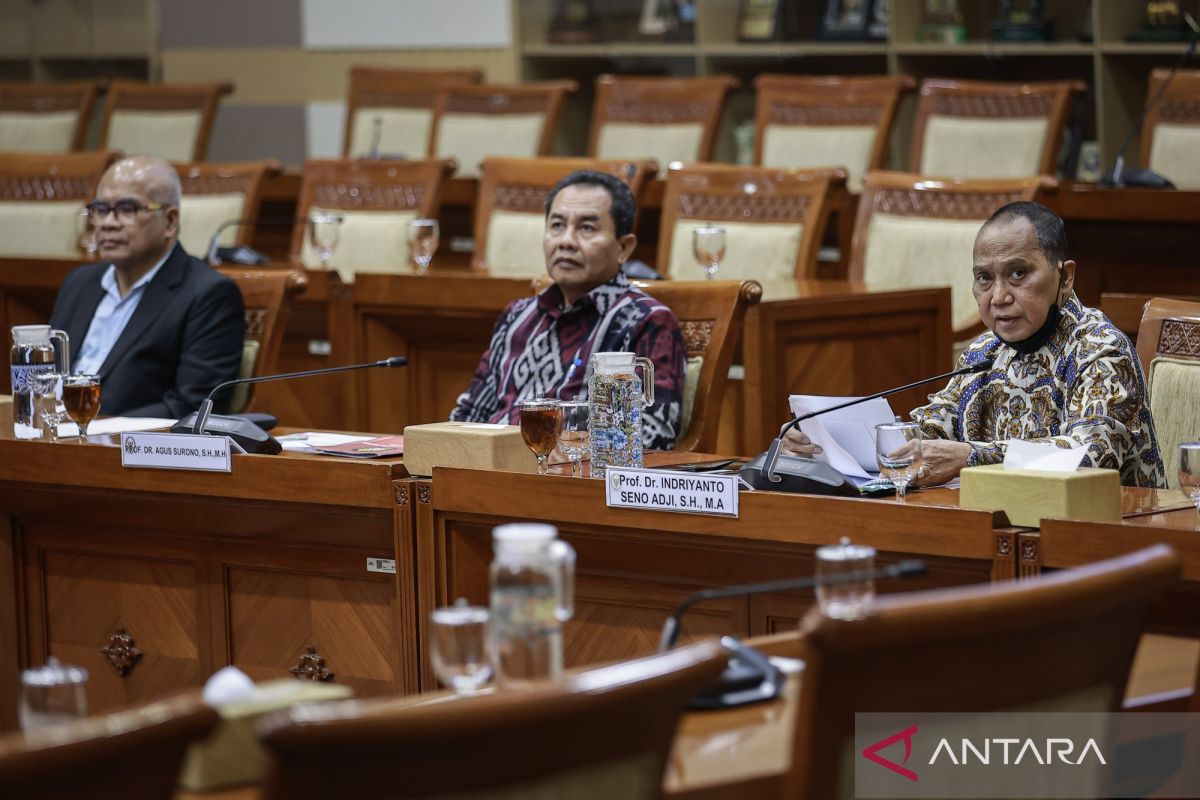
Jakarta (ANTARA) — Fighting corruption is not only about punishing perpetrators, but also about ensuring that assets derived from criminal acts are returned to the state. For this reason, the Asset Forfeiture Bill has once again come into focus within Indonesia’s anti-corruption agenda.
The Asset Forfeiture for Criminal Acts Bill has been under discussion for more than a decade. In 2026, deliberations on the regulation have been pushed forward again, with the House of Representatives (DPR) targeting its completion no later than December 2026.
So, why is the Asset Forfeiture Bill considered important for eradicating corruption?
Restoring state losses
One of the main reasons this bill is considered important is to strengthen the recovery of assets derived from criminal acts. In corruption cases, punishing the perpetrator does not automatically restore all the losses suffered by the state.
The Corruption Eradication Commission (KPK) recorded asset recoveries throughout 2025 at Rp1.53 trillion. That figure increased compared with the 2024 achievement of Rp739.6 billion.
At the level of law enforcement as a whole, the government also recorded asset recoveries from corruption cases handled by the Attorney General’s Office, the KPK and the National Police (Polri) reaching Rp28.6 trillion throughout 2025.
The magnitude of these figures shows that asset recovery is an important part of eradicating corruption, because the end result is not only punishment for perpetrators, but also the return of wealth linked to criminal acts.
Corruption is fundamentally aimed at obtaining unlawful gains. Therefore, law enforcement is not sufficient merely to ensure that perpetrators are punished; it must also pursue assets suspected of originating from criminal acts.
Studies on the Asset Forfeiture Bill assess that the regulation can strengthen the asset recovery approach, so that combating corruption is oriented not only towards prosecuting offenders, but also towards restoring state losses.
With this approach, the proceeds of crime become a key focus in the law enforcement process.
Filling gaps in existing regulations
At present, Indonesia actually already has a number of provisions on the seizure and forfeiture of assets through various regulations, including the Corruption Eradication Law and the Money Laundering Law.
However, several studies consider there to still be gaps in the existing legal framework, particularly regarding asset forfeiture mechanisms that do not depend entirely on criminal convictions of perpetrators.
The Asset Forfeiture Bill is expected to provide a more comprehensive legal basis for how the state can pursue and manage assets linked to criminal acts.
Understanding non-conviction based forfeiture
One aspect that has drawn considerable attention to the Asset Forfeiture Bill is the concept of non-conviction based forfeiture, or the forfeiture of assets without first waiting for a criminal conviction against an individual in certain circumstances.
This concept differs from the conviction-based forfeiture mechanism, which essentially ties forfeiture to criminal proceedings and verdicts.
Implementing such a mechanism requires very clear rules so that it does not become a tool for arbitrarily seizing someone’s property. For this reason, the protection of the rights of third parties acting in good faith, judicial process, evidentiary standards and oversight remain essential parts of drafting the regulation. Studies on the implementation of asset recovery in Indonesia have also highlighted the need for regulatory harmonisation, institutional strengthening and protection of third parties.
Efforts to strengthen the return of criminal proceeds also align with Indonesia’s commitment to the United Nations Convention Against Corruption (UNCAC).
Indonesia ratified the UNCAC through Law Number 7 of 2006. The Convention places asset recovery as an important part of international cooperation in combating corruption.
This has become increasingly important because the proceeds of corruption can be moved, hidden or placed in particular forms of assets, so that recovering them requires adequate legal instruments.
The bill is expedited again in 2026
After years on the legislative agenda, deliberation of the Asset Forfeiture Bill has been expedited again in 2026. Commission III of the DPR stated that discussions are ongoing and targeted completion of the regulation by the end of 2026.
The bill’s journey is not new. The idea of drafting asset forfeiture regulations first emerged in 2008 and later returned as part of the government’s anti-corruption agenda.
Pressure to pass the bill has also come from civil society groups, who consider the regulation necessary to strengthen efforts to pursue criminal proceeds.
On the other hand, deliberation of the bill still needs to be conducted openly and carefully. A number of anti-corruption groups have highlighted the importance of transparency in the draft and public participation in the drafting process.
Thus, the urgency of the Asset Forfeiture Bill is not merely about seizing the wealth of corrupt actors. The regulation is expected to strengthen the asset recovery system, narrow the space for perpetrators to hide their criminal proceeds, and ensure that state losses can be recovered as fully as possible.
However, its future effectiveness will still depend on the substance of the regulation, evidentiary mechanisms, the professionalism of law enforcement officials, oversight, and guarantees of protection for citizens’ rights. With that balance, corruption can be combated without abandoning the principles of the rule of law.