
Assessing the Nature Valuation of the Upper Cisokan Hydropower Project
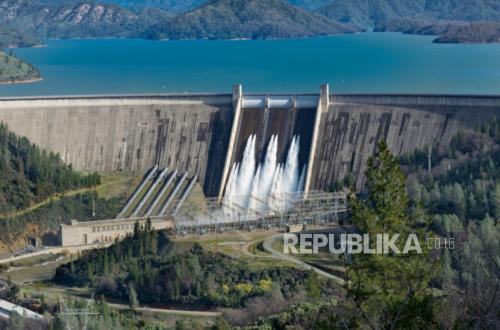
The development of large-scale renewable energy infrastructure is never free from the shadow of ecological and social impacts. A latest quantitative study that I compiled reveals that the Upper Cisokan Pumped Storage Hydropower Project with a capacity of 1,040 megawatts (MW) has a Nature-at-Risk Value or the value of natural assets at stake reaching up to $2.60 billion (equivalent to more than Rp 40 trillion) over the 40-year project lifespan.
This prestigious project, developed by PT PLN (Persero), is located in the Cisokan river basin, straddling the border between West Bandung Regency and Cianjur Regency, West Java. After a lengthy process of updating the Environmental and Social Impact Assessment (ESIA) documents in 2021, the main construction is being accelerated so that this facility, designed as a “giant battery” to stabilise the Java-Madura-Bali (Jamali) electricity system, can meet the commissioning target in 2028.
However, how do we assess the risks and feasibility of this massive project from a measurable ecological perspective financially? The answer lies in a cutting-edge framework called TNFD.
As an important note, the TNFD study on the 1,040 MW Upper Cisokan Pumped Storage Hydropower Project combines real data from the 2021 ESIA documents with the author’s measured estimates, thus overall providing a complete and comprehensive TNFD analysis picture.
In short, this study is a simulation or semi-simulation, with some data taken from the 2021 ESIA documents as a proxy and the rest using logical and relevant projected figures.
Understanding TNFD: From climate crisis to global ecosystem awareness
Before delving deeper into the figures in the Cisokan project, it is important to understand what The Nature-related Financial Disclosure (TNFD) is.
Historically, TNFD was born from the urgent awareness of the global financial community that environmental crises are not limited to carbon emissions and global warming. In previous years, the business world had TCFD (Task Force on Climate-related Financial Disclosures) which focused on climate risks and sustainability issues.
However, experts realised there was a major gap, namely the loss of biodiversity and ecosystem degradation (such as water crises and deforestation) that also directly threaten global economic stability.
Therefore, in mid-2021, the TNFD initiative began to be formed with support from the UN (UNEP FI and UNDP), WWF, and Global Canopy. After a series of global trials, the final version (v1.0) of the TNFD framework was officially launched in September 2023.
The main objective of TNFD is to provide a standard reporting framework for companies and financial institutions to identify, assess, manage, and disclose their dependencies and impacts on nature. Through a core approach called LEAP (Locate, Evaluate, Assess, Prepare), TNFD encourages corporations to stop viewing nature merely as an exploitation resource, but rather as a balance sheet asset that has real monetary value and financial risks.