
Asia's EVolution: The frontline workers keeping China’s electric car revolution running
Asia’s EVolution: The frontline workers keeping China’s electric car revolution running
Part of CNA’s series on the forces powering electric vehicles in Asia, this piece follows the mechanics, technicians and sales workers scrambling to keep pace with China’s EV boom.
HEFEI, Anhui province: On a wet January morning, rain slicks the concrete forecourt outside Hefei Rongchuang Automotive Service. Its bright green facade cuts through the drizzle.
Red banners hang over the entrance, welcoming a new cohort of trainees in electric vehicle (EV) repair.
Inside, 21-year-old Bao Shijie splits his time between university lectures and the workshop floor.
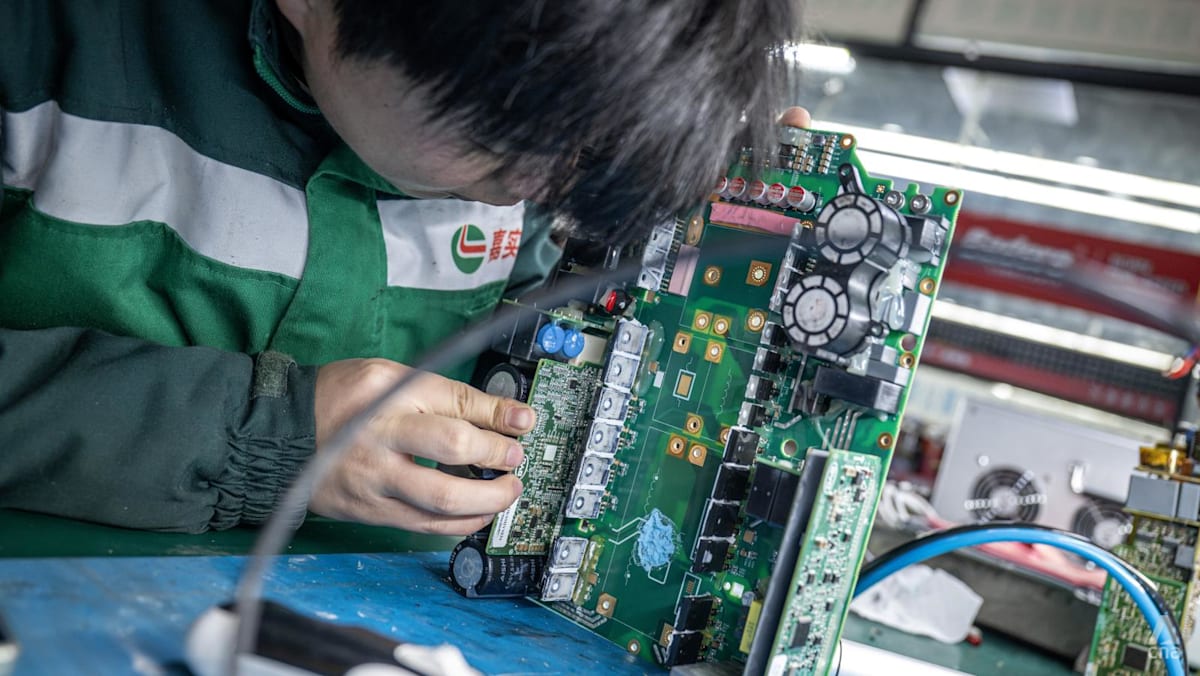
He hunches over a circuit board, tracing a maze of wiring under harsh fluorescent lights.
Around him, three other young technicians work through disassembled components at their stations.
Outside, the logos of more than a dozen Chinese EV brands line the wall in a neat grid - a promise of what the shop can fix.
Founder Zhao Fei stands near the entrance, phone pressed to his ear. The calls keep coming.
China has been the world’s EV superpower for more than a decade. In 2025, EVs made up over half of domestic car sales for the first time, with production exceeding 16.6 million units, according to the China Association of Automobile Manufacturers (CAAM).
But revolutions are not powered by sales alone.
Behind the gleaming showrooms and launch events are mechanics and technicians who diagnose faults by trial and error - the workers who keep the cars moving.
The city of Hefei has become one of the industry’s hubs - producing 1.37 million new-energy vehicles (NEVs) in 2024, with an industrial chain valued at 260 billion yuan (US$37.6 billion).
Officials aim to build a trillion-yuan cluster by 2027 capable of producing three million vehicles annually.
Yet the scale raises a bigger question: who will service them all?
Electric cars must still be sold, maintained and repaired long after they leave the factory floor, and the durability of China’s EV boom will depend on whether the workforce can keep pace.
ONE MAN’S GAMBLE
Zhao describes himself as among the “first to eat the crab” - a Chinese proverb for those who try what others hesitate to.
A former military man, he founded Rongchuang in 2013 as a traditional repair shop. By 2019, as Beijing pushed EV adoption and electric cars became common on city streets, he sensed a shift.
“If we hadn’t caught the scent (early), our technicians might have been eliminated,” he said.
At the time, no one in Hefei could train them. EV penetration was far higher in coastal megacities, so Zhao paid for trips to Shenzhen, Chongqing and Hangzhou, bringing technicians along to observe workshops.
When they returned to Hefei they bought two EVs - one new, one used - and dismantled them piece by piece for practice.
“We looked at what the battery looked like inside, how the motor was installed, how the compressor was installed,” Zhao said.
“Once we understood our own cars, we could tell customers we had the capability to work on theirs.”
They also designed their own specialised tools for motor removal and diagnostics, investing about 100,000 yuan.
Today, EVs account for nearly 60 per cent of the company’s business. Zhao has trained close to 200 technicians and is in the process of renovating a five-storey, 6,000 sq m facility dedicated to EV training and repair.
TOO FEW HANDS
But one workshop cannot close a national gap.
China’s Ministry of Industry and Information Technology had projected that labour demand in NEV servicing could reach 1.2 million by 2025, up from 170,000 in 2015 - a shortfall of more than one million workers, though updated figures have not been released.
Industry leaders said the most acute shortages are in after-sales roles, particularly maintenance technicians.
CAAM data highlight the mismatch: about 65 per cent of NEV faults involve electric control systems, yet only 12 per cent of China’s roughly four million auto repair workers have been trained to handle them.
Fewer than 100,000 are considered skilled.
“The time investment is too high,” Zhao said, adding that it takes “at least three to four years to go from apprentice to master”.
“And in today’s market, young people don’t want to do it.”
“In this industry, I believe the most noble are the front-line service workers,” he said.
“They must understand the principles. They must keep trying, keep making errors, keep attempting.”
Still enrolled in university, Bao joined Zhao’s shop after being offered an opportunity his classes could not provide.
Drawn to electronic circuits, he had spent six months repairing onboard chargers - even earning a low-voltage electrician’s certificate before formally entering the trade.
Much of his day is spent dismantling, diagnosing and rebuilding chargers, a process that can take hours. On a productive day, he services up to three vehicles.
The work carries risks. Once, a capacitor - a small component on the circuit board that stores electrical charge - exploded as he leaned over a circuit board.
“The electrolytes sprayed across the whole board,” Bao said.
“When you hear a bang, your heart jumps - and afterwards you feel a lingering fear.”
Handling high voltage systems was especially nerve-wrecking during his early days, Bao said - a heavy responsibility for someone barely out of his teens.
Zhao’s hardest moment was less dramatic but just as telling.
He recalled spending two sleepless nights in the workshop with two technicians, trying to repair a compressor made by a Chinese automaker that had gone bankrupt.
With no technical manuals or data to reference, Zhao and his team had to troubleshoot the problem from scratch. They managed to find a solution by the second night.
“I was happier than (if I had) scored 100 on an exam,” Zhao said.
He later shared the case with his peers. Hoarding knowledge serves no one, he said.
Zhao also sees his technicians as something like doctors.
“A doctor treats each person one-to-one - but a mechanic f