
Asia’s EVolution: How Mongolia became a dumping ground for Japan’s hybrid electric vehicles
Asia’s EVolution: How Mongolia became a dumping ground for Japan’s hybrid electric vehicles
Over the decade, Mongolia has been flooded with cheap, end-of-life hybrid electric vehicles (EVs) from Japan. The final instalment of a CNA series on Asia’s EVs looks at how the country could be turning into a green technology dumping ground.
ULAANBAATAR: Winter is coming on the Mongolian steppe. The wind has started to bite hard as it sweeps through the open grasslands and low granite hills that punctuate the landscape.
For Namnansuren Tuvdsuren and his family of nomadic herders, the temperature dropping means guiding their sheep, goats and cattle on horseback or motorcycle becomes a tougher proposition.
So, like many herders across Mongolia’s harsh expanse, they keep a more modern tool at hand: a Toyota Prius.
The hybrid electric vehicle (HEV), originally designed for the streets of Tokyo, is proving its worth in the wild.
“Basically, if we don’t have our motorcycle around, we just use the Prius,” Tuvdsuren explained as he navigated the open land from behind the wheel, shifting his animals in a tight flock.
“In winter, if a young horse or cow gets injured, we just tie their legs together, lay down the backseats in the car and load it in.”
Nationwide, hybrid vehicles account for 45 per cent of Mongolia’s total vehicle fleet of about 1.5 million, according to the Ministry of Road and Transport Development.
The vast majority of these are Priuses, attractive because of their reliability, cheap and available spare parts and fuel efficiency that offsets the high cost of petrol.
“If you throw a rock in Mongolia, chances are you’ll hit a Prius,” said a taxi diver in the capital.
“Climb up the Khüiten Peak and guess what, a Prius will be there,” he added, referring to the country’s tallest mountain that even the most rugged four-wheel drives struggle to ascend.
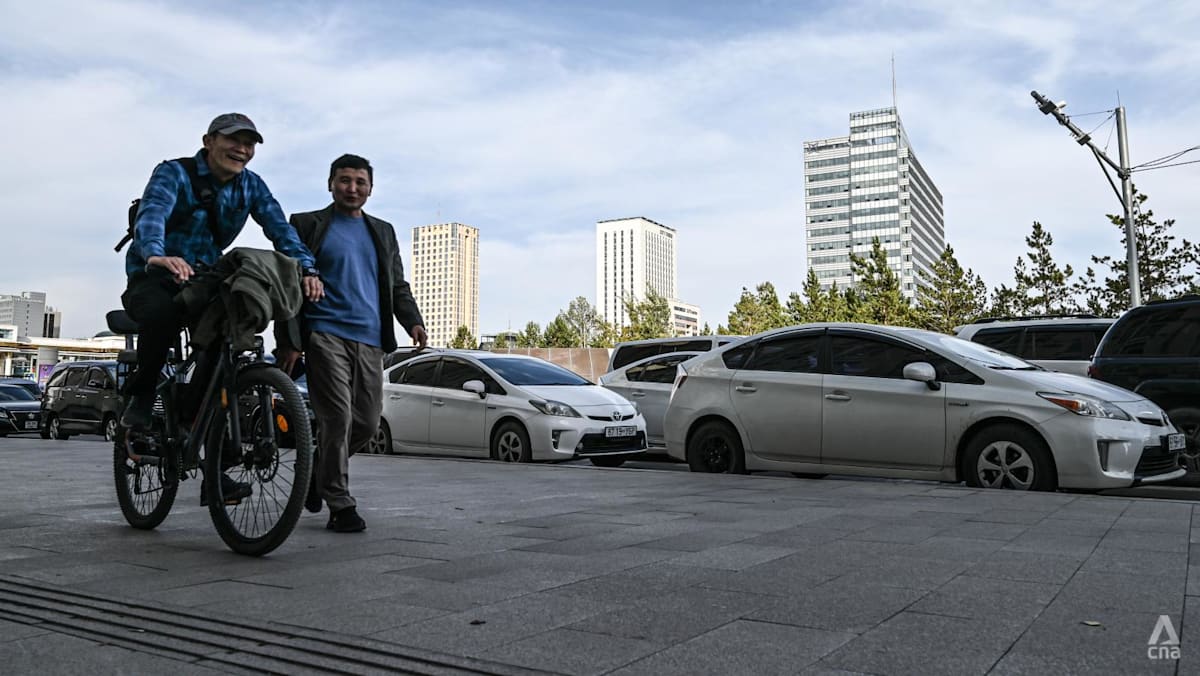
Mongolia is awash with cheap, end-of-life hybrids imported from Japan once they have served their purposes on tamer urban streets.
They can be found in every corner: from the jammed avenues of Ulaanbaatar to the depths of the Gobi Desert.
Read the other articles in this series here:
Ulaanbaatar has one of the coldest winters of any capital in the world and some of its dirtiest air. The Prius functions reliably even in such extremes, and its cleaner, battery-assisted motor helps cut the vehicle emissions driving the city’s air crisis.
Yet behind the affection for the Prius lies a more difficult reality - and a deep irony: in trying to reduce air pollution by promoting cleaner vehicles, Mongolia has inadvertently imported a new form of waste.
In a country with such brutal conditions and the roughest roads imaginable, those batteries, already expiring after years of use overseas, fail fast and need to be replaced.
With no permitted way to recycle or safely dispose of the depleted and hazardous battery packs, and recent legislation putting those who try on the wrong side of the law, experts warn that Mongolia is becoming a green technology dumping ground.
And it is an emerging lesson for other countries bracing for a wave of electric vehicles without plans in place for when they are no longer roadworthy.
THE PRIUS REPUBLIC
Where pure electric vehicles have struggled to take off due to a lack of charging infrastructure, minimal tax incentives, vast travel distances outside of Ulaanbaatar and climatic conditions slashing their performance, HEVs have proliferated.
“For a country like Mongolia, with vast distances, hybrids are much more practical. You can drive 100 to 150 km on electricity and then 800 to 1000 km with the gasoline engine”, said Baasanbayar Sambuu-Yondon, the executive director of the Mongolian Automobile Distributors Association (MADA).
Where many countries throughout Asia prohibit or severely restrict the importation of used vehicles, Mongolia’s policies have facilitated the deluge of second-hand hybrids from Japan.
For more than a decade, the country’s regulatory environment actively enabled the surge of used hybrid imports through a combination of low import taxes and duty exemptions on such vehicles, which were marketed as “clean” cars.
Approximately 80 per cent of vehicle imports to the country come from Japan, with 95 per cent of those used.
Priuses are purchased at auction typically once their Toyota battery service period and warranty have expired - after that the batteries become expensive to maintain and replace.
The vehicles are then brought into Mongolia by various industry players, Sambuu-Yondon explained.
“In other words, cars with expired or heavily deteriorated batteries are coming into Mongolia,” he said.
Only at the start of 2025 did the government start to enforce a rule that vehicles older than 10 years would no longer be eligible for registration in the capital.
It is still a flexible rule, far more lenient than countries in Southeast Asia, for example.
Countries such as Indonesia prohibit used car imports entirely, while Vietnam and Singapore impose much stricter age and registration limits.
Over the past decade, Mongolia has typically imported between 50,000 and 70,000 cars annually, both old and new, according to figures from MADA.
But in recent years, that number roughly doubled - to around 120,000 cars in 2023 and 130,000 cars in 2024.
“Mongolia’s vehicle fleet has reached a point where its age and need for renewal have become significantly pressing,” said Munkhnasan Enkhtaivan from Mongolia’s Ministry of Road and Transport Development.
The vast majority of imports are right-hand drive vehicles - opposite to what they are meant to be based on driving lanes in Mongolia - due to being from Japan, where right hand drive vehicles and driving on the left side of the road are the norm.
One major driver for the huge increase in imports was public fear that the government and city administration might ban right-hand-drive vehicles, prompting grey-market dealers to rush large numbers of cars into the country before any po